
Bald Eagle
American eagle · Haliaeetus leucocephalus
By the Birdfact teamChecked by Nathan Cope
See it in 3D
2 plumages
An adult Bald Eagle is 27.5–40 in (70–102 cm) long, bill to tail.
Adult
© 2026 NC Digital Limited (Birdfact). All rights reserved. This 3D model may be viewed on this page and shared by link only. Downloading, extracting, copying or reusing it, or using it to train machine-learning models, is not permitted without our written permission. Using our models
On this page16 sections
How to recognise it
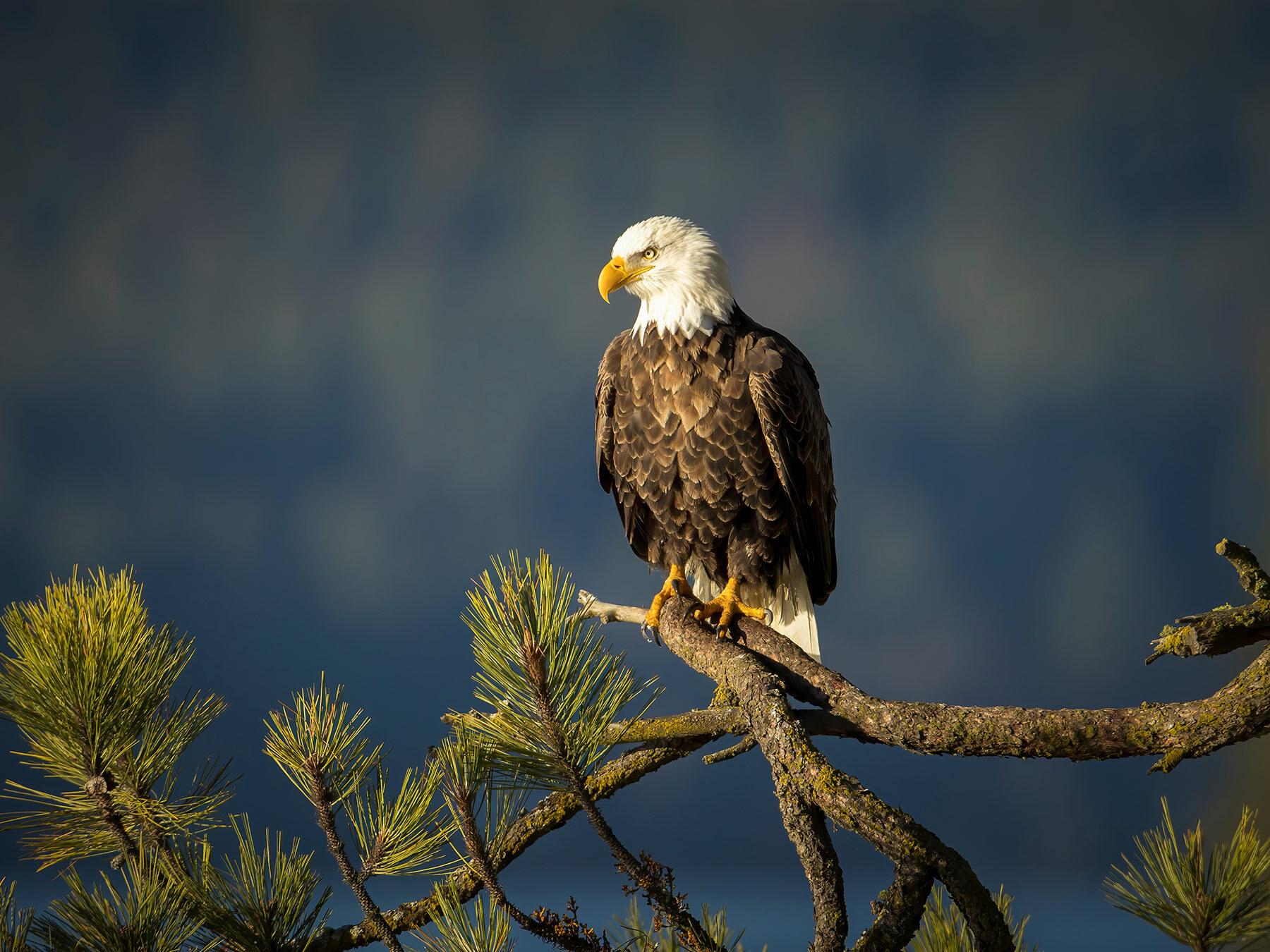
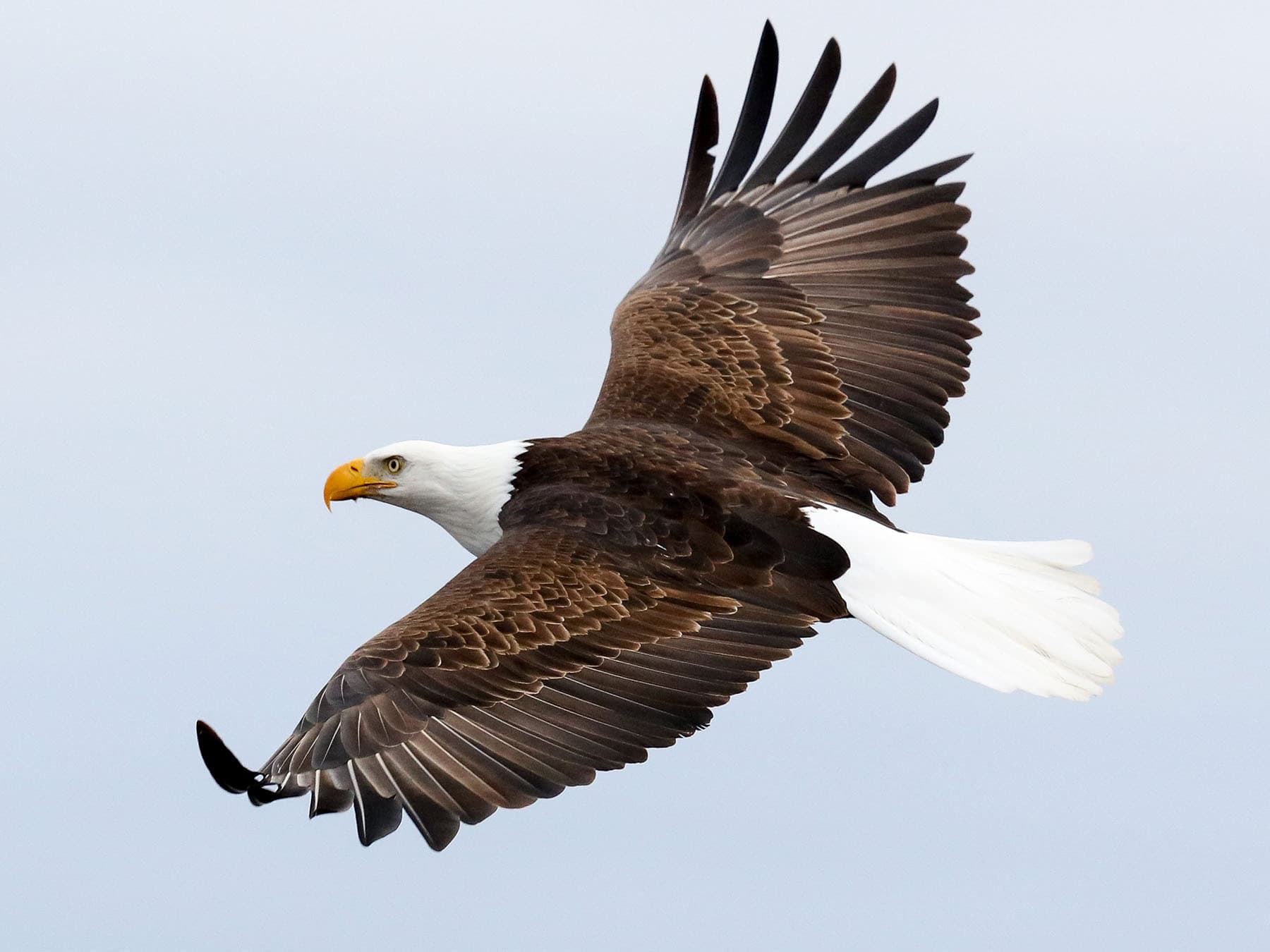
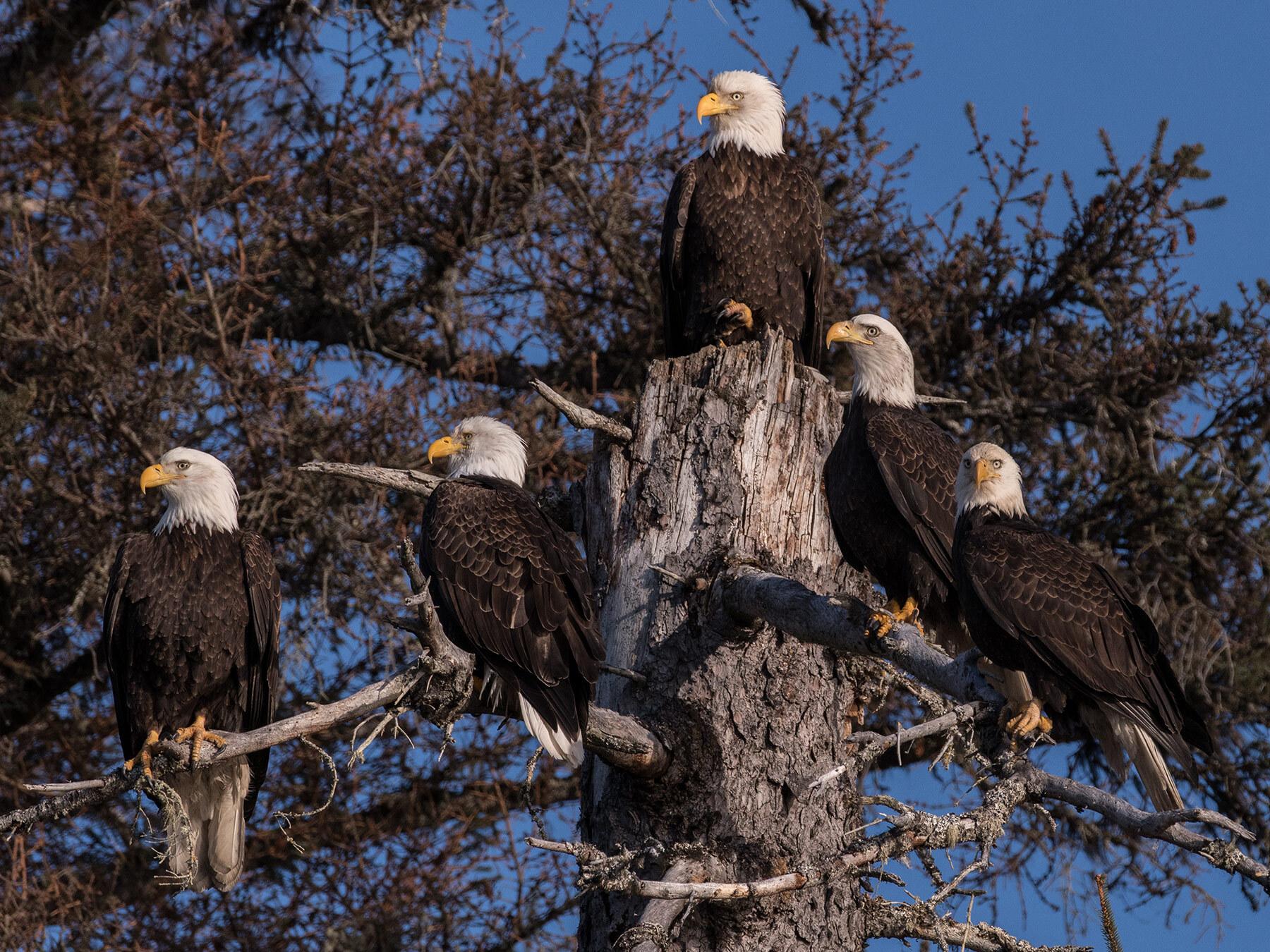
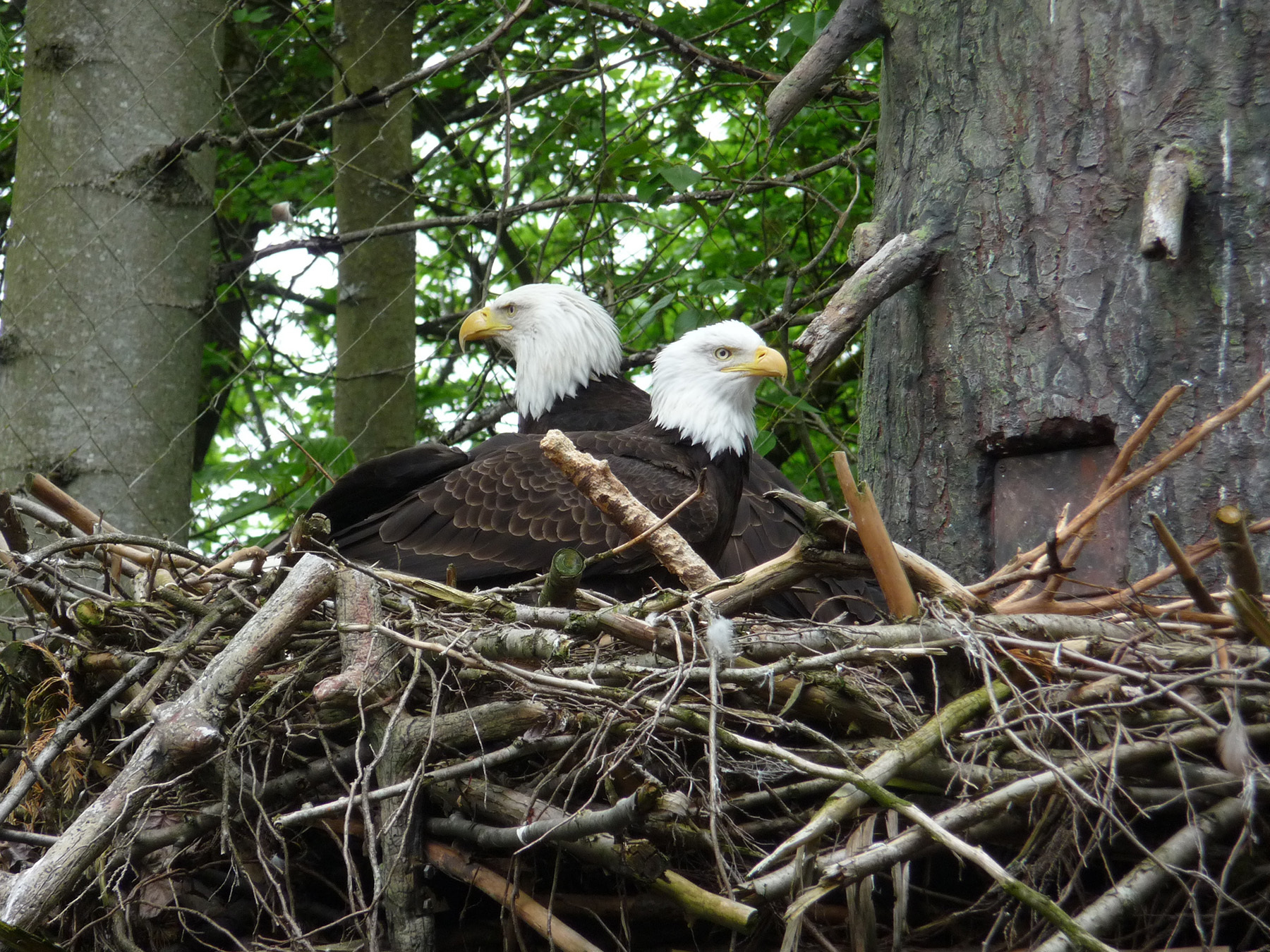
An adult Bald Eagle is hard to mistake: a huge, dark brown bird with a white head and neck, a white tail and a heavy yellow bill. The eyes and feet are yellow too. It is not bald at all; the name comes from the white feathers on its head. It is the only bird of prey in North America with an all-white head and tail.
Look for one perched in a tall tree by a river, lake or coast, or soaring on long, broad wings held flat like a plank. In flight its big head and bill stick out in front about half as far as the tail does behind, and its wingbeats are slow and powerful.
Size
A Bald Eagle is 28-38 in (71-96 cm) long, with a wingspan of 66-96 in (168-244 cm), or roughly 5.5 to 8 feet, and a weight of 6.6-13.9 lb (3.0-6.3 kg). Next to a Red-tailed Hawk it looks enormous. Birds get bigger from south to north, so the largest are in Alaska and Canada and the smallest in the southeastern and southwestern US. In Alaska, adult females averaged 11.8 lb (5.35 kg) and males 9.3 lb (4.23 kg).1
Male and female
Males and females look alike in every plumage. The female is about a quarter larger than her mate, which shows when a pair sit together, but size overlaps between big northern males and small southern females, so a lone bird can't safely be sexed by size.

Juveniles and the white head
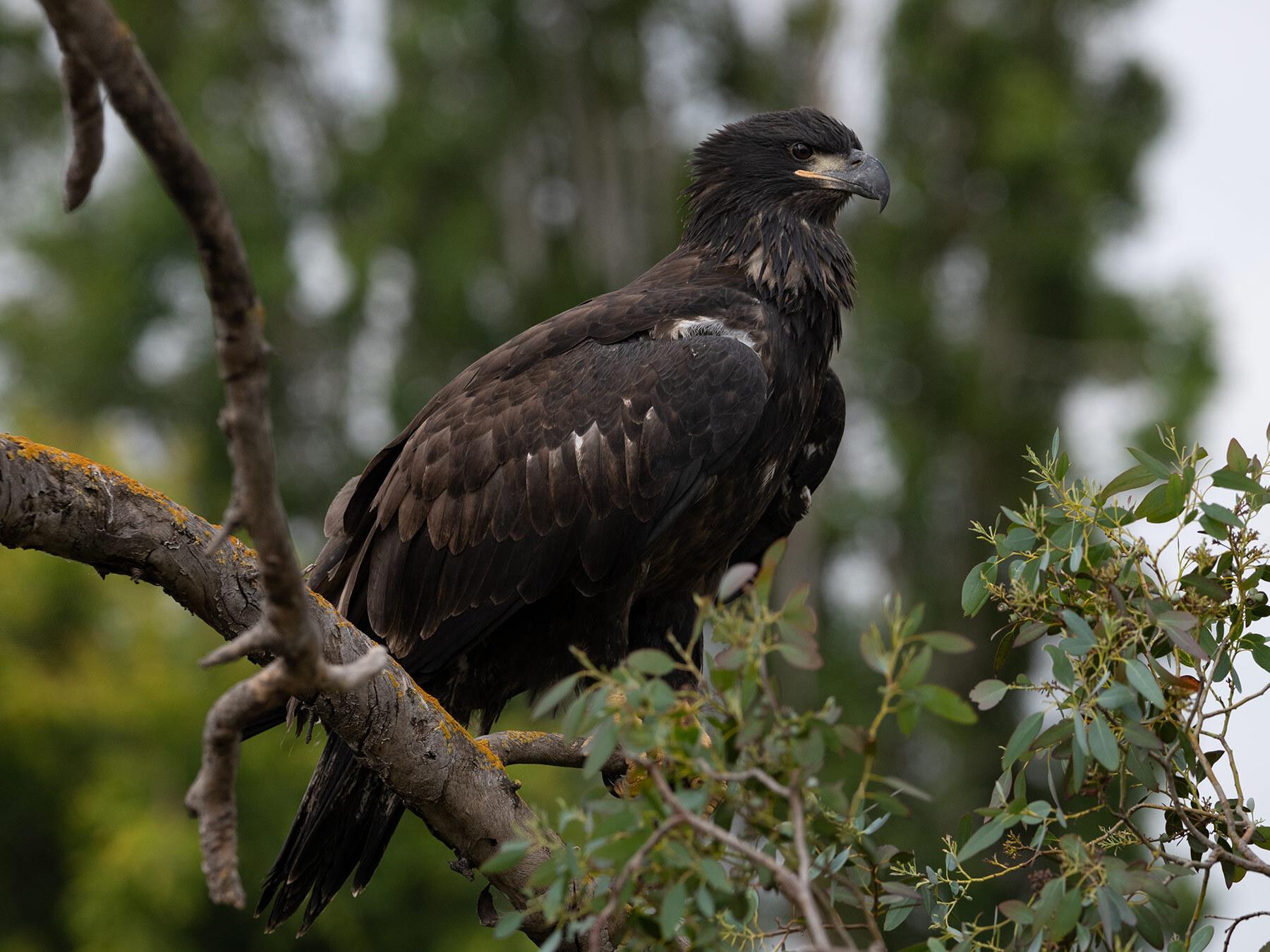
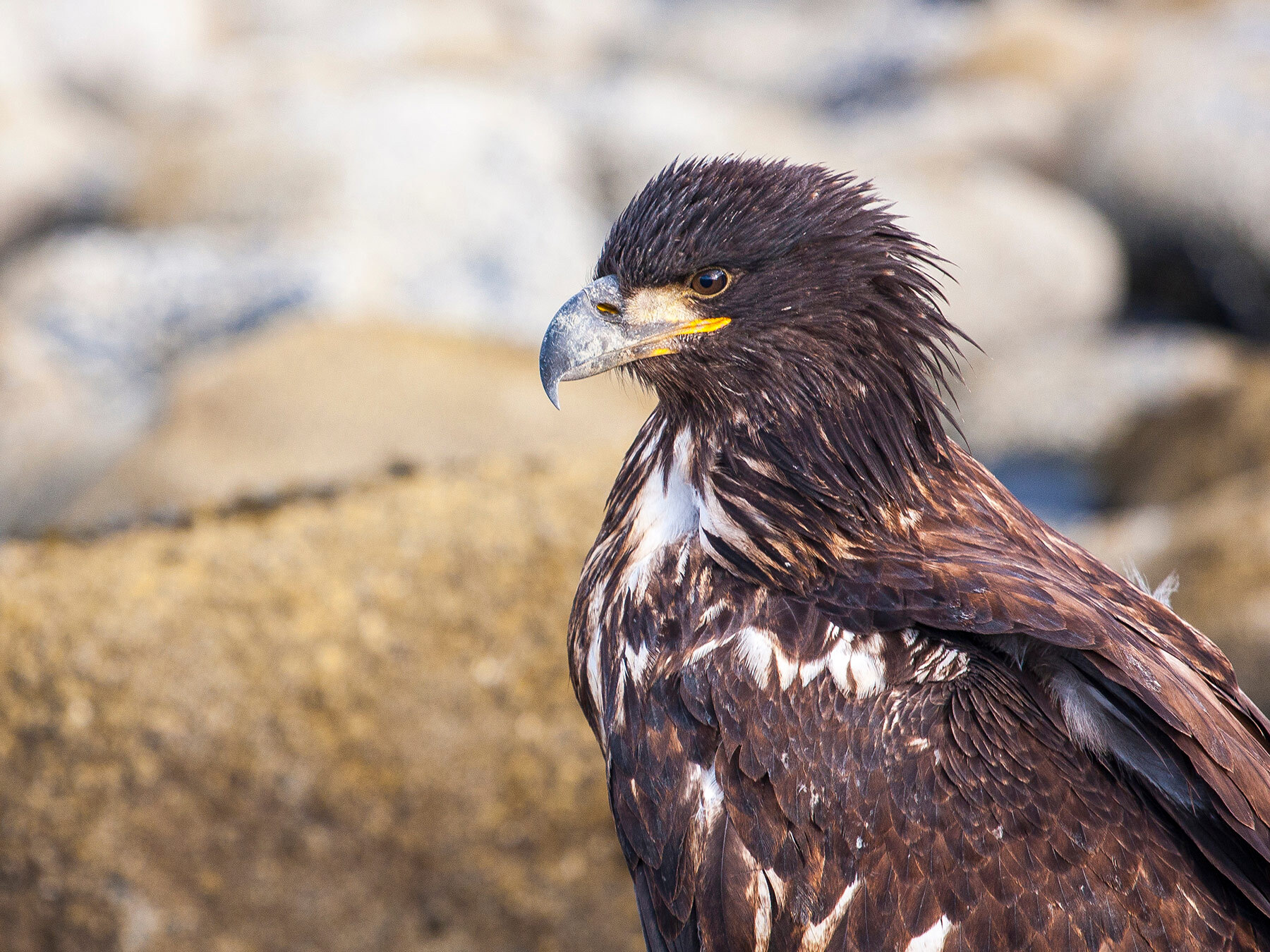
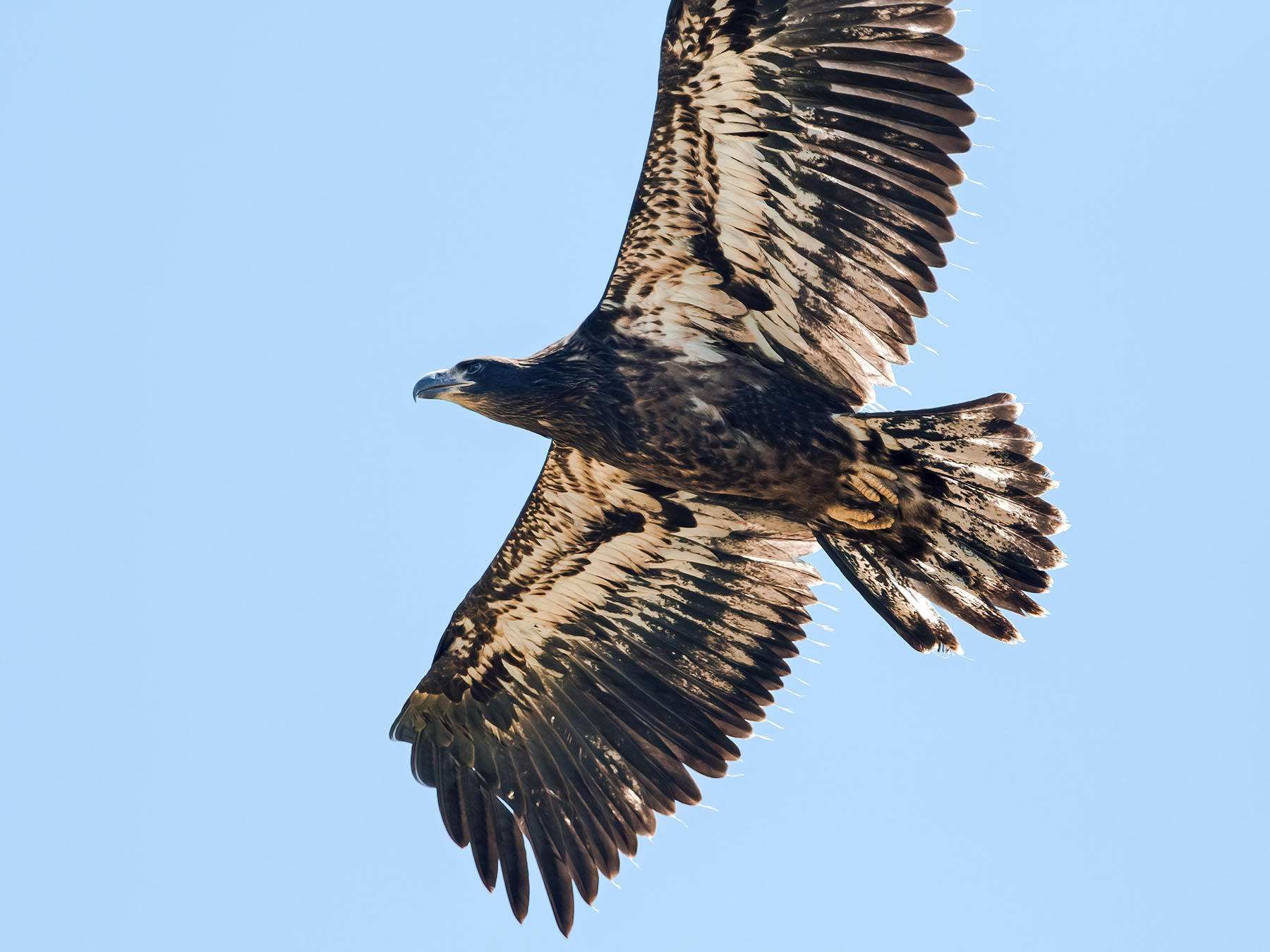
A young Bald Eagle has no white head or tail. In its first year it is dark brown all over, with white mottling under the wings and on the belly, a dark bill and a dark brown eye. Over the next few years it becomes blotchier: many second-year birds have a whitish belly below a dark breast and a whitish triangle on the back, and older immatures often have a mostly white head with a dark stripe through the eye. The bill and eye slowly turn yellow.
The white head and tail come at about 4 to 5 years old. In a study that followed 135 wild birds of known age, about a quarter had full adult plumage at 4.5 years and most or all had it by 5.5.1 See Juvenile Bald Eagles.

Identifying young eagles from Golden Eagles
Young Bald Eagles are most often confused with Golden Eagles. Look at the bill and legs: a Bald Eagle has a more massive bill and bare yellow lower legs, and it never has the Golden Eagle's golden nape, though that is hard to see on young Goldens. Overhead, a young Bald shows messy white mottling on the wing linings and often the body; a young Golden has solid dark wing linings, white to gray patches at the base of the flight feathers and a white base to the tail, and never any white on the head or body. See Bald Eagle or Golden Eagle?
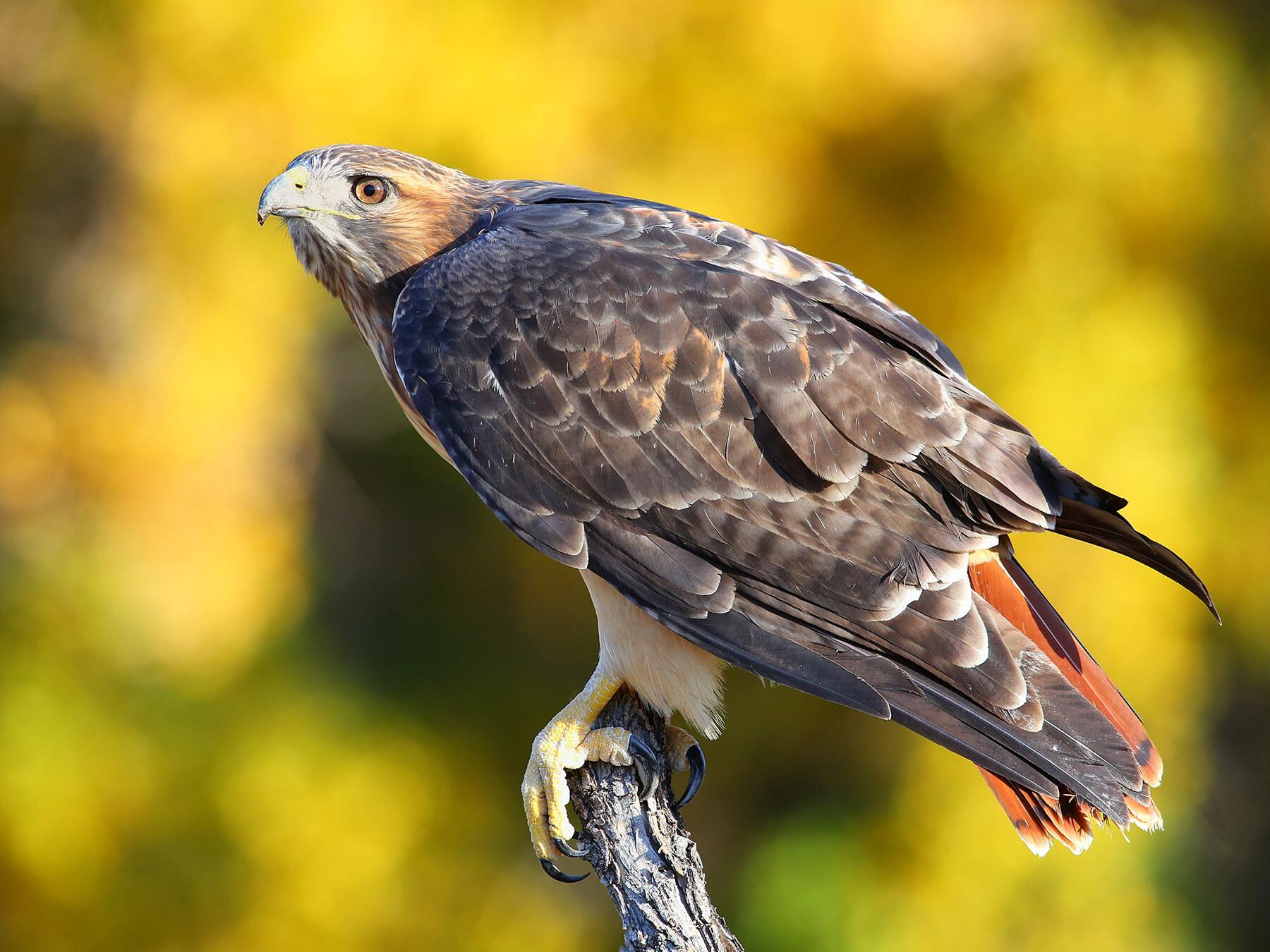
At a distance a young Bald Eagle can also pass for a Turkey Vulture or a big hawk such as a Red-tailed Hawk, but its size and huge bill usually show. A Turkey Vulture has a small head and holds its wings in a shallow V. In Alaska, look out for two rare visitors from Asia: the White-tailed Eagle, whose adults have a dingy, tan-streaked head and a short tail, and Steller's Sea-Eagle, with a bigger bill, a long wedge-shaped tail and, as an adult, white shoulders.
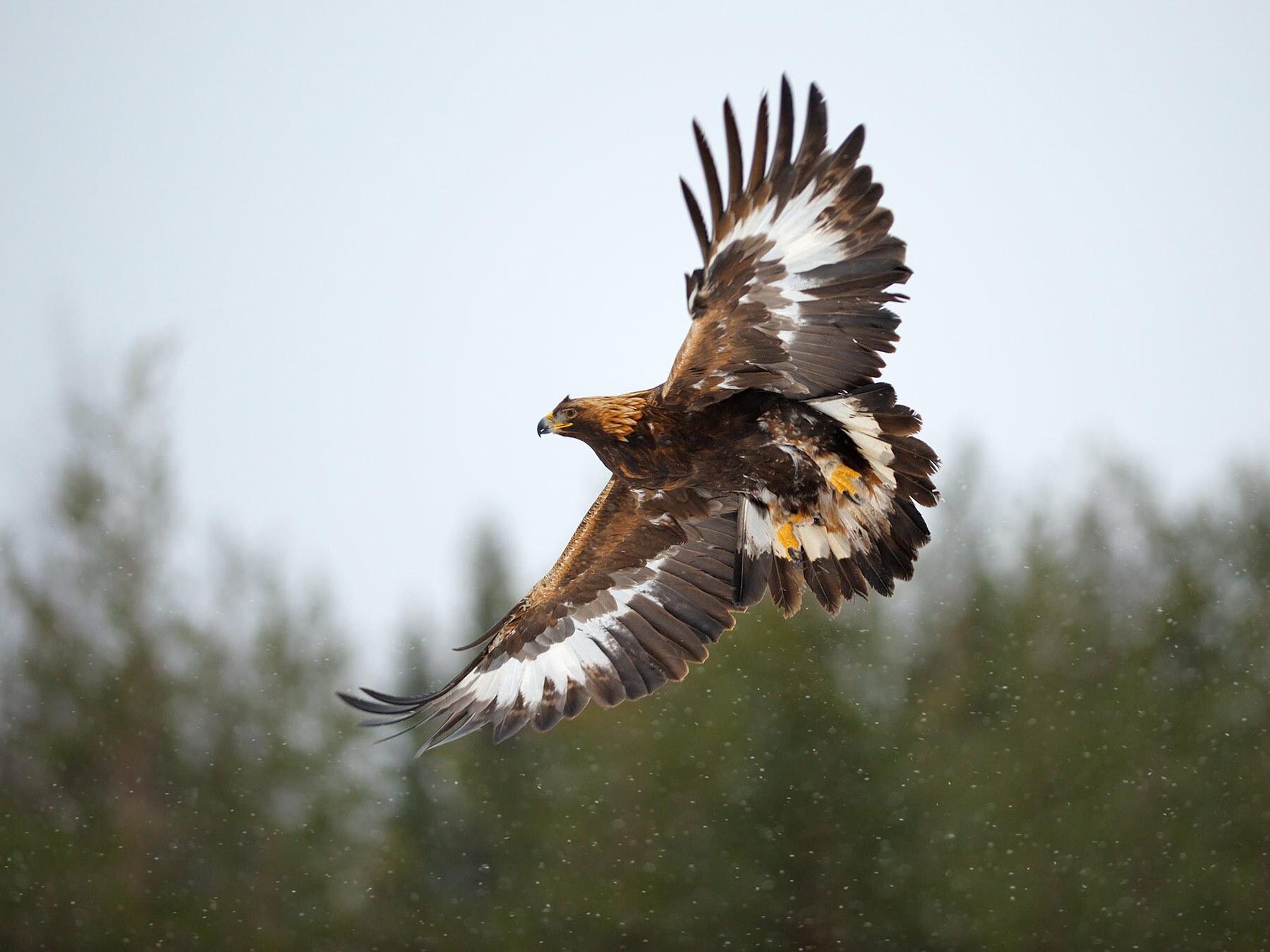
Not sure it’s a Bald Eagle? Check your photo: Birdfact names the bird and shows the look-alike side by side.
Its size
Adults- Length
- 71–96 cm
- Wingspan
- 168–244 cm
- Weight
- 3000–6300 g
Its song and calls
For such a big bird the Bald Eagle has a surprisingly weak, high voice, more like a gull than a hawk. The commonest call is a chatter: a few spaced notes and then a quick run of descending, piping notes, "kwit kwit kwit kee-kee-kee-ker". The other common call, the peal, is a long, slightly rising gull-like cry, often repeated three to five times. Near the nest birds also give a low, nasal bark that may be an alarm.
Bald Eagles call most near the nest, at communal roosts and at feeding sites; at feeding sites most calls are part of squabbles over food. A pair call back and forth when they swap places on the eggs. Young in the nest peep, and fledglings beg with a persistent cheeping.1
The fierce scream you hear when a Bald Eagle appears in a movie is usually dubbed in from a Red-tailed Hawk.1
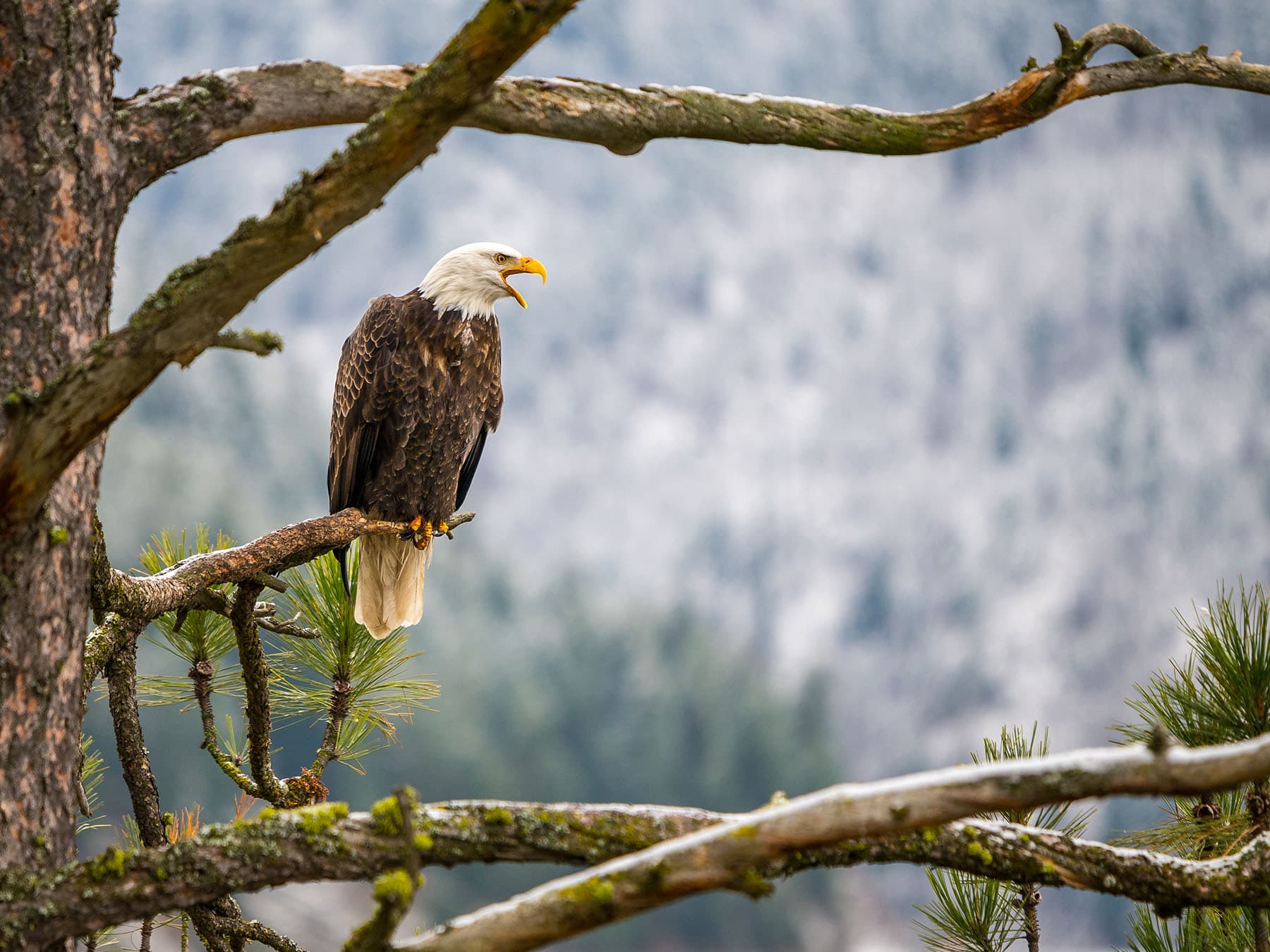
- Chatter call0:00 / 0:10
Recorded in Alaska, United States · October 2026
- Peal call0:00 / 0:07
Recorded in Alaska, United States · September 2026
Heard one and not sure? Let the bird song identifier listen.
When and where to see it
NovemberArriving
Most recorded in November
- 1. Alaska4.7%
- 2. Manitoba3.6%
- 3. Northwest Territories3.1%
- 4. Minnesota3.0%
- 5. Yukon Territory2.9%
Each dot is a county, state or province: the bigger and darker, the larger the bird’s share of that place’s bird records that month. Grey dots: no regular records. The ringed point is the centre of the bird’s records this month; the arrow shows how it moved since last month, and the dashed loop its path through the year. “Arrivals” colours places where it becomes regular this month (orange) or is in its last regular month (grey). GBIF eBird Observation Dataset, 2019–2024. Map data: Natural Earth, US Census Bureau; place centres © OpenStreetMap contributors.
In your area
See when the Bald Eagle is recorded in your county, state or province.
How often the Bald Eagle turns up in the United States and Canada through the year, from birdwatchers' records.
United States
Resident · all year · most records in January
Canada
Resident · all year · most records in January
Show as a table
| Month | United States | Canada |
|---|---|---|
| January | 0.96% (regular) | 1.7% (regular) |
| February | 0.90% (regular) | 1.6% (regular) |
| March | 0.80% (regular) | 1.4% (regular) |
| April | 0.55% (regular) | 0.89% (regular) |
| May | 0.42% (regular) | 0.54% (regular) |
| June | 0.35% (regular) | 0.55% (regular) |
| July | 0.39% (regular) | 0.71% (regular) |
| August | 0.46% (regular) | 0.81% (regular) |
| September | 0.52% (regular) | 0.78% (regular) |
| October | 0.64% (regular) | 0.97% (regular) |
| November | 0.79% (regular) | 1.4% (regular) |
| December | 0.86% (regular) | 1.6% (regular) |
Worldwide: recorded regularly in 4 countries
Countries where it was recorded in at least 3 of the 6 years 2019–2024. Linked countries have their own bird list.
North America (4)
Data: EOD – eBird Observation Dataset (Cornell Lab of Ornithology), accessed via GBIF.org, CC BY 4.0. Records from 2019–2024, aggregated and filtered by Birdfact. How these lists are made
Bald Eagles live near water across North America, from Alaska and Canada south through every state of the contiguous US to a few pairs in northwestern Mexico. They nest in big trees near rivers, lakes, reservoirs and coastal bays, with large populations along the whole Atlantic Coast, around the western Great Lakes and in the Pacific Northwest and coastal British Columbia.
Winter is the best time to see them in most of the lower 48 states. Eagles gather wherever there is open water and food: big midwestern rivers below dams, Chesapeake Bay, the southeastern coast and Florida, river valleys of the Pacific Northwest, the Klamath Basin and western reservoirs. In winter they also turn up in dry, open country and high western valleys, as long as there is open water nearby.
Do they migrate?
Some do and some don't. Adults that breed south of about 40°N, roughly the latitude of Philadelphia and Denver, usually stay near the nest all year. Northern birds move south from August into January, wherever lakes and rivers freeze, and return from January to March as weather and food allow; young birds leave first and go farther. In the Pacific Northwest and Alaska, eagles follow the salmon runs, some heading north to the Chilkat River in Alaska for the earliest fish.
Young eagles from the south do the opposite: many from Florida and Texas head north in spring and summer, some as far as the Great Lakes, and come back south in late summer and fall. Bald Eagles usually migrate alone, by day, riding thermals and the updrafts along ridges, and do not form flocks or kettles like hawks. Two radio-tagged adults flew 1,240 miles (2,000 km) from Colorado to Saskatchewan in 15 days.1
Tips for seeing it
What it eats
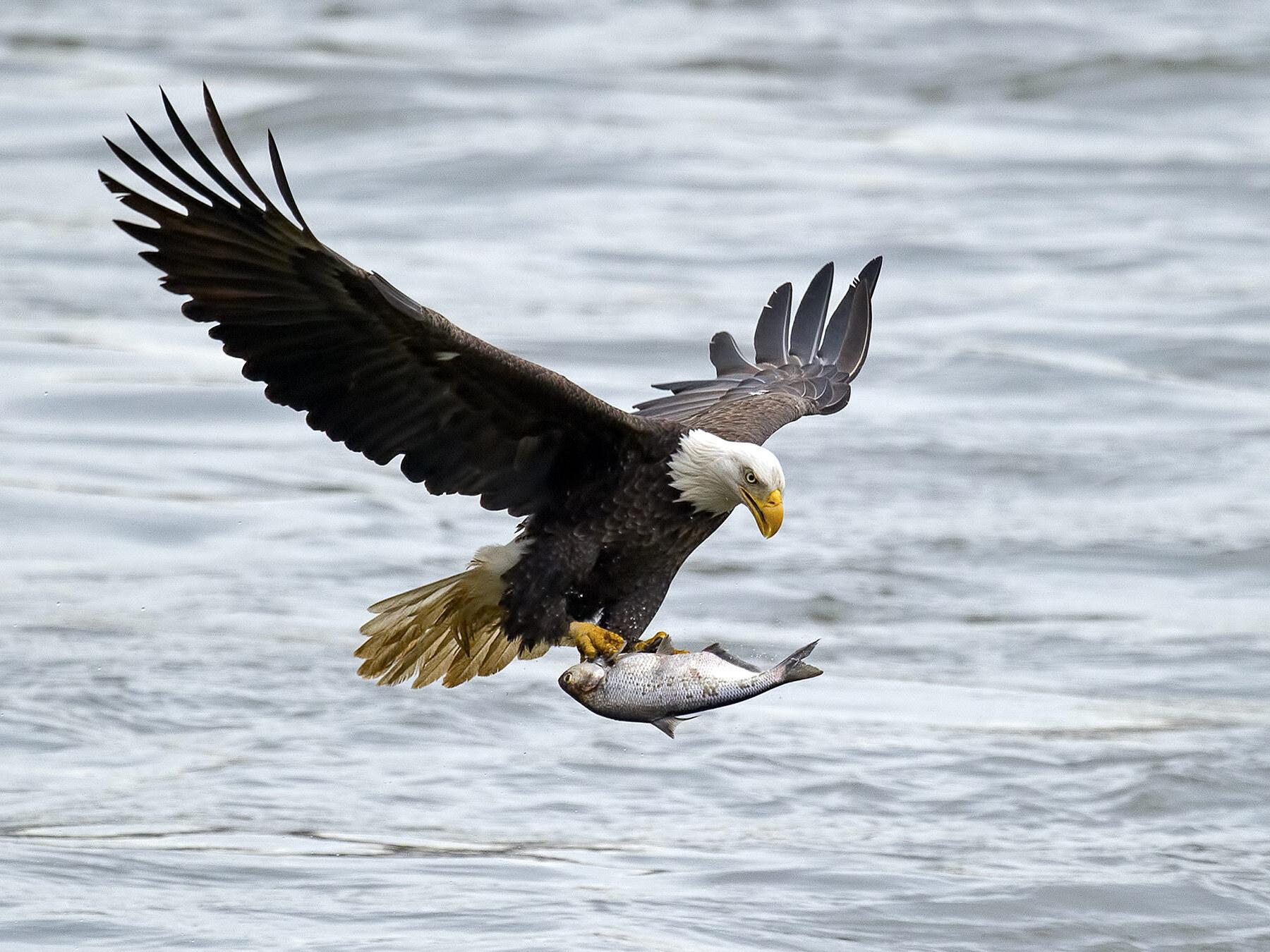
Fish come first. Bald Eagles eat many kinds, including salmon, herring, shad and catfish, but they are opportunists that take whatever is easiest: ducks, coots, gulls and other waterbirds, mammals from muskrats to rabbits, and carrion, from dead salmon and roadkill to deer carcasses in winter; in Alaska and British Columbia they also visit garbage dumps. Combining 20 diet studies at nests across the range, food was 56% fish, 28% birds, 14% mammals and 2% other.1
There are very few documented cases of Bald Eagles killing live livestock; most cases blamed on them turned out to be Golden Eagles.1 See What do Bald Eagles eat?
How they find food
A Bald Eagle hunts from a perch or while soaring, then swoops down and snatches prey near the surface with its feet. Hunting is hard work: in a Nebraska winter study only 24% of fishing searches ended in a catch, though 73% of strikes succeeded.1 Pairs sometimes hunt together, one flushing prey toward the other.
Stealing is the other way. Bald Eagles harass Ospreys until they drop their fish, rob other eagles and herons, and occasionally take food from otters, mostly outside the breeding season. They also scavenge dead fish below dams and salmon carcasses after spawning. Benjamin Franklin held the habit against the bird: in a 1784 letter he criticized the choice, calling it a bird of "bad moral Character" that "does not get his Living honestly".2 A big meal can be stored in the crop and digested over several days, and eagles can go days or even weeks without food.

Nesting and breeding
Nesting starts in late fall in Florida and along the Gulf Coast; in Florida most pairs begin incubating in December and January, and in early spring farther north; in Alaska eggs are laid between late April and late May. The nest is usually in one of the largest trees near water, high up against the trunk, a little under the crown. Where there are no trees, eagles nest on cliffs or the ground. See Bald Eagle nesting.
The nest
Both birds build the nest from sticks, filling the gaps with grass, moss or even corn stalks and lining it with fine material and down. A new nest can take up to three months, and pairs add to it every year, so old nests become enormous. A typical nest is about 4-6 ft (1.2-1.8 m) across and 2-4 ft (0.6-1.2 m) deep.
The records are far bigger. A nest at Vermilion, Ohio, which eagles used for 34 years before its tree came down, was 9 ft (2.7 m) across and 12 ft (3.6 m) tall, with an estimated weight of almost 2 metric tons (about 4,400 lb).1 The largest on record, at St. Petersburg, Florida, was 9.5 ft (2.9 m) across and 20 ft (6.1 m) deep and weighed almost 6,000 pounds.3 Pairs often have a second nest in the territory and may switch between them, especially after a failure.

Eggs and young
The female lays 2 eggs, sometimes 1 or 3, dull white and unmarked. Both parents incubate, the female more, for about 35 days, starting with the first egg, so the chicks hatch a day or more apart and the first is bigger. When food is short a third chick usually starves, and siblings sometimes kill each other.
For the first two weeks the male brings most of the food while the female stays with the chicks; after 3-4 weeks she hunts as much as he does. The young leave the nest at 8-14 weeks old. Up to half of first flights end on the ground, where the parents usually keep feeding them, and fledglings may be fed for up to 6 weeks before they leave the area at 17-23 weeks old. Pairs raise one brood a year, and most eagles can breed at 4 or 5, around the time they get their white heads.

Behaviour
As far as anyone knows, Bald Eagles pair for life: a pair stays together until one bird dies, though few marked birds have been followed to prove it. A new partner can arrive within days: in Arizona a male that vanished during incubation was replaced the next day.1 In the best-known courtship display, the cartwheel, a pair fly high, lock talons and tumble toward the ground, letting go just before they hit. See Do Bald Eagles mate for life?

Social behavior in winter
Breeding pairs defend a territory around the nest, but outside the breeding season Bald Eagles gather in numbers, sometimes hundreds, at communal roosts and rich feeding places such as the Chilkat River in Alaska in fall or the Mississippi in winter. The roosts may help birds learn where the food is. Squabbles over food are common, though real fights are rare. In winter they spend most of the day perched, saving energy: four young eagles in Washington spent 98% of the day roosting or perched.1
On the ground a Bald Eagle walks with a rocking gait, and if it ends up in deep water it can float and "row" with its wings. Eagles also play, tossing plastic bottles around, and six eagles were once seen passing sticks to each other in the air.
Lifespan and predators
A Bald Eagle that survives its first year can live a long time. Banding data from the lower 48 states give about 69% survival in the first year and 91% a year after that.1 The oldest wild Bald Eagle on the US Bird Banding Laboratory's longevity list was at least 38 years old: banded as a young bird in New York in 1977, it was hit by a vehicle in New York in 2015; the next oldest, banded in Wisconsin in 1981, was found on a highway there in 2014 at 33 years 5 months.4 The record in captivity is 36 years.1 See How long do Bald Eagles live?
Predators and other dangers
Few animals can take a healthy adult. Raccoons, black bears, ravens, crows, magpies and gulls take eggs. Nestlings are reported taken by bears, raccoons, hawks and owls, but with little real documentation; starvation and attacks by siblings kill more, and fledglings that end up on the ground are at risk from mammals.1
Among eagles found dead and examined, most died of human causes. Of 2,980 eagles examined at the National Wildlife Health Center from 1982 to 2013, 25.6% had died of poisoning, 22.9% of trauma such as collisions, 12.5% of electrocution and 10.2% of gunshot wounds; shooting and trapping fell sharply from the levels of the 1960s to early 1980s; lead was the commonest poison, 63.5% of those poisoning cases; it comes mostly from shot and bullet fragments in waterfowl and big game killed by hunters.1 A 2022 study of 1,210 Bald and Golden Eagles from 38 states found long-term lead poisoning in 46-47% of the birds tested in bone, and suggests that lead slows Bald Eagle population growth by 3.8%.5 In the southeastern US, eagles that eat American Coots have died of a brain disease caused by a toxin from a cyanobacterium growing mainly on invasive hydrilla.1, 6 H5N1 bird flu killed Bald Eagles in 29 states in 2022;1 in four southeastern states it killed at least 22 breeding adults and nestlings, and nest success on the Georgia coast fell to 47%, about 30% below average.7
Conservation
Bald Eagles are common again and listed as Least Concern worldwide.8 The US Fish and Wildlife Service estimated 316,700 Bald Eagles, including 71,467 breeding pairs, in the lower 48 states from surveys in 2018 and 2019.3 The surveys left out the Southwest, where eagles are scarce; Alaska is estimated separately.9 Aerial surveys put about 58,000 adults on the Pacific coast between southern British Columbia and the Alaska Peninsula in 2010.1
The North American Breeding Bird Survey shows a steep, steady rise: roughly 4% a year across the survey from 1966 to 2025 (95% credible interval 2.76 to 4.97) and about 5% a year in the US, and the count is at its highest in 2024 and 2025. Survey routes record few eagles, so treat the rates as approximate, but the rise is clear.10
Population decline and recovery
Accounts from the 1700s and 1800s describe Bald Eagles as abundant, but by the middle and late 1900s they were rare in most of the lower 48 states and southern Canada. They were shot and trapped, often over fears for livestock, game and fish: in Alaska a bounty was paid on more than 128,000 eagles between 1917 and 1952. Shoreline habitat was built on, and after 1947 DDT entered the food chain. DDE, a breakdown product of DDT, was most likely behind the breeding failures, with thin eggshells as a symptom.1 By 1963 only 417 nesting pairs were known in the lower 48 states.3
Protection came in stages. The Bald Eagle Protection Act of 1940 prohibited killing, selling or possessing the species.3 In 1967 eagles south of the 40th parallel were listed as endangered,11, 12 and in 1978 the species was listed throughout the lower 48 states, as endangered in 43 states and threatened in five; Alaska was never listed.13 The EPA ordered DDT cancelled in June 1972, and its general use became illegal at the end of that year.14 In northwestern Ontario, young raised per breeding area fell from 1.26 in 1966 to 0.46 in 1974 and recovered to 1.12 by 1981, tracking DDE levels in failed eggs.15
Numbers grew dramatically from about 1980, helped by nest protection and the release of young eagles to restock eastern states.1 The eagle was moved from endangered to threatened in 199512 and removed from the endangered species list in August 2007, when there were an estimated 9,789 breeding pairs in the lower 48 states.16 The Fish and Wildlife Service has since put growth at around 10% a year.9
Legal status
In the US the Bald Eagle is still protected by the Bald and Golden Eagle Protection Act and the Migratory Bird Treaty Act.3 Without a permit it is illegal to take, possess, sell, purchase, transport, export or import a Bald Eagle, alive or dead, or any part, nest or egg, and under the eagle Act "take" includes molesting or disturbing one.17, 18, 19 Federal permits can allow limited, regulated take, such as disturbance by work near nests or incidental take by wind farms and power lines.20, 21 The National Eagle Repository receives eagles found dead and supplies their parts and feathers to enrolled members of federally recognized tribes for religious use.22 In Canada eagles are not covered by the federal Migratory Birds Convention Act but may be protected under provincial and territorial law.23
Similar birds
Often mistaken for



More photos
5 photos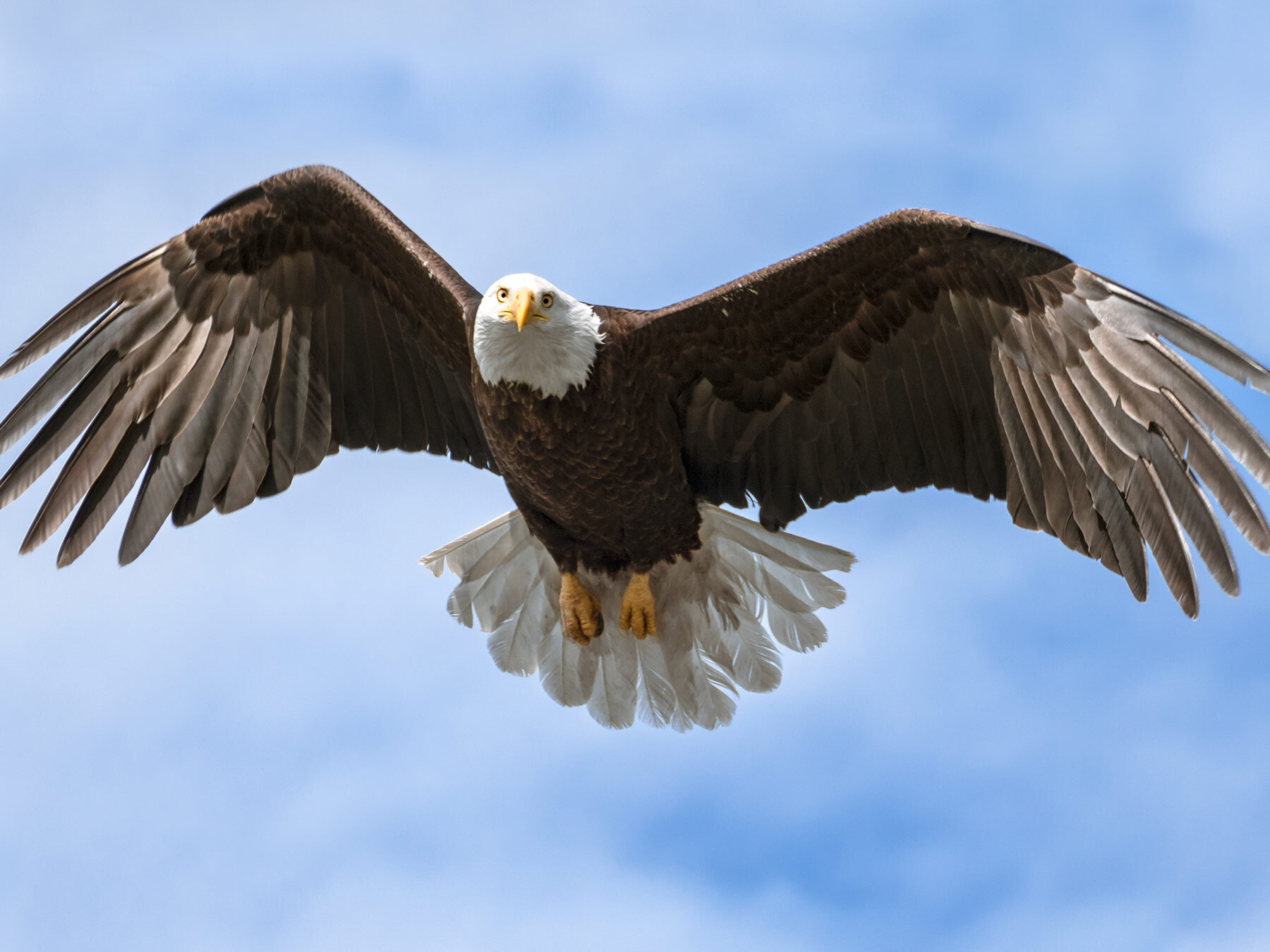

Bald Eagle guides
4 guidesQuick facts
- Length
- 71–96 cm
- Wingspan
- 168–244 cm
- Weight
- 3000–6300 g
- Lifespan
- oldest recorded 38 years
- Family
- Hawks & Eagles
- Migration
- Partial migrant
- Global status (IUCN)
- Least Concern
- World population
- 316,700 in the lower 48 states (USFWS, 2018-19 surveys)
- Population trend
- Increasing: about 4% a year since 1966 (North American Breeding Bird Survey)
- Also called
- American eagle
- Scientific name
- Haliaeetus leucocephalus
Questions
4Is the Bald Eagle the national bird of the United States?
Yes. It was adopted for the Great Seal on June 20, 1782, and a law approved on December 23, 2024, made it the national bird.24
Why is it called the Bald Eagle?
Not because it is bald: an adult's head is covered in white feathers, which stand out against its dark body. See how to recognize it.
Can you keep a Bald Eagle feather?
Not without a permit in the US. The Bald and Golden Eagle Protection Act makes it illegal to possess any part of a Bald Eagle, and a feather is part of the bird.17 See legal status.
Do Bald Eagles mate for life?
Usually, as far as anyone knows: pairs stay together until one dies, and a widowed bird can find a new mate within days. See pair behavior.
Sources
28- 1Buehler, D. A. (2022). Bald Eagle (Haliaeetus leucocephalus), version 2.0. Birds of the World (P. G. Rodewald and S. G. Mlodinow, editors). Cornell Lab of Ornithology. doi:10.2173/bow.baleag.02 (opens in a new tab)
- 2Cornell Lab of Ornithology. Bald Eagle: overview, identification and life history. All About Birds. Accessed 11 November 2026. Source (opens in a new tab)
- 3U.S. Fish and Wildlife Service. Bald eagle (Haliaeetus leucocephalus) species page. U.S. Fish and Wildlife Service. Accessed 11 November 2026. Source (opens in a new tab)
- 4USGS Bird Banding Laboratory. Longevity records of North American birds: Bald Eagle. USGS Patuxent Wildlife Research Center. Accessed 11 November 2026. Source (opens in a new tab)
- 5Slabe, V. A., Anderson, J. T., Millsap, B. A. et al. (2022). Demographic implications of lead poisoning for eagles across North America. Science 375: 779-782. doi:10.1126/science.abj3068 (opens in a new tab)
- 6Breinlinger, S., Phillips, T. J., Haram, B. N. et al. (2021). Hunting the eagle killer: A cyanobacterial neurotoxin causes vacuolar myelinopathy. Science 371: eaax9050. doi:10.1126/science.aax9050 (opens in a new tab)
- 7Nemeth, N. M., Ruder, M. G., Poulson, R. L. et al. (2023). Bald eagle mortality and nest failure due to clade 2.3.4.4 highly pathogenic H5N1 influenza a virus. Scientific Reports 13: 191. doi:10.1038/s41598-023-27446-1 (opens in a new tab)
- 8BirdLife International (2024). Haliaeetus leucocephalus. The IUCN Red List of Threatened Species 2024. doi:10.2305/IUCN.UK.2024-2.RLTS.T22695144A264598530.en (opens in a new tab)
- 9U.S. Fish and Wildlife Service (2022). Eagle Permits; Updated Bald Eagle Population Estimates and Take Limits (87 FR 5493). Federal Register. Accessed 11 November 2026. Source (opens in a new tab)
- 10Hostetler, J. A. et al. (2026). The North American Breeding Bird Survey, Analysis Results 1966 - 2025. U.S. Geological Survey. doi:10.5066/P1OSNSFC (opens in a new tab)
- 11U.S. Department of the Interior (1967). Native Fish and Wildlife: Endangered Species (32 FR 4001). Federal Register. Accessed 11 November 2026. Source (opens in a new tab)
- 12U.S. Fish and Wildlife Service (1995). Final Rule to Reclassify the Bald Eagle From Endangered to Threatened in All of the Lower 48 States (60 FR 36000). Federal Register. Accessed 11 November 2026. Source (opens in a new tab)
- 13U.S. Fish and Wildlife Service (1978). Determination of Certain Bald Eagle Populations as Endangered or Threatened (43 FR 6230). Federal Register. Accessed 11 November 2026. Source (opens in a new tab)
- 14U.S. Environmental Protection Agency (1972). DDT Ban Takes Effect (press release, December 31, 1972). EPA archive. Accessed 11 November 2026. Source (opens in a new tab)
- 15Grier, J. W. (1982). Ban of DDT and Subsequent Recovery of Reproduction in Bald Eagles. Science 218: 1232-1235. doi:10.1126/science.7146905 (opens in a new tab)
- 16U.S. Fish and Wildlife Service (2007). Removing the Bald Eagle in the Lower 48 States From the List of Endangered and Threatened Wildlife (72 FR 37346). Federal Register. Accessed 11 November 2026. Source (opens in a new tab)
- 17United States Congress (1940). Bald and Golden Eagle Protection Act, 16 U.S.C. 668-668d. United States Code (govinfo, 2023 edition). Accessed 11 November 2026. Source (opens in a new tab)
- 18United States Congress (1918). Migratory Bird Treaty Act, 16 U.S.C. 703. United States Code (govinfo, 2023 edition). Accessed 11 November 2026. Source (opens in a new tab)
- 19U.S. Fish and Wildlife Service (2023). 50 CFR 10.13, List of Birds Protected by the Migratory Bird Treaty Act. Electronic Code of Federal Regulations. Accessed 11 November 2026. Source (opens in a new tab)
- 20U.S. Fish and Wildlife Service (2024). 50 CFR part 22, Eagle permits. Electronic Code of Federal Regulations. Accessed 11 November 2026. Source (opens in a new tab)
- 21U.S. Fish and Wildlife Service (2024). Permits for Incidental Take of Eagles and Eagle Nests (89 FR 9920). Federal Register. Accessed 11 November 2026. Source (opens in a new tab)
- 22U.S. Fish and Wildlife Service. National Eagle Repository. U.S. Fish and Wildlife Service. Accessed 11 November 2026. Source (opens in a new tab)
- 23Environment and Climate Change Canada. Birds protected in Canada. Government of Canada. Accessed 11 November 2026. Source (opens in a new tab)
- 24United States Congress (2024). Public Law 118-206 (S. 4610): designating the bald eagle as the national bird. United States Statutes at Large, 138 Stat. 2699. Accessed 11 November 2026. Source (opens in a new tab)
- 25National Audubon Society. Bald Eagle (Haliaeetus leucocephalus). Guide to North American Birds. Accessed 11 November 2026. Source (opens in a new tab)
- 26National Audubon Society. Golden Eagle (Aquila chrysaetos). Guide to North American Birds. Accessed 11 November 2026. Source (opens in a new tab)
- 27National Audubon Society. Turkey Vulture (Cathartes aura). Guide to North American Birds. Accessed 11 November 2026. Source (opens in a new tab)
- 28National Audubon Society. Red-tailed Hawk (Buteo jamaicensis). Guide to North American Birds. Accessed 11 November 2026. Source (opens in a new tab)

Checked by
Nathan Cope, founder and editor
Nathan founded Birdfact and leads its writers and contributors in the UK, the US and Canada. He has watched and studied birds for more than ten years, and checks every article and species guide before it’s published.