From the Journal
What Birds Lay Blue Eggs? UK & North American Species Identified
Stumbling across a nest cradling a clutch of bright blue eggs is a memorable experience for any birdwatcher. While most bird eggs are camouflaged in dull browns and creams, several common species across the UK and North America produce eggs in striking shades of cyan, turquoise, and sky blue. Identifying birds with blue eggs requires looking closely at the specific shade of blue, the presence of speckles or scrawls, and the overall size of the egg. From the iconic unmarked clutch of the American Robin to the blue speckled eggs of the Eurasian Blackbird, egg morphology offers a revealing window into avian biology.
The Science Behind Blue Eggs: What is Biliverdin?
Every blue bird egg in the world owes its colour to a single pigment: biliverdin. Derived from the Latin words for 'green' and 'bile', biliverdin is a byproduct of the breakdown of red blood cells. During the final stages of egg development in the female's shell gland, this pigment is deposited directly into the calcium carbonate shell. Because the pigment permeates the entire shell structure, a blue egg remains blue on the inside even after it hatches.
The evolutionary purpose of blue eggs puzzled ornithologists for decades, but recent research points to a delicate balancing act. A blue shell acts as a natural sunblock, protecting the developing embryo from harmful ultraviolet radiation while absorbing just enough heat to maintain an optimal incubation temperature. Furthermore, the intensity of the blue colour serves as a biological signal. A 2012 study on Pied Flycatchers demonstrated that females in peak physical condition deposit more biliverdin into their eggs. In response, males actually increase their feeding efforts, investing more energy into chicks that hatch from vibrant, healthy eggs.
Did You Know?
UK Birds That Lay Blue Eggs
If you are wondering what bird lays blue eggs in the UK, several common garden and woodland species fit the description. While the European Robin is famous for its red breast, it actually lays pale buff eggs with brown freckles — a common point of confusion for those familiar with its North American namesake. If you find a blue egg in a British garden, it likely belongs to one of the following species.
Blackbird (Turdus merula)
Blackbird
Turdus merula
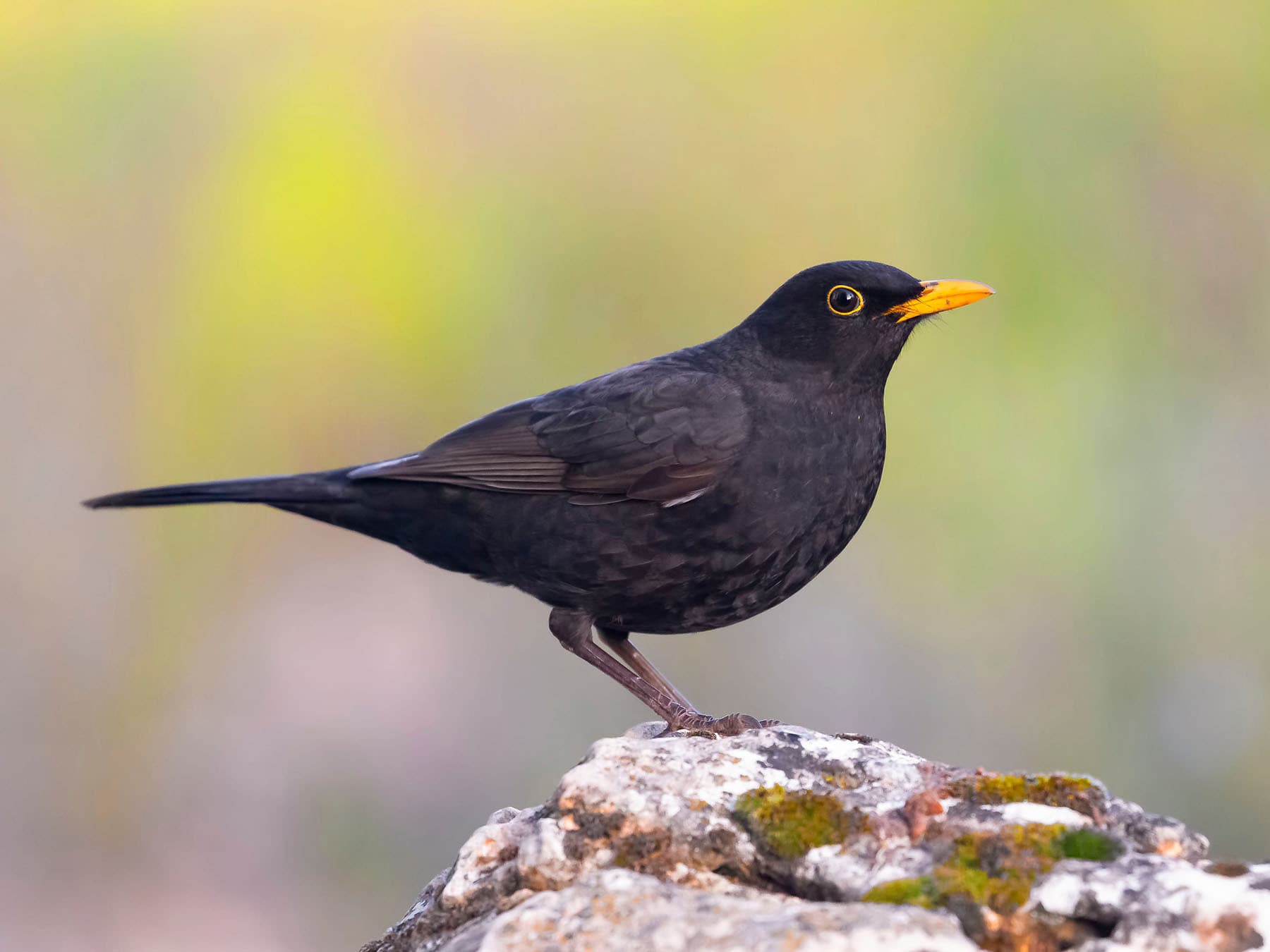
With its beautiful song and striking jet-black plumage, this garden favourite is a year-round staple of British backyards and parks.
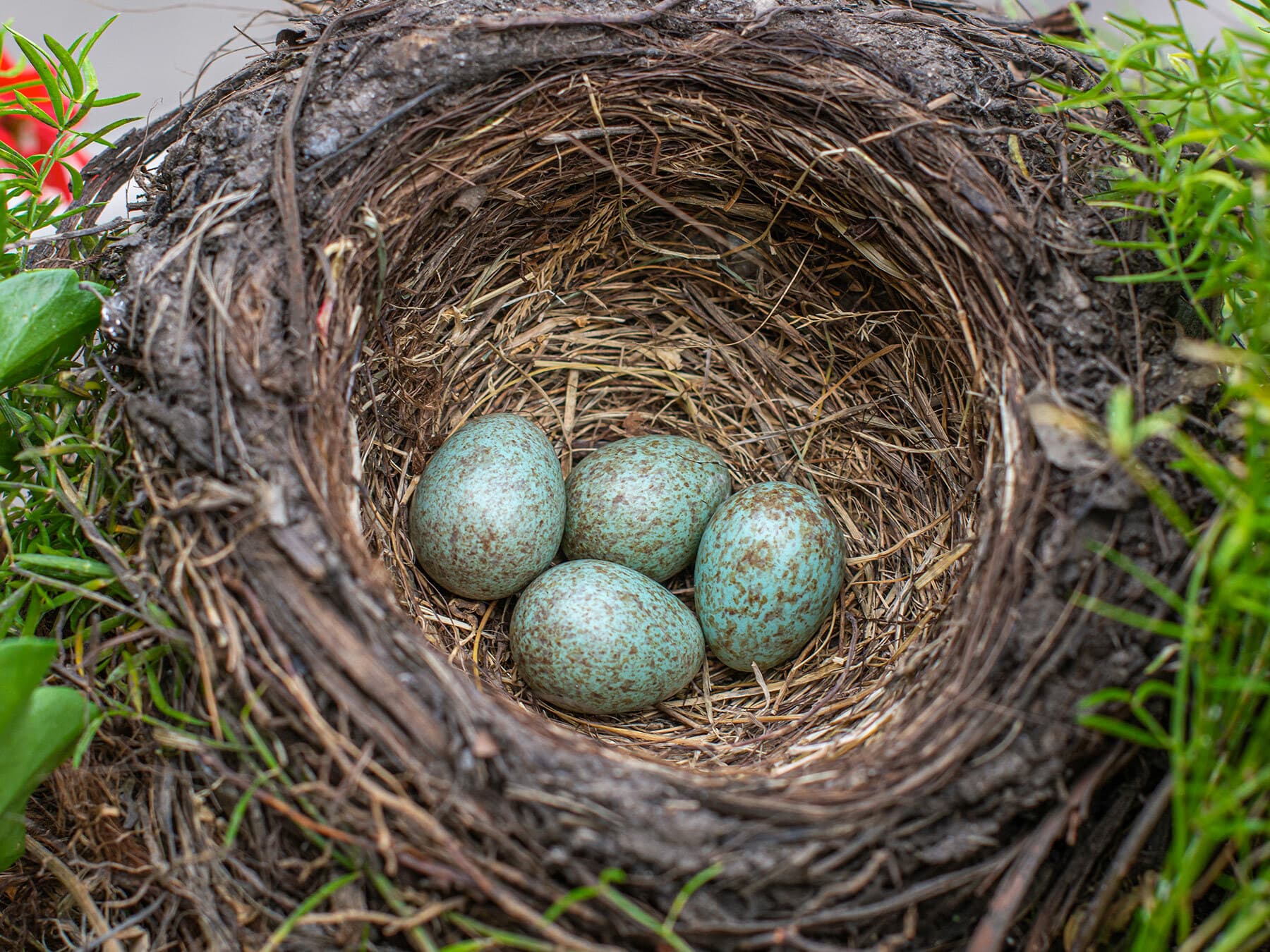
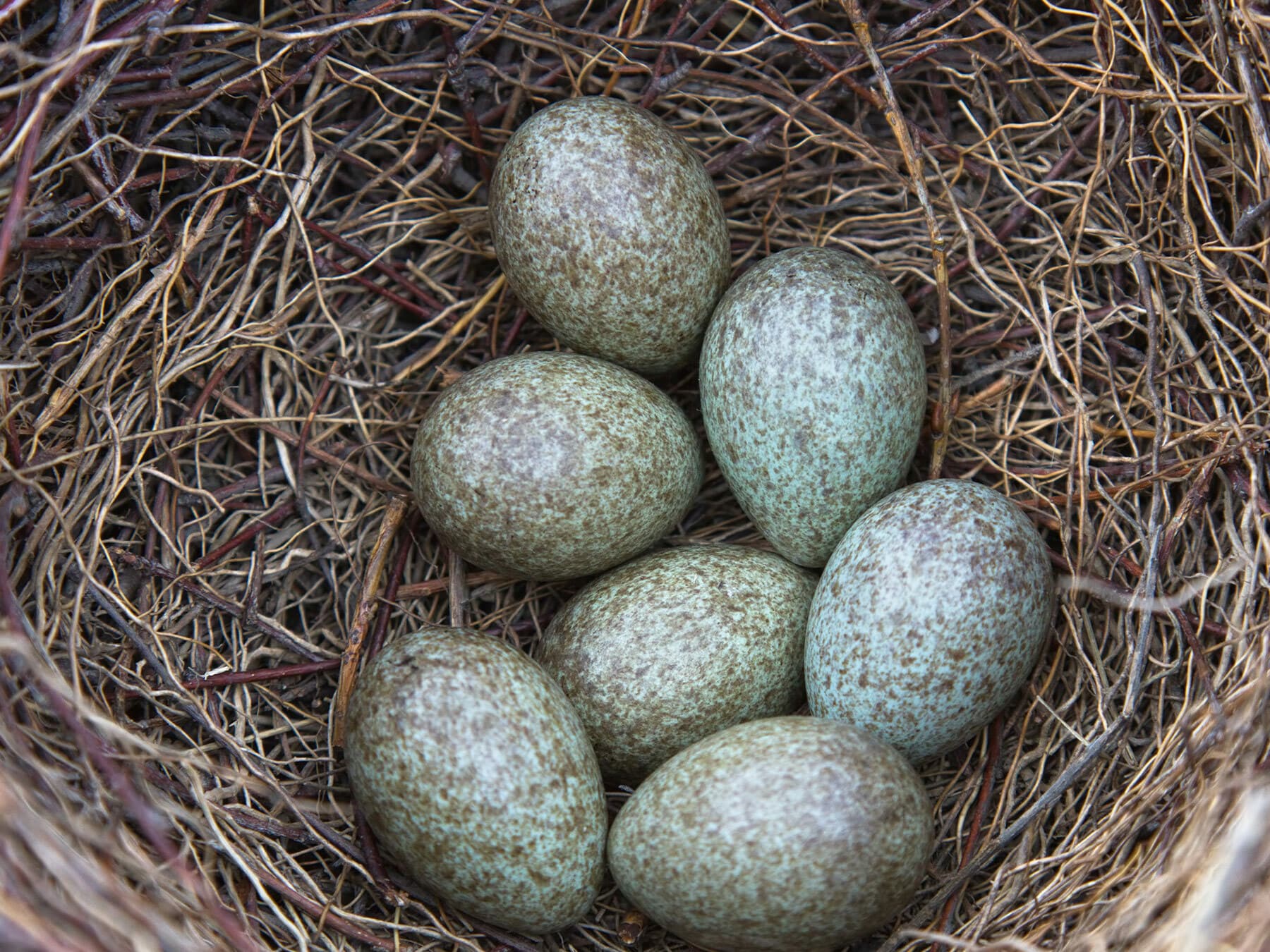
The Eurasian Blackbird is one of the most prolific breeders in UK gardens, often raising up to three broods between March and July. A typical clutch contains three to five eggs, measuring approximately 29mm long by 22mm wide. Blackbird eggs feature a distinct blue-green base colour, heavily overlaid with reddish-brown speckles. These markings are usually concentrated at the wider end of the egg. The female constructs a sturdy, cup-shaped nest from twigs and mud, typically hidden low in dense shrubs or hedges.
Song Thrush (Turdus philomelos)
Song Thrush
Turdus philomelos
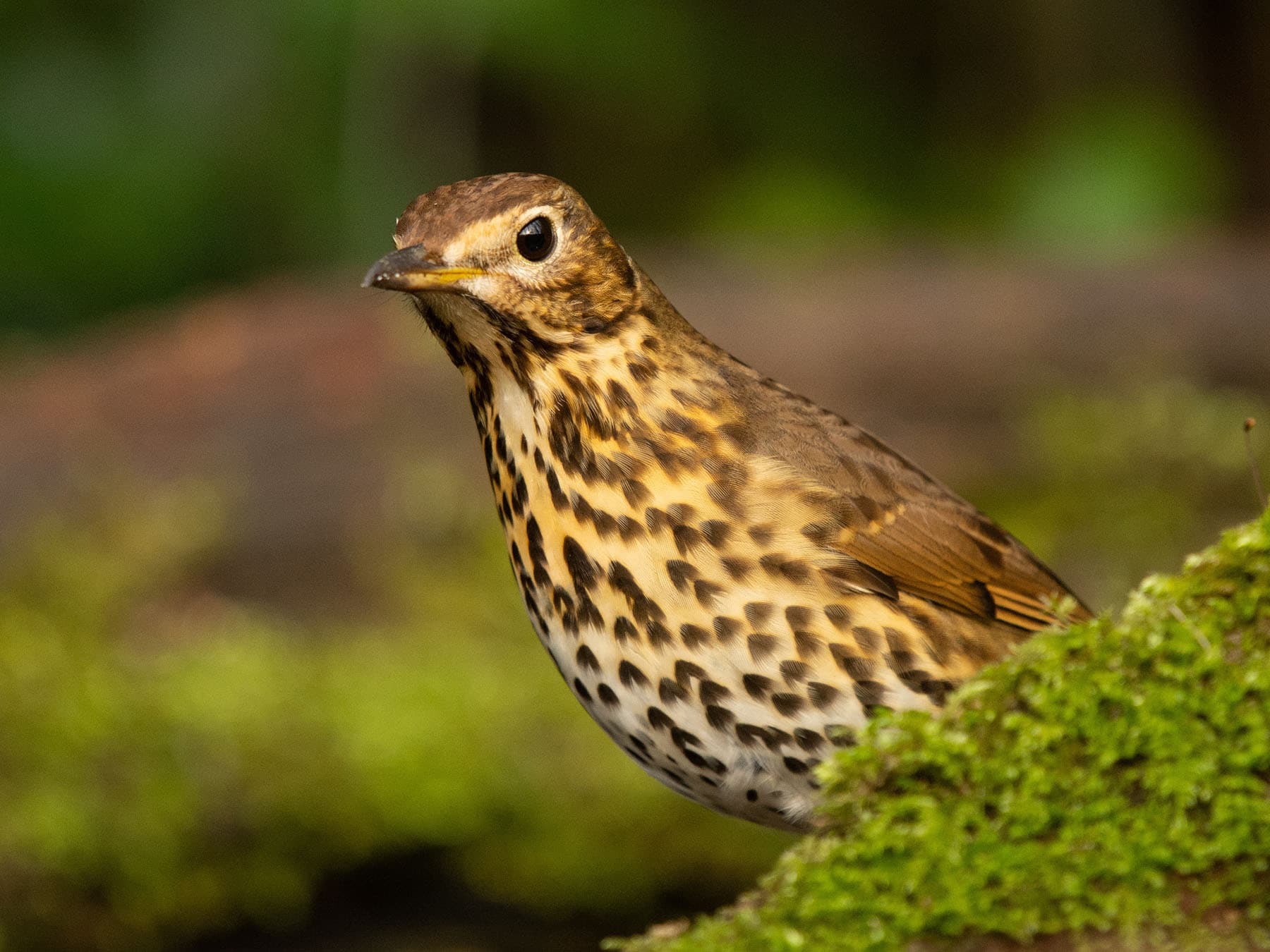
With its melodious repertoire of over 100 distinct phrases, this speckled snail-loving songster fills gardens and woodlands with enchanting tunes across its range.
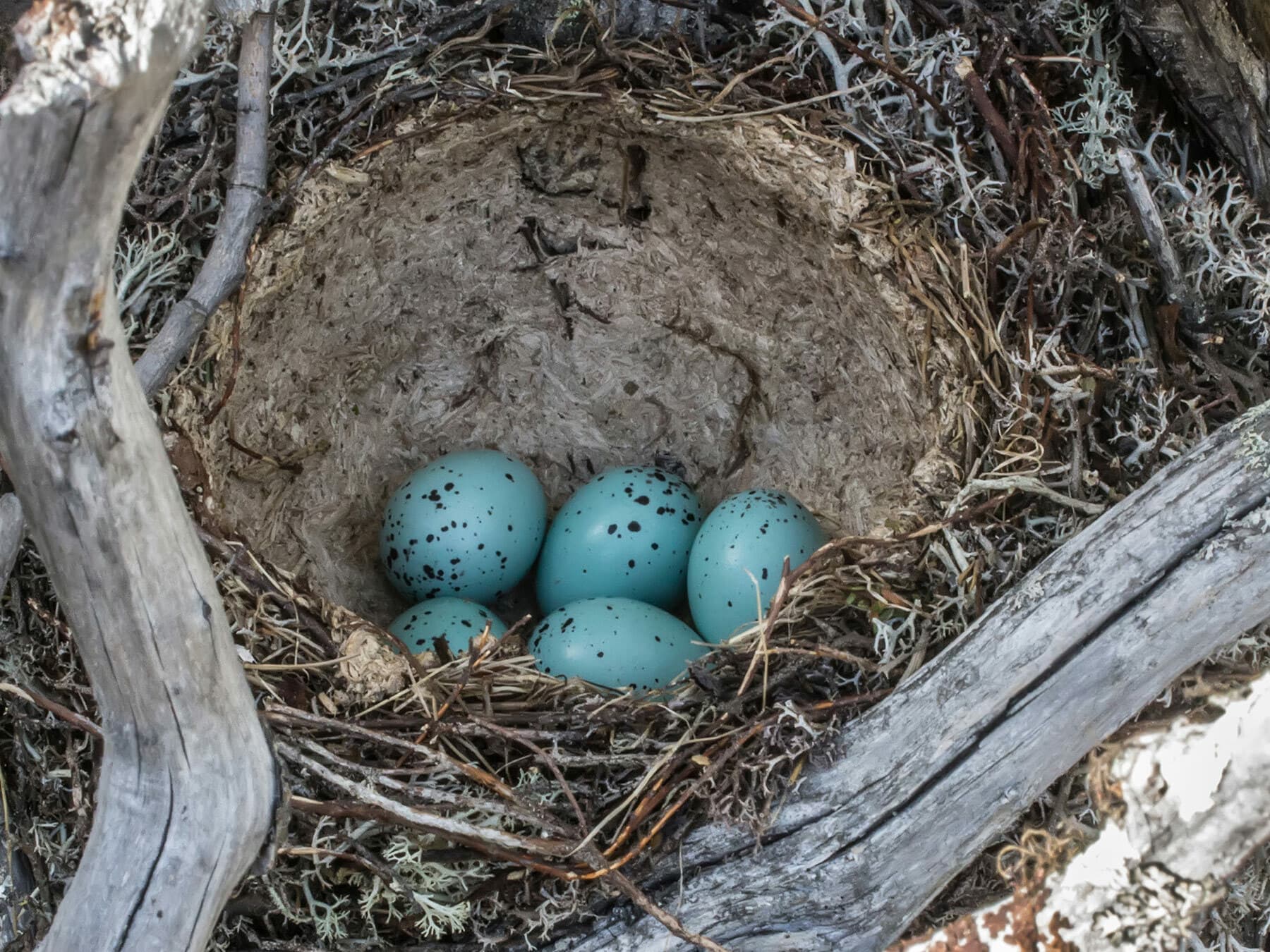
Song Thrush eggs are arguably the most striking of any British garden bird. Measuring around 27mm by 21mm, they boast a glossy, vibrant light-blue background punctuated by stark, ink-black or deep purple spots. Unlike the Blackbird's heavily freckled eggs, the spots on a Song Thrush egg are usually sparse and sharply defined. The nest itself is equally distinctive — the female lines the interior with a smooth, hard layer of mud and rotten wood, creating a perfect, unlined cup for her clutch of four to five eggs.
Dunnock (Prunella modularis)
Got a photo of a bird you can't identify?
Upload a photo and find out what it is in seconds — no account needed
Identify a BirdDunnock
Prunella modularis
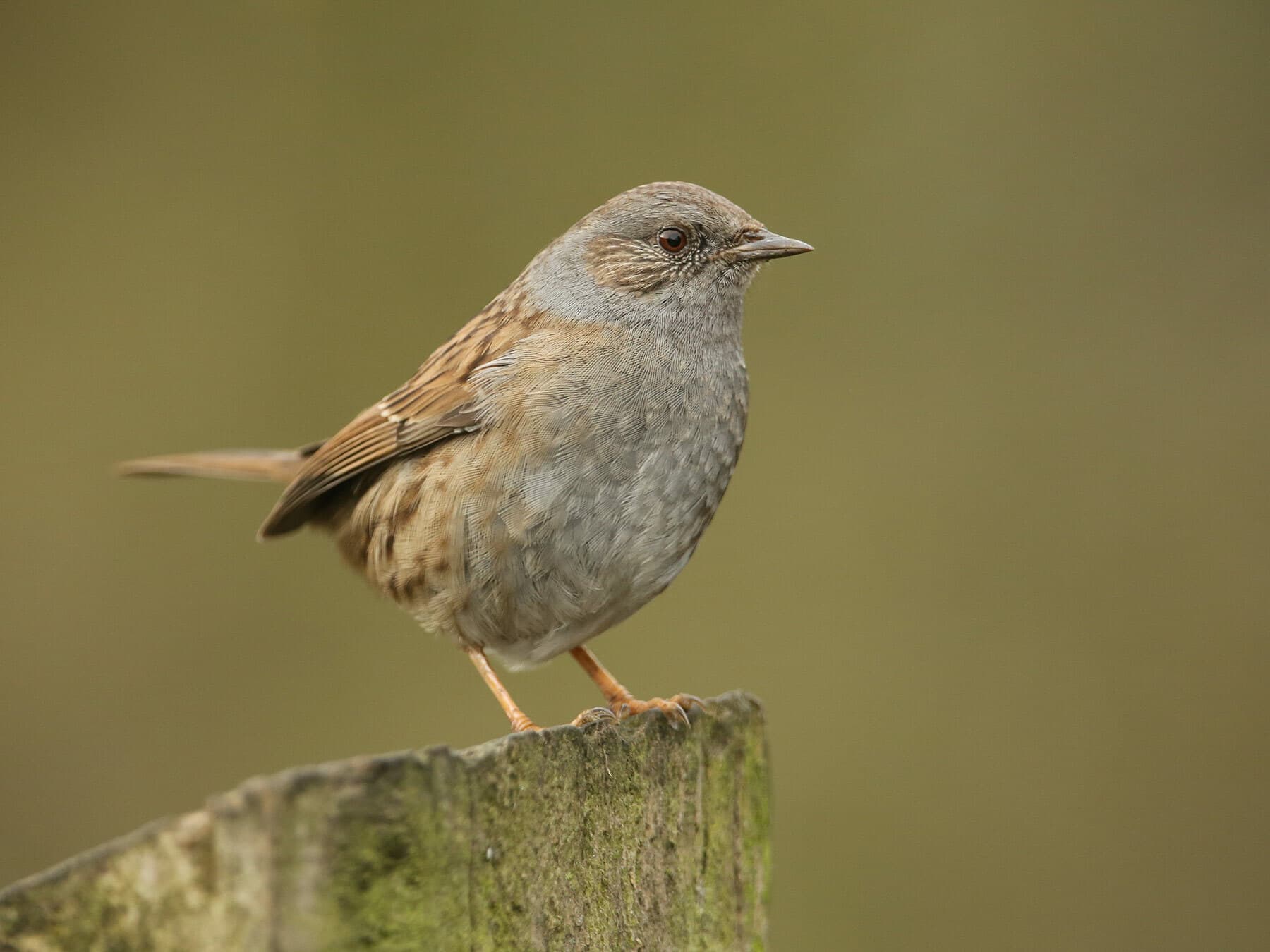
A relatively nondescript and unobtrusive species, the Dunnock is a common bird with a fascinating breeding strategy.
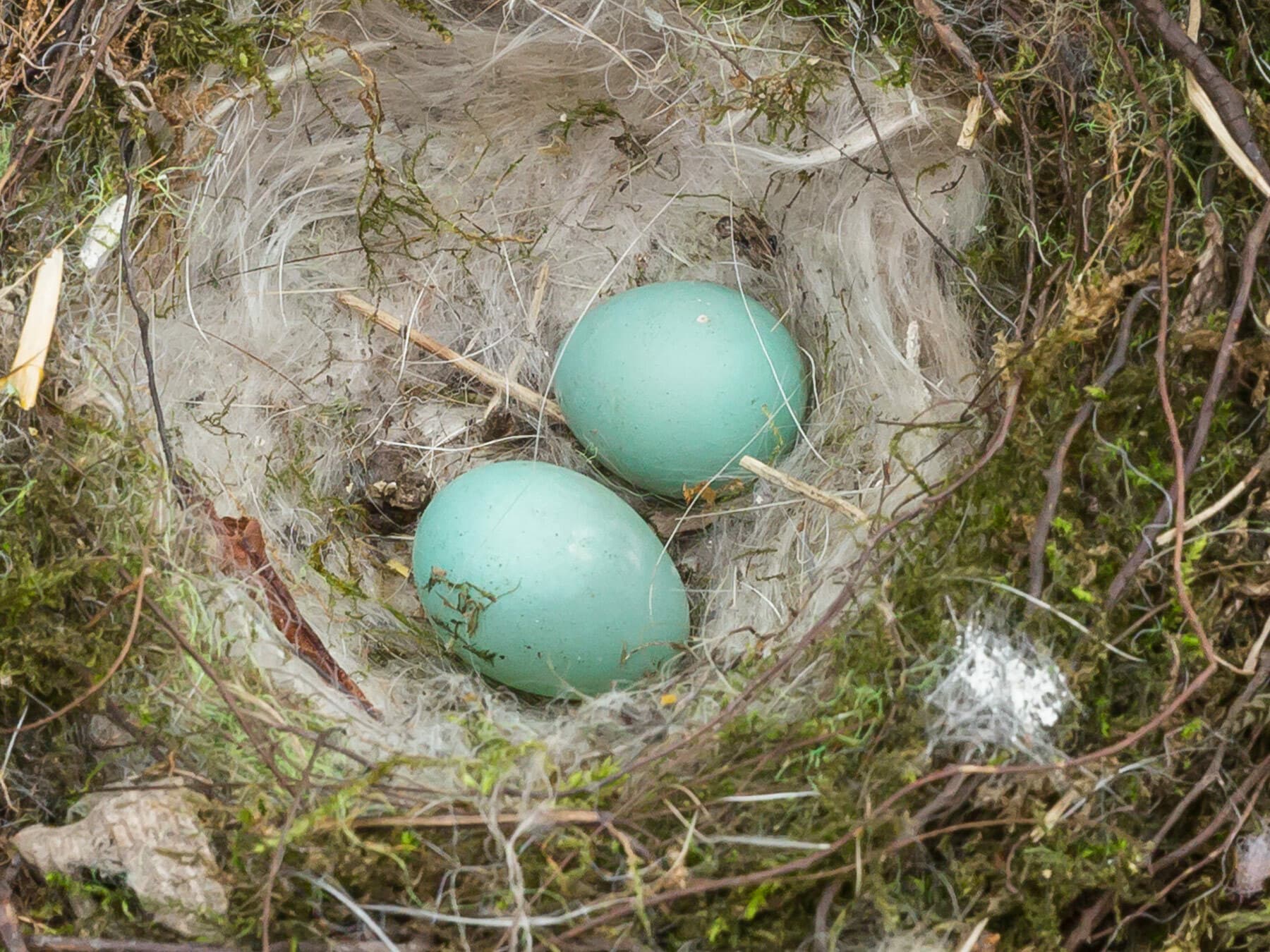
Often overlooked and mistakenly called a hedge sparrow, the Dunnock produces intensely coloured eggs. A Dunnock's egg is a smooth, glossy sky blue, typically completely unmarked, though very faint reddish spotting occurs on rare occasions. They are noticeably small, measuring just 19mm in length and 14mm in width. Females lay four to five eggs in a neat nest of twigs and moss, usually tucked deep within a thorny hedge or dense conifer.
Common Starling (Sturnus vulgaris)
Common Starling
Sturnus vulgaris
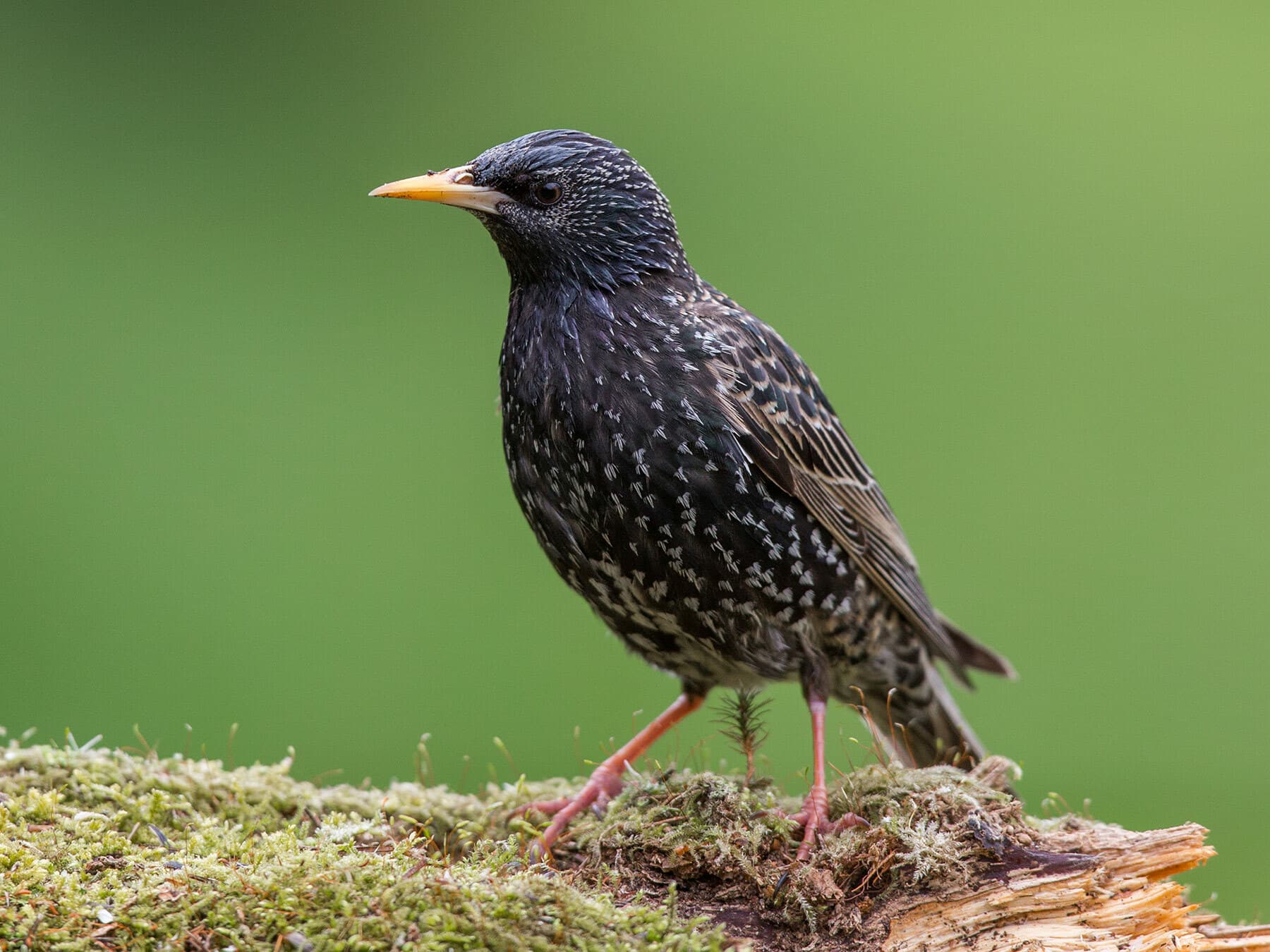
This iridescent troublemaker has a knack for mimicry and a taste for farmland snacks, making it both admired and controversial across its widespread range.
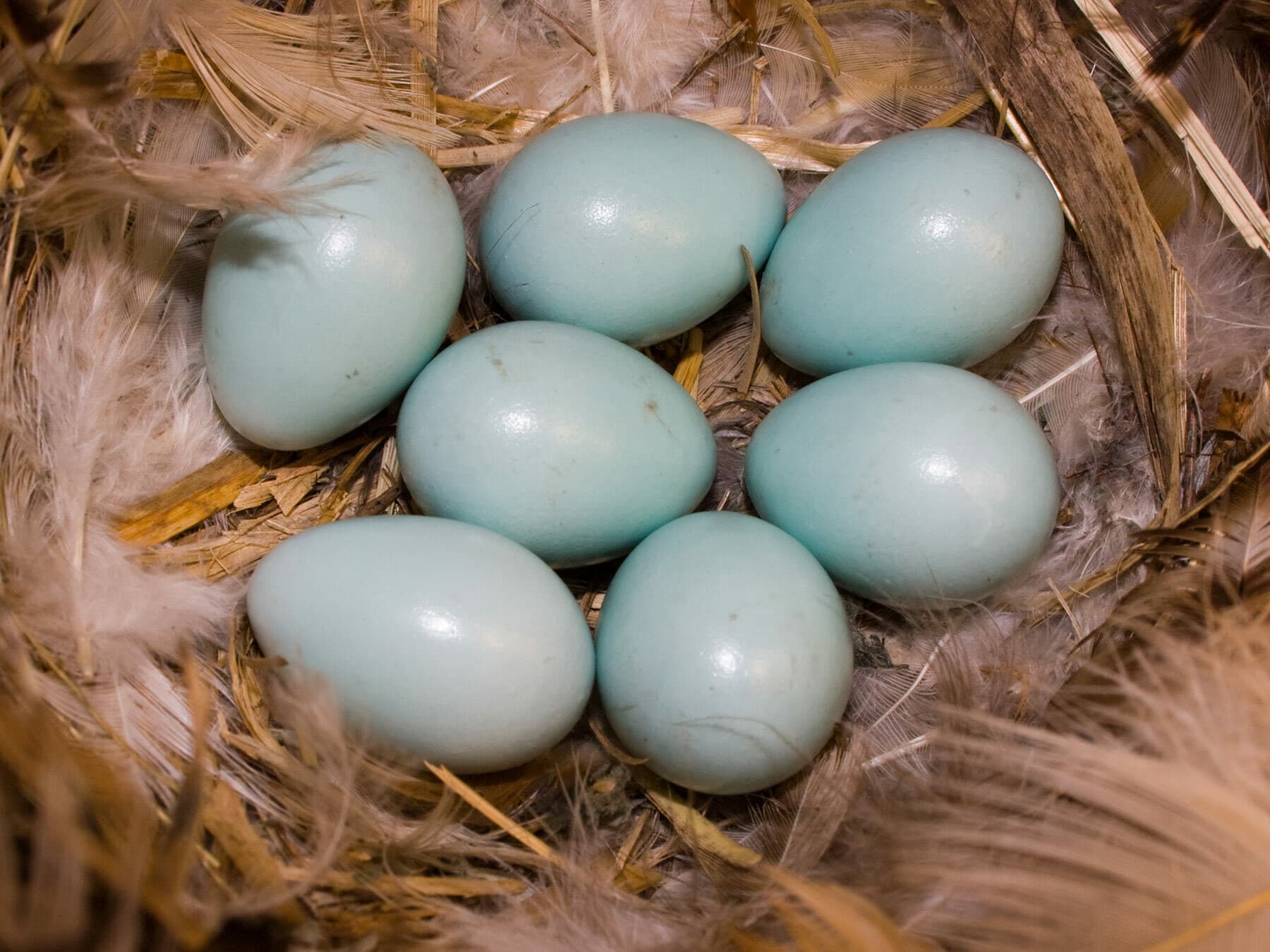
Starlings are cavity nesters, favouring holes in trees, buildings, and nest boxes. Because their eggs are hidden away in the dark, they do not require the camouflage patterns seen in open-cup nesters. A Starling's clutch of four to five eggs ranges from very pale blue to a milky blue-green, completely devoid of speckles or markings. They are relatively elongated, measuring roughly 30mm by 21mm. The pale colour helps the parent birds locate the eggs in the dim light of the nesting cavity.
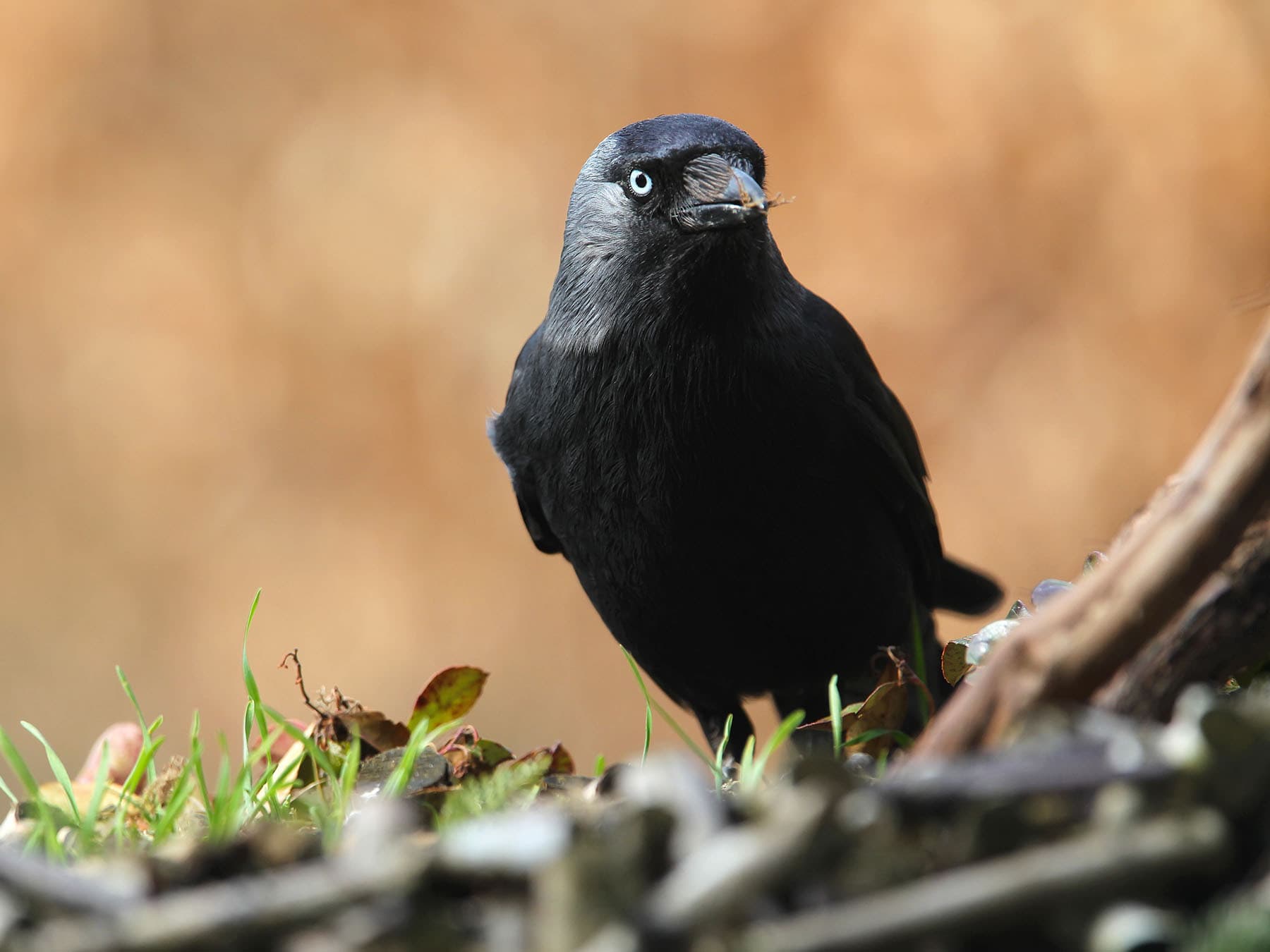
Magpie (Pica pica)
Magpies build large, domed nests of twigs high in the canopy, often with a side entrance to deter predators. Inside, the female lays a clutch of five to eight eggs. Magpie eggs are similar in colour to a Blackbird's but significantly larger, measuring around 35mm long and 24mm wide. The base colour is a pale bluish-green, heavily mottled and speckled with olive-brown and grey. The dense speckling provides excellent camouflage against the dappled light filtering through the nest's twiggy roof.
North American Birds That Lay Blue Eggs
Across the Atlantic, several North American species are famous for their blue eggs. While the American Robin is the most well-known, blue eggs appear across several different bird families, from thrushes to finches and blackbirds.
American Robin (Turdus migratorius)
American Robin
Turdus migratorius
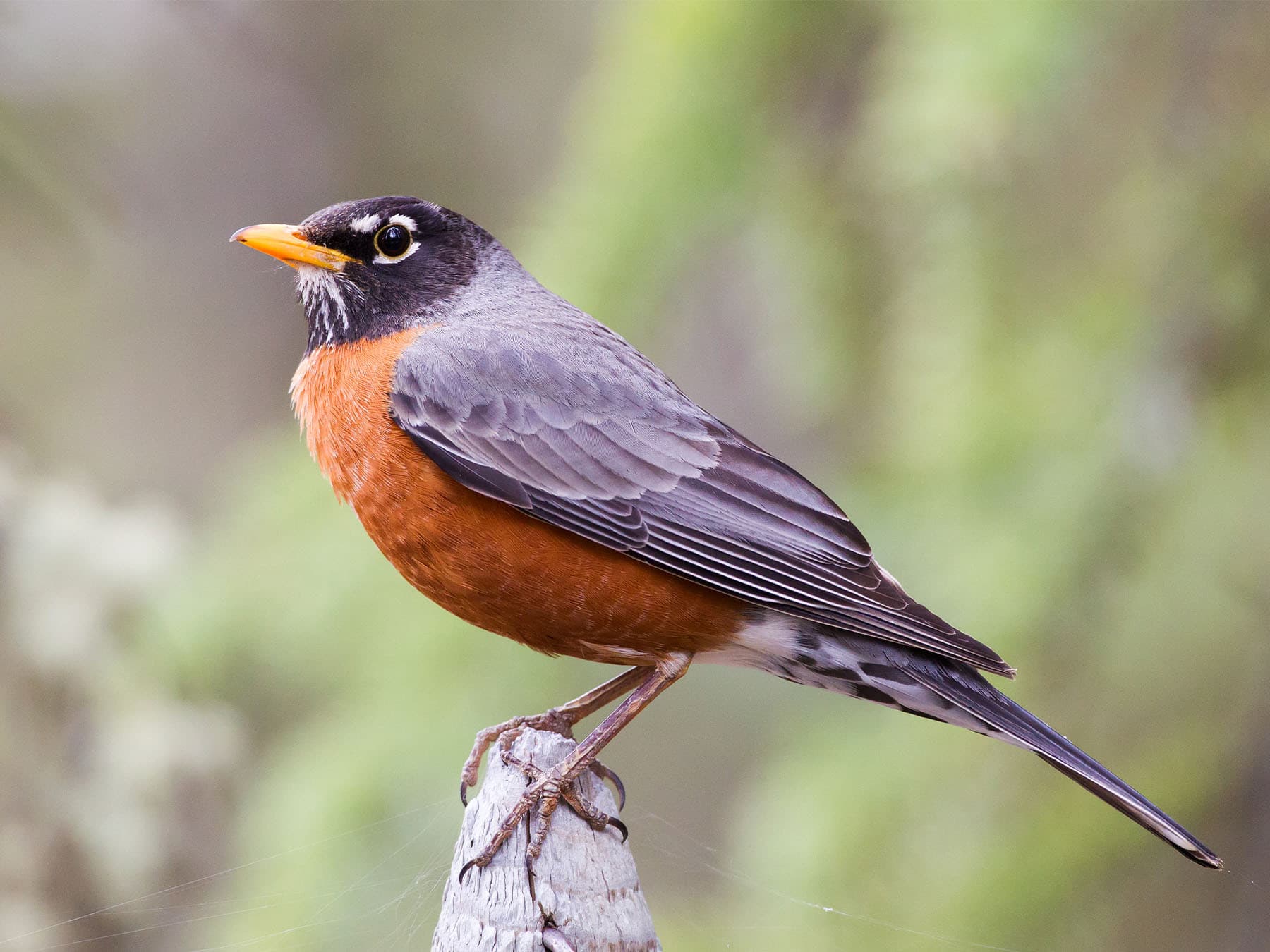
This cheerful songbird with its bright orange breast is a beloved harbinger of spring across North American backyards and parks.
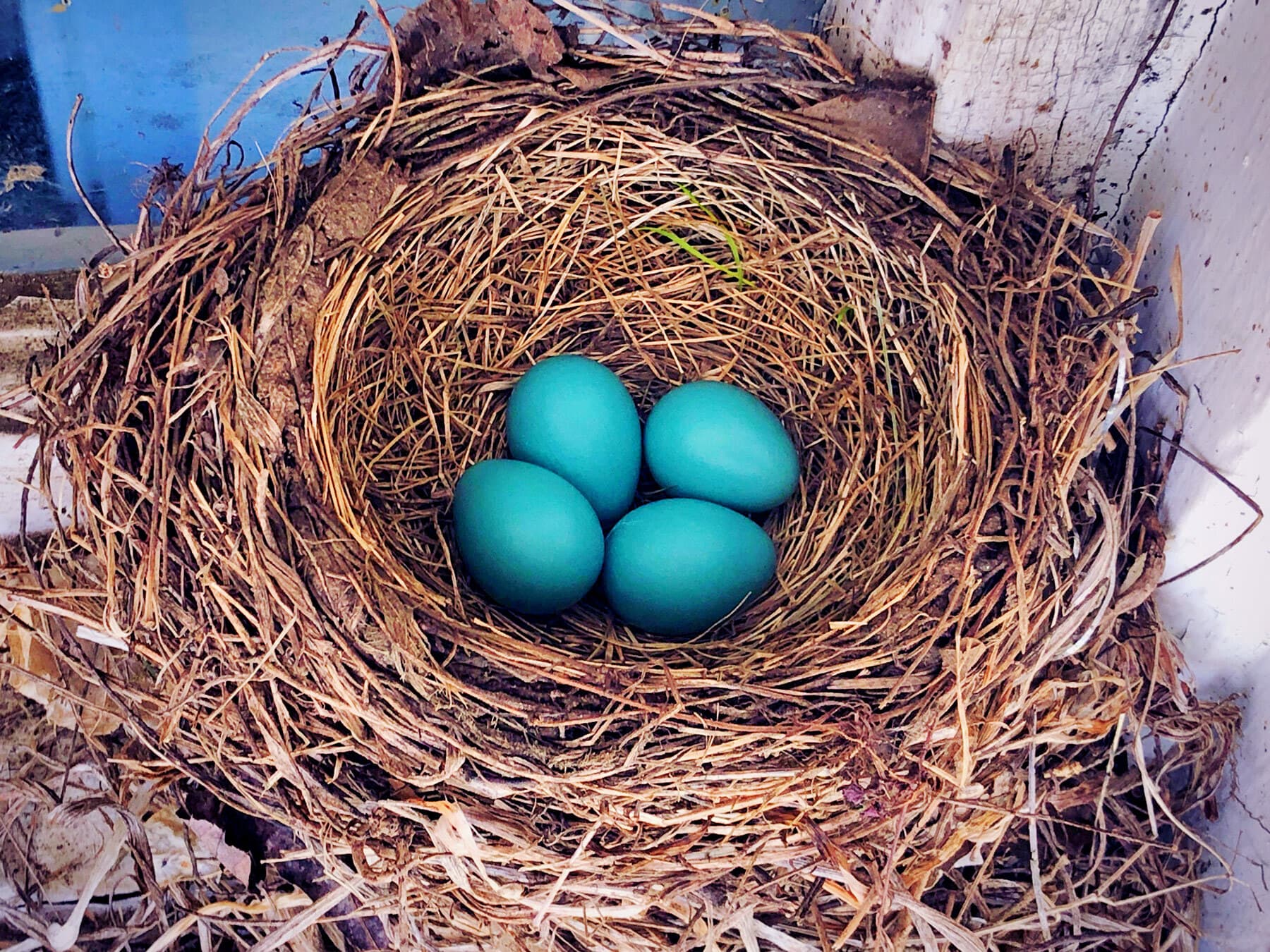
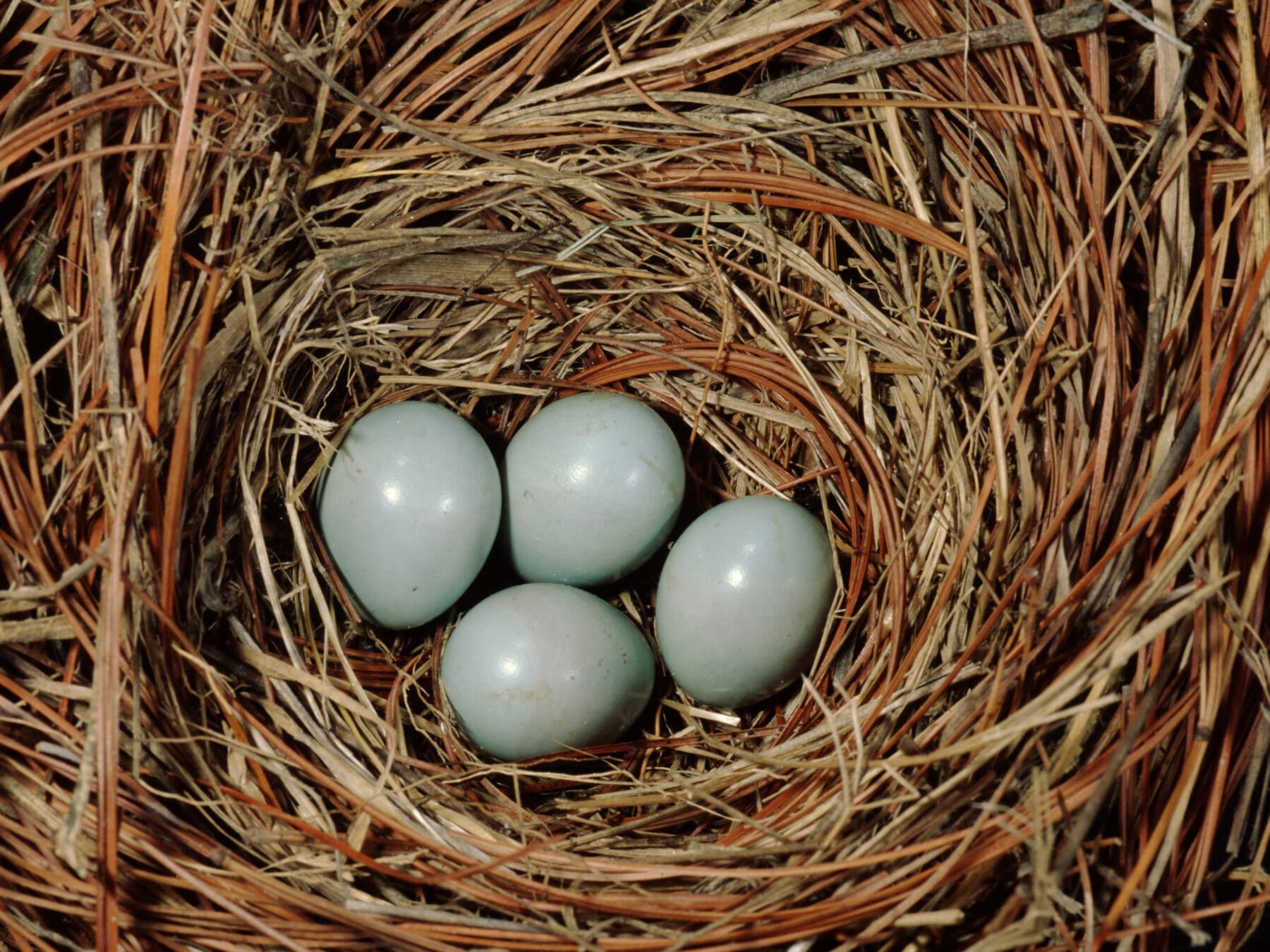
The American Robin is the gold standard for blue eggs. A typical clutch contains three to five eggs in a flawless, unmarked shade of vivid sky blue. Measuring between 28mm and 30mm in length and 20mm in width, these eggs are laid in a sturdy cup nest reinforced with mud and lined with fine grasses. The female incubates the eggs for about two weeks. The striking blue colour protects the embryo from sunlight while the parents are away foraging for earthworms and insects.
Eastern Bluebird (Sialia sialis)
Eastern Bluebird
Sialia sialis
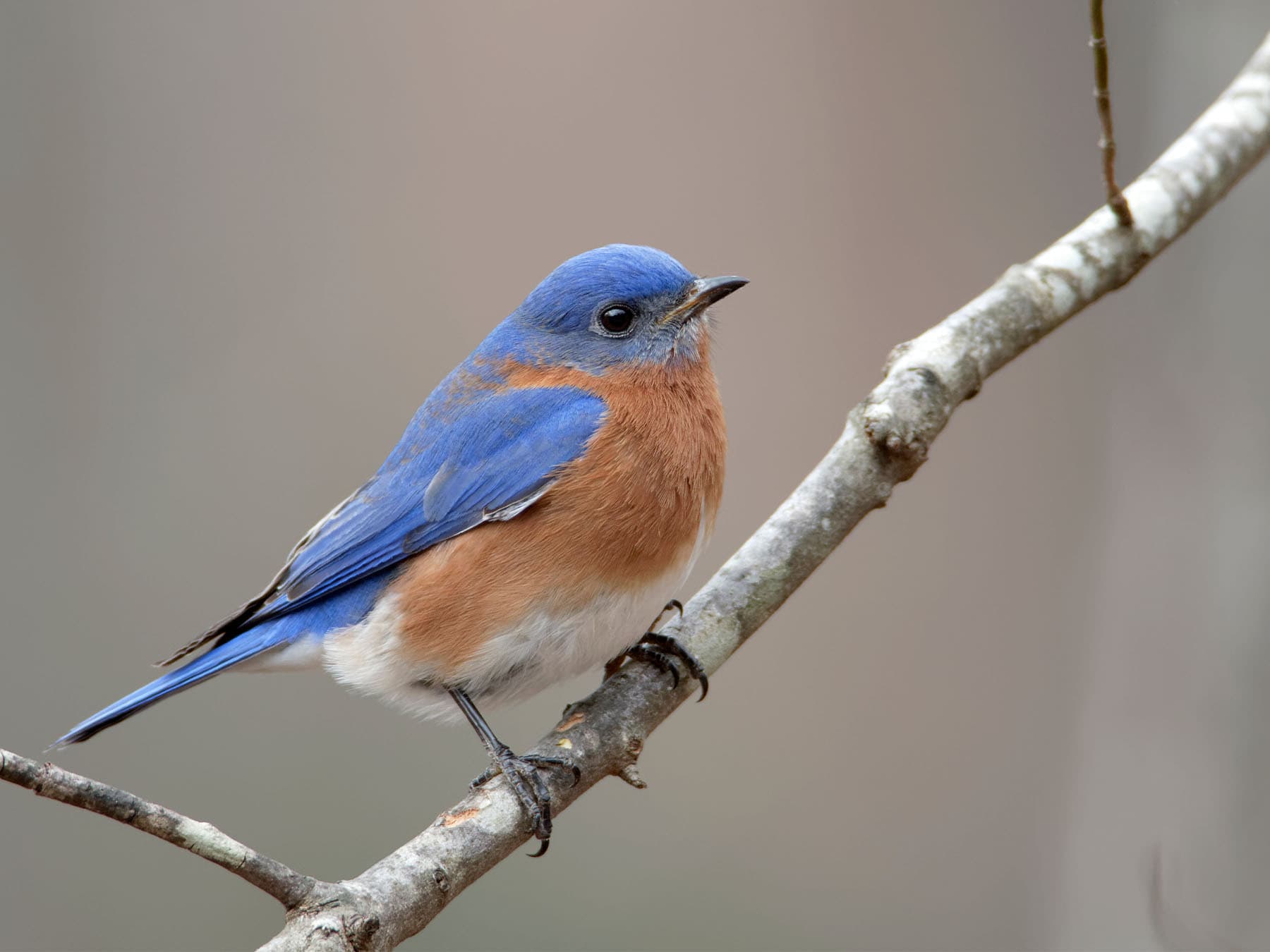
This vibrant thrush brings a splash of sky-blue brilliance to backyard feeders and open woodlands across North America.
True to their name, Eastern Bluebirds lay pale blue eggs. As cavity nesters that readily accept artificial nest boxes, their eggs are a common sight for backyard bird monitors. The eggs are unmarked and slightly paler than those of an American Robin, measuring roughly 21mm by 16mm. Interestingly, around 4-5% of Eastern Bluebirds lay completely white eggs due to a genetic quirk that prevents the deposition of biliverdin, though these white eggs hatch into healthy chicks.
House Finch (Haemorhous mexicanus)
House Finch
Haemorhous mexicanus
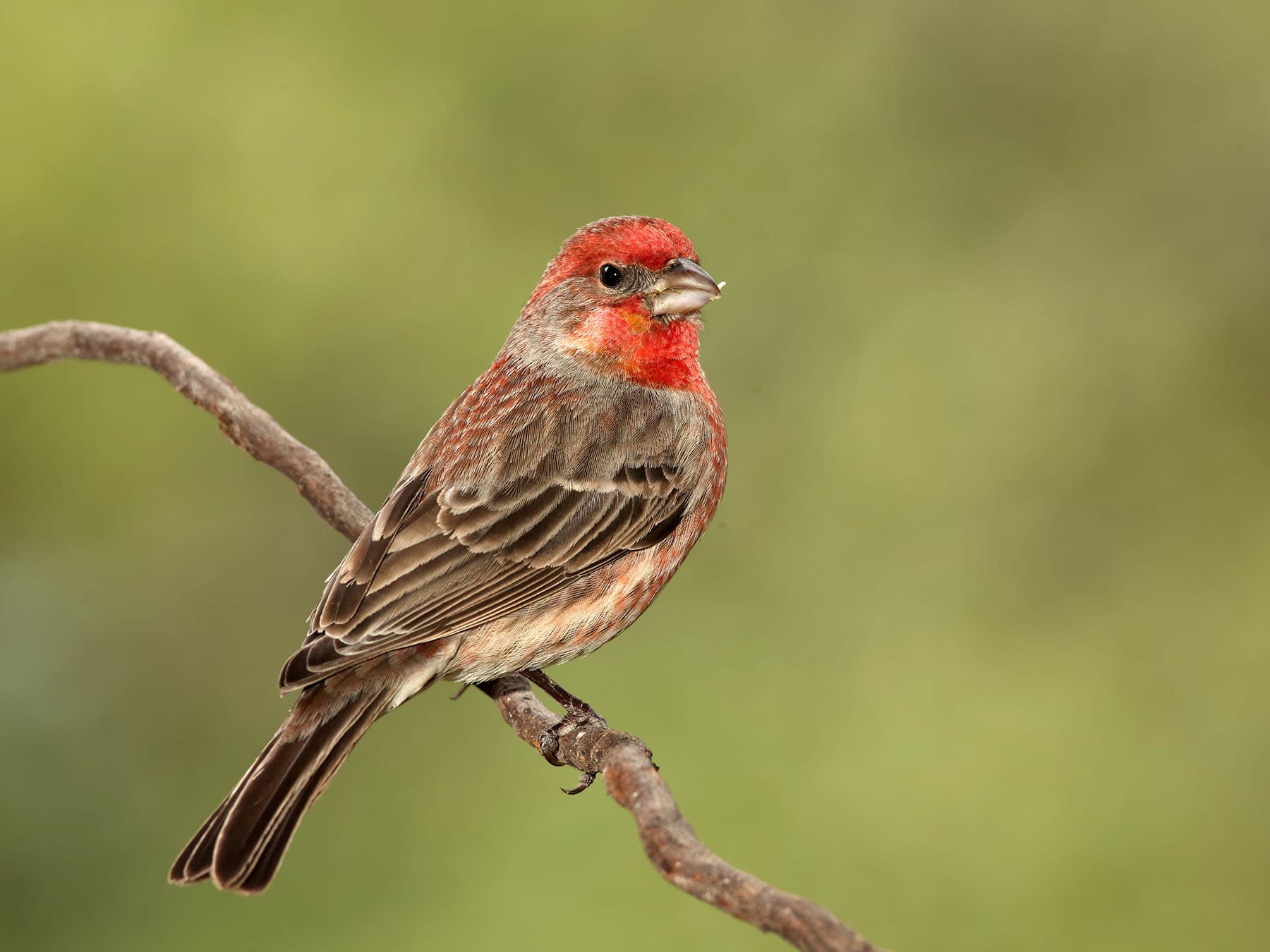
This charming songbird brightens backyards across North America with its cheerful melodies and rosy-red plumage.
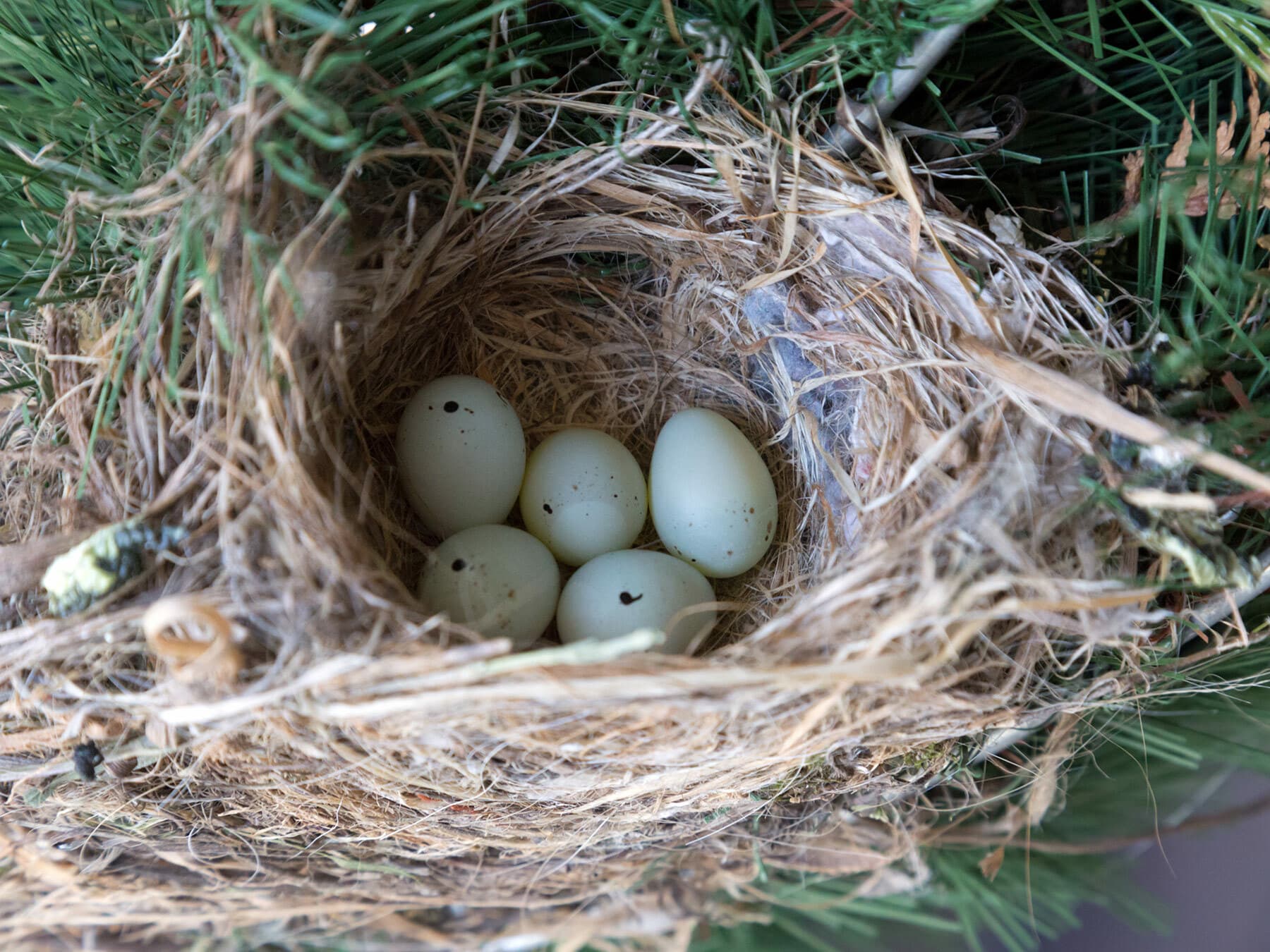
House Finches are highly adaptable birds that will nest in hanging planters, ivy, and even old shoes left on porches. Their eggs are very small, measuring 16mm to 21mm in length and 13mm to 15mm in width. The base colour is a very pale bluish-green, sparsely marked with fine black, brown, or purple speckles, usually clustered at the larger end. A female typically lays four to five eggs between late March and July.
Red-winged Blackbird (Agelaius phoeniceus)
Red-winged Blackbird
Agelaius phoeniceus

A striking songbird with red shoulder patches, this species brings a splash of color to wetlands and grasslands across North America.
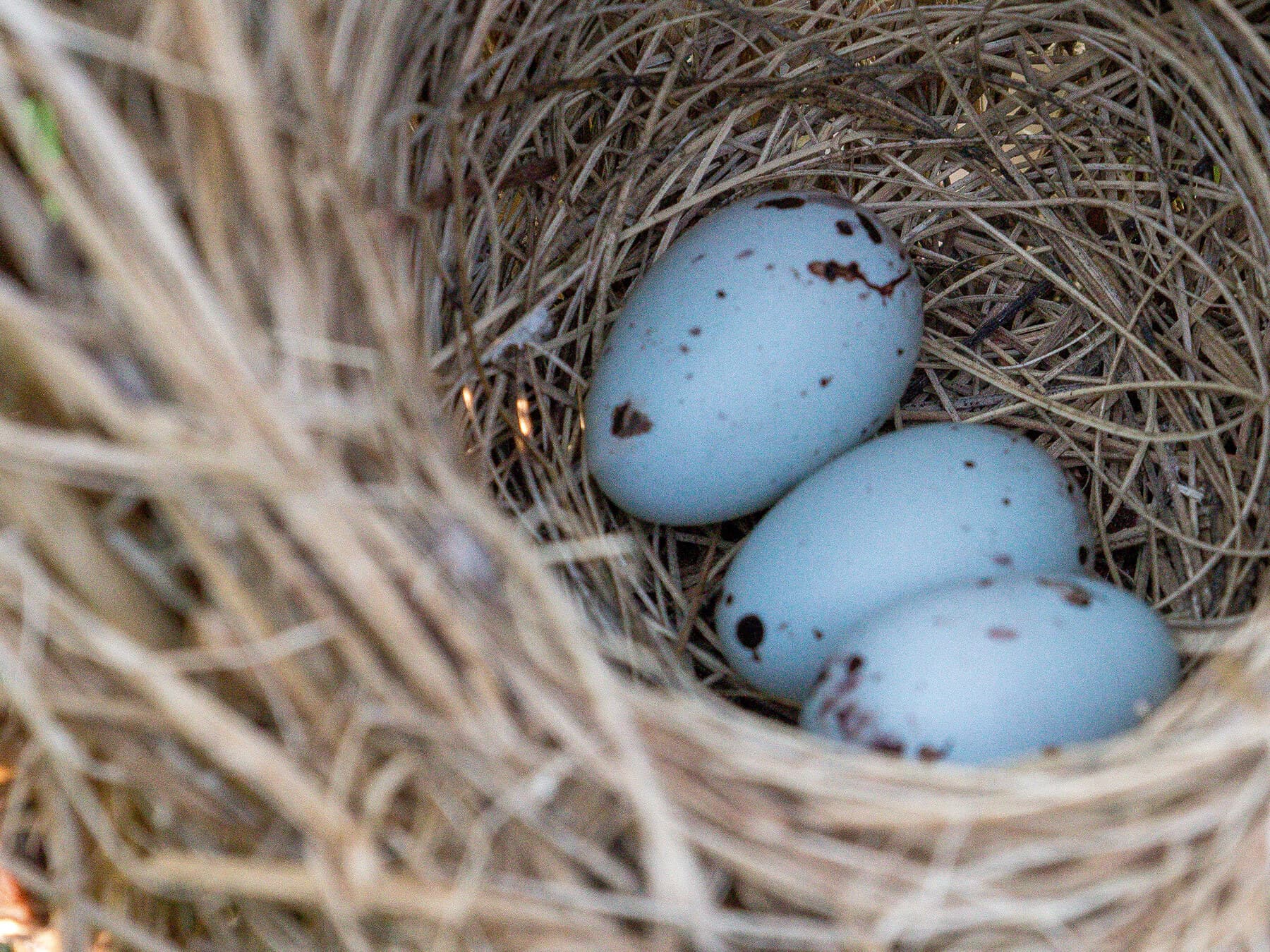
Nesting in dense cattails and marsh vegetation, the Red-winged Blackbird weaves a complex cup nest suspended above the water. The female lays three to four eggs that are a pale blue-green, decorated with striking, erratic scrawls and zigzags of dark brown and black. These markings look almost as though they were drawn on with a fine-tipped pen. The eggs measure approximately 25mm by 18mm. The intricate scrawling helps camouflage the eggs among the linear shadows cast by the surrounding reeds.
Gray Catbird (Dumetella carolinensis)
Gray Catbird
Dumetella carolinensis
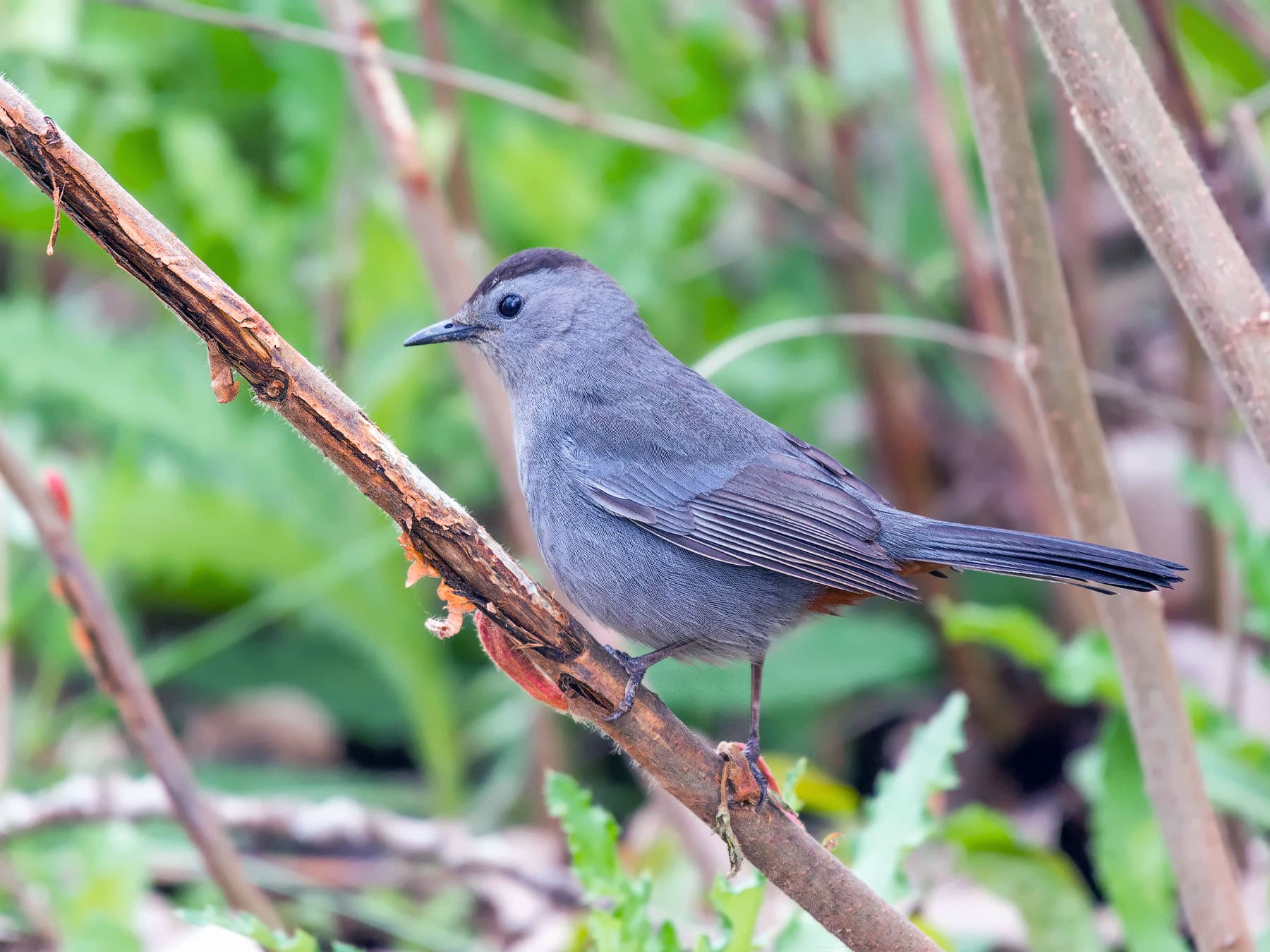
This vocal mimic is a backyard favorite across North America, famous for its cat-like mewing calls and ability to copy the songs of over a dozen other birds.
The Gray Catbird, a relative of the mockingbird, lays some of the most intensely coloured eggs in North America. Hidden deep within dense thickets or thorny shrubs, the nest holds three to five eggs of a deep, rich turquoise or emerald-blue. Unlike the eggs of many other shrub-nesting species, Catbird eggs are completely unmarked. They measure around 24mm by 17mm. The deep pigmentation provides effective UV protection in the dappled light of their preferred scrubby habitats.
Did You Know?
Comparing Blue Bird Eggs by Size and Markings
If you have found a blue egg and need to identify it, size and markings are your best clues. Here is a quick reference guide to help narrow down the possibilities:
- Small (Under 22mm long): If the egg is unmarked bright blue, it is likely a Dunnock (UK) or Eastern Bluebird (US). If it is pale blue-green with sparse dark speckles, it is a House Finch.
- Medium (24mm - 28mm long): A glossy blue egg with sharp black spots is a Song Thrush. A pale blue-green egg with dark, pen-like scrawls is a Red-winged Blackbird. A deep, unmarked turquoise egg belongs to a Gray Catbird.
- Large (28mm - 35mm long): An unmarked, vivid sky-blue egg is an American Robin. An unmarked, pale milky-blue egg is a Common Starling. If the egg is blue-green and heavily speckled with brown or red, it is a Blackbird (smaller) or a Magpie (larger).
What to Do If You Find a Bird's Nest
Discovering a nest with blue eggs is a thrilling experience, but it is crucial to prioritise the welfare of the birds. If you accidentally flush a bird from its nest, step back immediately and leave the area. Parent birds are highly sensitive to disturbance and may abandon their eggs if they feel the nest site has been compromised by predators or humans.
In the UK, the Wildlife and Countryside Act 1981 makes it illegal to intentionally take, damage, or destroy the nest of any wild bird while it is in use or being built. It is also a criminal offence to take or destroy wild bird eggs. Similar protections exist in North America under the Migratory Bird Treaty Act. The best way to enjoy nesting birds is from a distance, using binoculars to watch the parents come and go without causing them undue stress.
Identify Any Bird Instantly
- Upload a photo from your phone or camera
- Get an instant AI identification
- Ask follow-up questions about the bird
Monthly Birds in Your Area
- Personalised for your location
- Seasonal tips and garden advice
- Updated every month with new species
Associated Species
Red-winged Blackbird
Agelaius phoeniceusLC
New World Blackbirds
American Robin
Turdus migratoriusLC
Thrushes
Dunnock
Prunella modularisLC
Accentors
Blackbird
Turdus merulaLC
Thrushes
Eastern Bluebird
Sialia sialisLC
Thrushes
Song Thrush
Turdus philomelosLC
Thrushes
Gray Catbird
Dumetella carolinensisLC
Mockingbirds & Thrashers
Common Starling
Sturnus vulgarisLC
Starlings & Mynas
House Finch
Haemorhous mexicanusLC
Finches