Species Profile
Bar-headed Goose
Anser indicus
Bar-headed Goose
Quick Facts
Conservation
LCLeast ConcernLifespan
15–20 years
Length
68–78 cm
Weight
1870–3200 g
Wingspan
140–160 cm
Migration
Full migrant
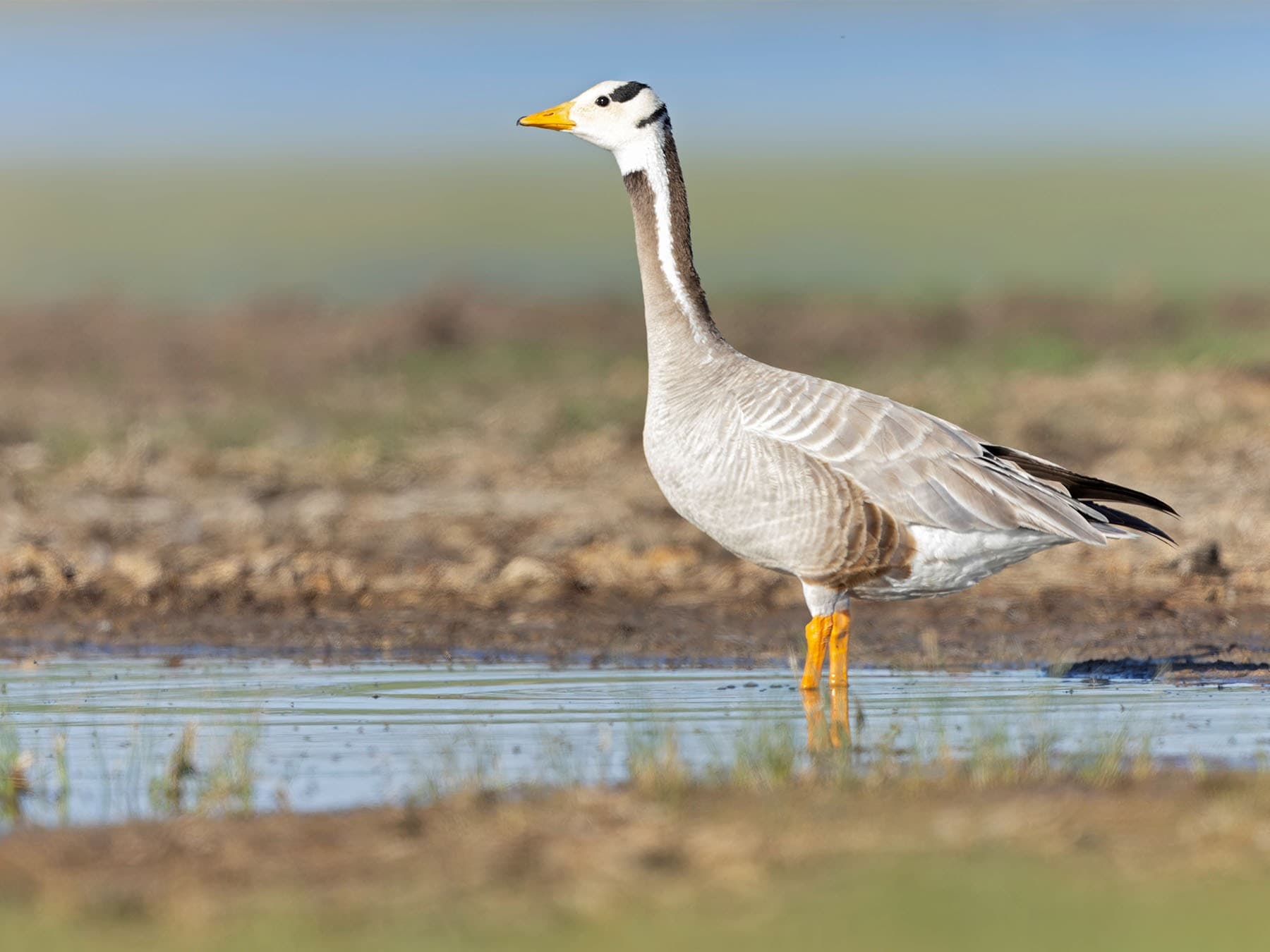
The Bar-headed Goose flies directly over the Himalayas to reach its wintering grounds, navigating altitudes where oxygen levels are less than half of those at sea level. Easily recognised by the striking black stripes across the back of its white head, this pale grey goose possesses unique physiological adaptations that allow it to survive extreme mountain crossings.
Think you've spotted a Bar-headed Goose?
Upload a photo and our AI will confirm it instantly
Confirm with a PhotoGallery
Appearance
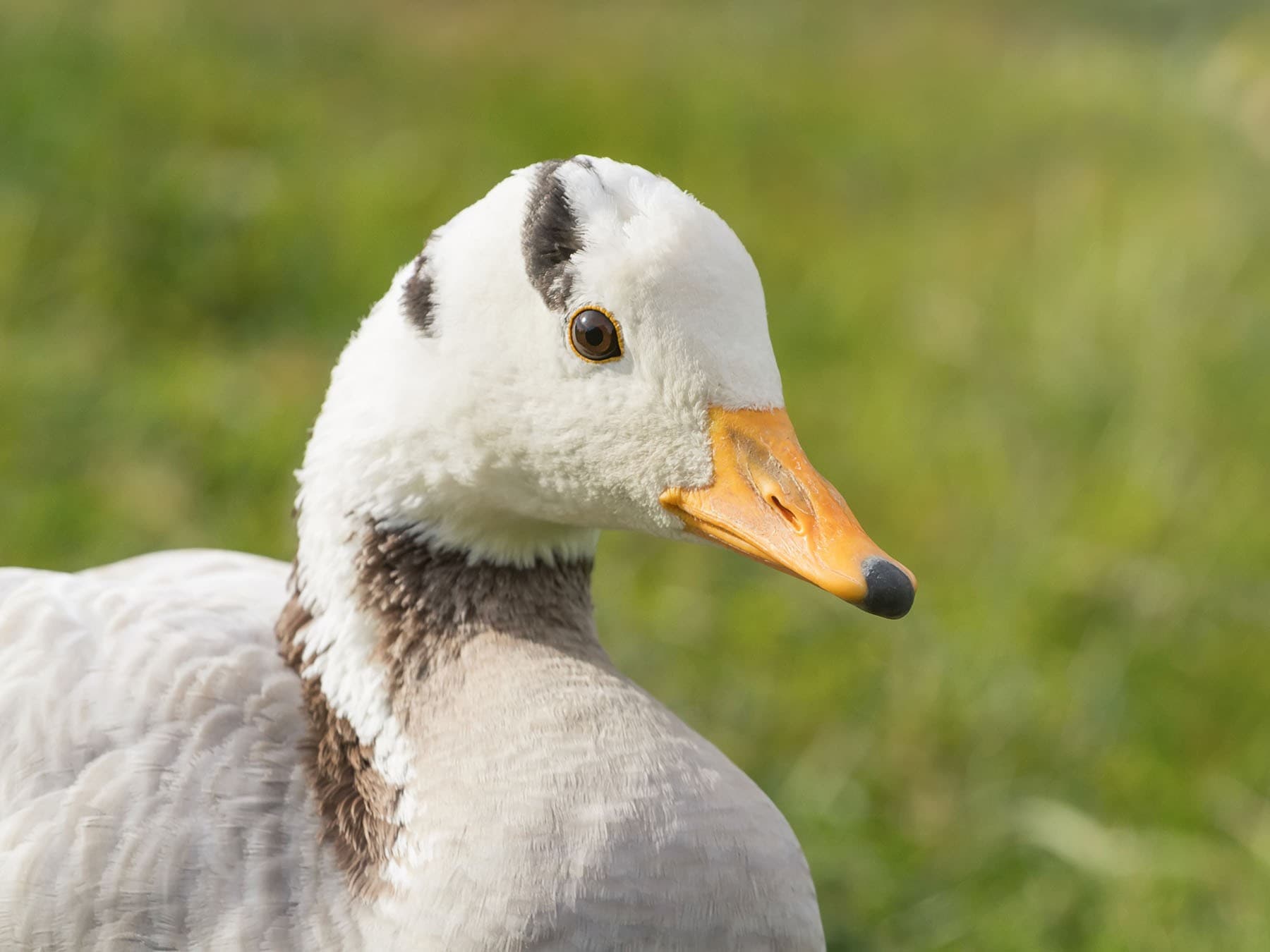
With predominantly pale grey plumage, the Bar-headed Goose is noticeably lighter than other geese in the Anser genus. Its most defining feature is its white head, which bears two distinct black, U-shaped bars wrapping around the back of the head and upper neck.
The bill is a bright orange and the legs are yellow, contrasting sharply with the pale body. In flight, the pale grey wings reveal a broad black trailing edge. Males and females are identical in plumage, though males tend to be slightly larger on average.
Identification & Characteristics
Colors
- Primary
- Grey
- Secondary
- White
- Beak
- Orange
- Legs
- Yellow
Attributes
Understanding Attributes
Rated 0–100 based on research and observation. A score of 50 is average across all bird species. These attributes are relative and don't necessarily indicate superiority.
Habitat & Distribution
During the summer breeding season, Bar-headed Geese inhabit high-altitude environments on the Tibetan-Qinghai Plateau, typically between 4,000 and 6,000 metres above sea level. They favour mountain lakes, freshwater marshes, and highland grasslands from Mongolia south through Russia and Western China to Tibet.
In winter, they migrate south across the Himalayas to lowland wetlands, rivers, and agricultural fields in India, Bangladesh, and Nepal, reaching as far south as Tamil Nadu.
Diet
On their summer breeding grounds on the Tibetan-Qinghai Plateau, Bar-headed Geese graze on short highland grasses, roots, tubers, leaves, and seeds found around mountain lakes and streams.
During the winter months in South Asia, they shift their focus to agricultural areas. Here, they feed heavily on cultivated crops such as barley, rice, wheat, and corn. This reliance on agricultural fields can sometimes bring them into conflict with local farmers protecting their harvests.
Behaviour
Bar-headed Geese rely heavily on visual and vocal cues to maintain flock cohesion while flying in their characteristic V-formations. This formation flying is a crucial energy-saving strategy, reducing wind resistance for the trailing birds during long migrations.
Within their breeding colonies, lower-ranking females sometimes engage in intraspecific brood parasitism. They attempt to lay their eggs in the nests of higher-ranking females, passing off the energetic costs of incubation and chick-rearing to other members of the flock.
Calls & Sounds
In flight, the Bar-headed Goose produces a resonant, honking call that carries across long distances. These vocalisations are crucial for maintaining spacing while flying in their characteristic V-formations.
The constant calling helps family groups and larger flocks stay connected, especially during their demanding migratory journeys or when navigating through poor visibility.
Flight
Twice a year, Bar-headed Geese undertake a demanding journey between their breeding grounds on the Tibetan-Qinghai Plateau and their wintering grounds in South Asia, crossing the formidable Himalayas.
They fly in V-formations, often travelling at night or in the early morning to take advantage of colder, denser air. This strategy provides more lift and oxygen, allowing them to complete the mountain crossing non-stop in as little as seven hours.
Nesting & Breeding
Nesting in large colonies on the ground near highland marshes and lakes, Bar-headed Geese create shallow depressions lined with vegetation to rear their young. They are seasonal breeders that typically form monogamous pairs, though polygynous arrangements can occur in populations with more females than males.
Between late April and June, females lay a clutch of 3 to 8 eggs. The female incubates the eggs for 28 to 30 days while the male stands guard nearby. The precocial goslings leave the nest shortly after hatching and fledge at 55 to 60 days of age, receiving care and protection from both parents.
Lifespan
Wild Bar-headed Geese typically live between 15 and 20 years, provided they survive their perilous bi-annual migration over the Himalayas and avoid predators like golden eagles and red foxes.
While exact maximum lifespans for wild individuals are difficult to verify, related goose species have been recorded living up to 31 years in captivity.
Conservation
The Bar-headed Goose population is currently increasing across a vast Asian range of over 2,500,000 square kilometres, earning it a Least Concern conservation status. They face natural predation from sea eagles, golden eagles, crows, ravens, and red foxes.
The species is closely monitored by health organisations, as they are known carriers of the highly pathogenic avian influenza (HPAI) H5N1 virus, which can impact both wild bird populations and domestic poultry.
Population
Estimated: Unknown exact size, but occurs over 2,500,000 km²
Trend: Increasing
Increasing
Elevation
Sea level to 7,290 metres
Birdwatching Tips
During the winter months, large numbers of Bar-headed Geese congregate in lowland wetlands and agricultural fields across India and Nepal. Look for their striking pale grey bodies and the unmistakable black bars on the back of their white heads.
In the UK and Europe, keep an eye out for escapees from waterfowl collections mingling with other wildfowl on lakes and reservoirs. A small naturalised population also breeds in Germany, offering European birdwatchers a chance to see them in the wild.
Did You Know?
- They have been recorded flying at altitudes up to 7,290 metres (23,920 ft) over the Himalayas — making them one of the highest-flying birds on Earth.
- Their haemoglobin has a unique genetic mutation that gives it a higher affinity for oxygen, allowing them to survive in air that would render most animals unconscious.
- They possess more capillaries in their heart and flight muscles than lowland birds, ensuring highly efficient oxygen delivery during extreme flights.
- Despite predictable daytime tailwinds blowing up the Himalayas, they prefer to fly at night or early morning when the colder, denser air provides more lift and oxygen.
- The flight across the Himalayas is often completed non-stop in as little as seven hours.
Community Photos
Be the first to share a photo of the Bar-headed Goose
Upload a PhotoIdentify Any Bird Instantly
- Upload a photo from your phone or camera
- Get an instant AI identification
- Ask follow-up questions about the bird
Monthly Birds in Your Area
- Personalised for your location
- Seasonal tips and garden advice
- Updated every month with new species