

Turkey Vulture
Turkey Buzzard, Buzzard · Cathartes aura
By the Birdfact teamChecked by Nathan Cope
See it in 3D
3 plumages
An adult Turkey Vulture is 24.5–32 in (62–81 cm) long, bill to tail.
Adult
© 2026 NC Digital Limited (Birdfact). All rights reserved. This 3D model may be viewed on this page and shared by link only. Downloading, extracting, copying or reusing it, or using it to train machine-learning models, is not permitted without our written permission. Using our models
On this page16 sections
How to recognise it
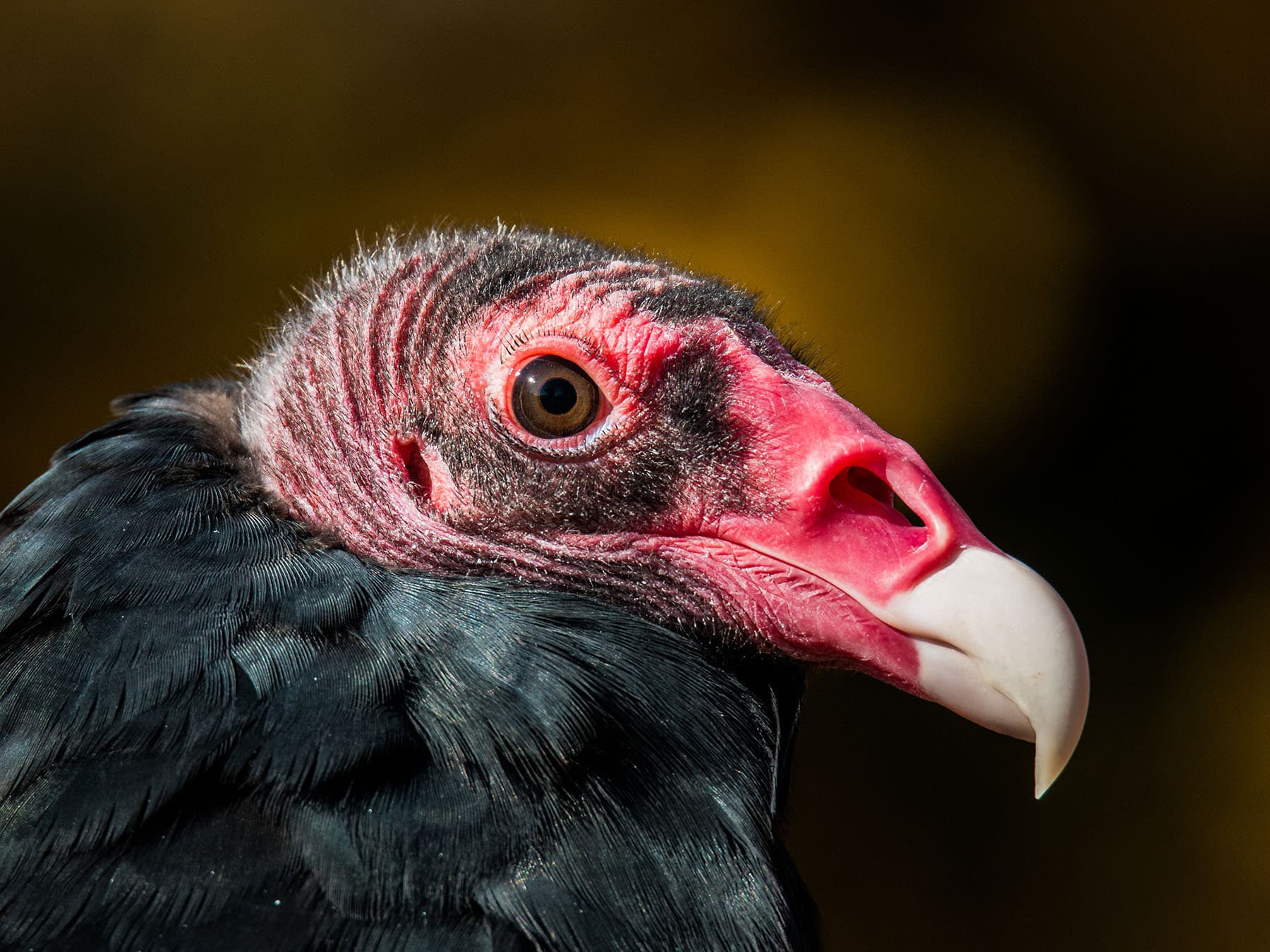
The Turkey Vulture is the big, dark bird you see tilting over roadsides and fields across most of the Americas, from southern Canada to the tip of South America. It is blackish brown all over, with a small, bare red head, a short hooked bill the color of old ivory, and pinkish legs. At close range the paler brown edges to its back and wing feathers give it a scaly look, and its large nostrils are open right through, so you can see light through them.
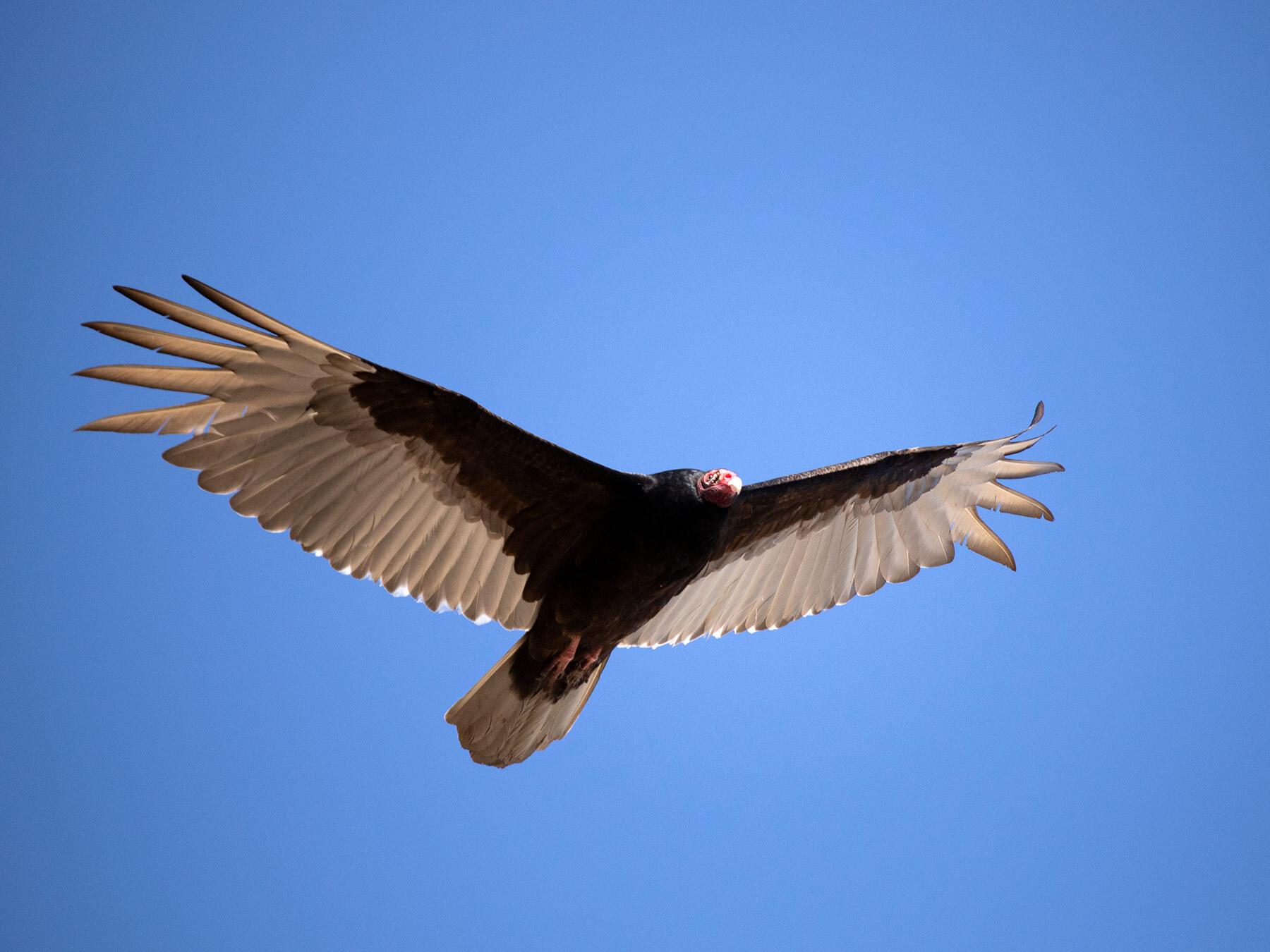
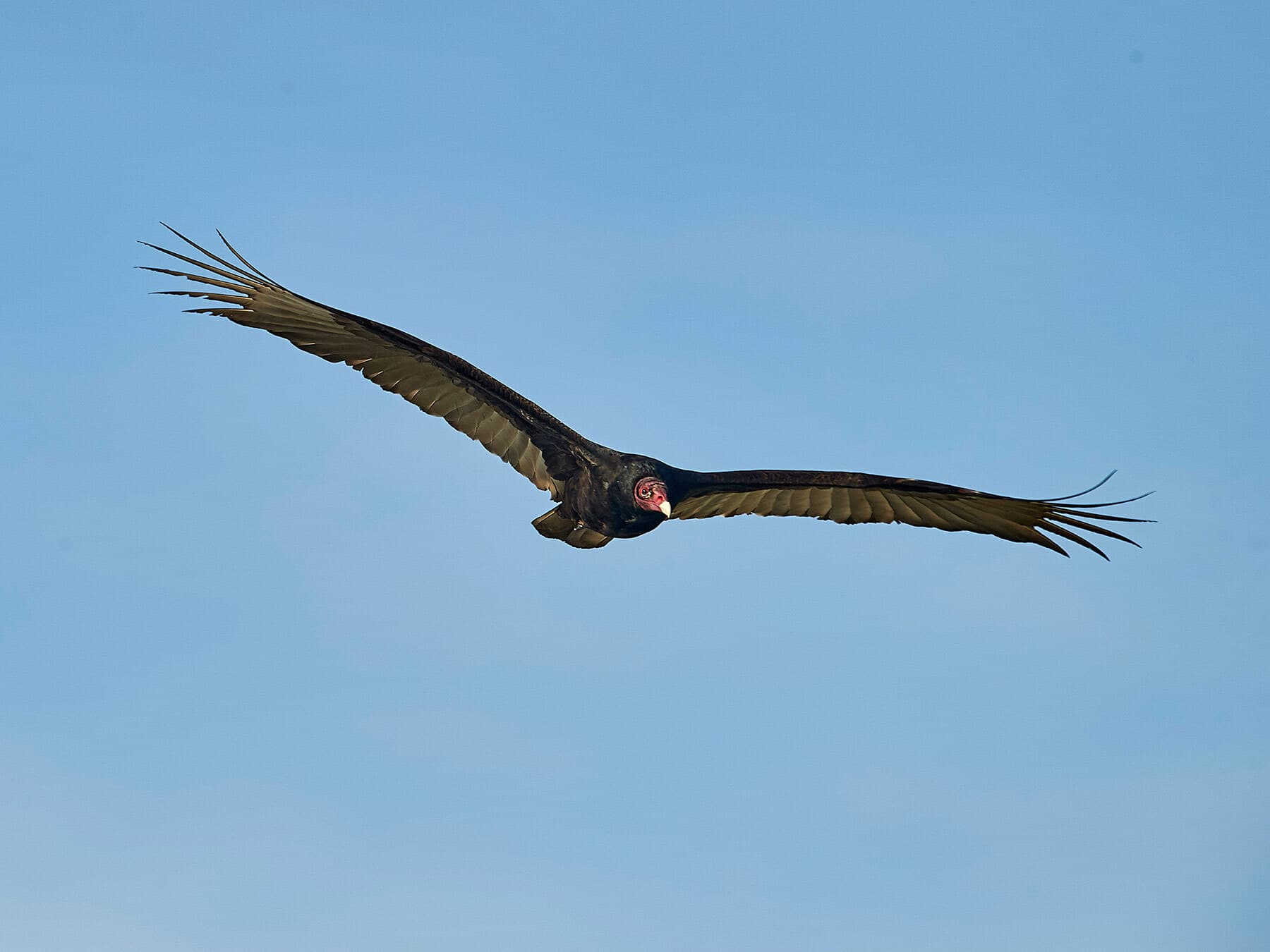
In the air, look at the underside of the wings: the flight feathers along the whole rear half shine silvery gray against blackish wing linings, so the wing looks two-toned. Turkey Vultures soar with their long wings raised in a shallow V and rock from side to side, rarely flapping, and the head looks tiny for the size of the bird.
Many people call it the turkey buzzard, or just buzzard. It is named for the Wild Turkey, whose bare red head the adult's resembles, but it is not related to turkeys: it belongs to the New World vultures, the family that includes the Black Vulture and the condors.
Size and wingspan
A Turkey Vulture is 25-32 in (64-81 cm) long, with a wingspan of about 5-6.5 ft (1.5-2 m), nearly the size of an eagle. Yet it is light for its size, often around 3.3 lb (1.5 kg).1 Weights vary with region and season. Live birds weighed in summer in Ohio, Pennsylvania and Virginia averaged about 4.2-4.4 lb (1.9-2.0 kg), and migrants wintering in Florida 4.4 lb (2,006 g), while birds that live year-round in south Florida averaged 3.5 lb (1,582 g).1
Turkey Vultures are biggest in the north: eastern birds are the largest, and those of Mexico and Central America the smallest. Males and females look alike, though females average slightly larger.
Juveniles and young birds
Young Turkey Vultures look different at the head end. A juvenile has a blackish-gray head with some pale down and a dark bill, so it can be taken for a Black Vulture. Over the first autumn its head starts to turn pinkish and the base of its bill pales; most young birds still have a dark bill tip in their first spring and take about two years to get an adult's red head and ivory bill. In flight, young birds have the same two-toned wings and wobbling glide as adults.

Identification: similar birds
Birds that can be mistaken for a Turkey Vulture:
- Black Vulture: more compact, with a dark gray head at every age, shorter wings with white patches near the tips and a short tail. It flaps with quicker wingbeats, and soars on flat wings.
- Zone-tailed Hawk: can look much like a Turkey Vulture in flight, but is smaller, with a feathered head, yellow legs and cere, and a barred tail.
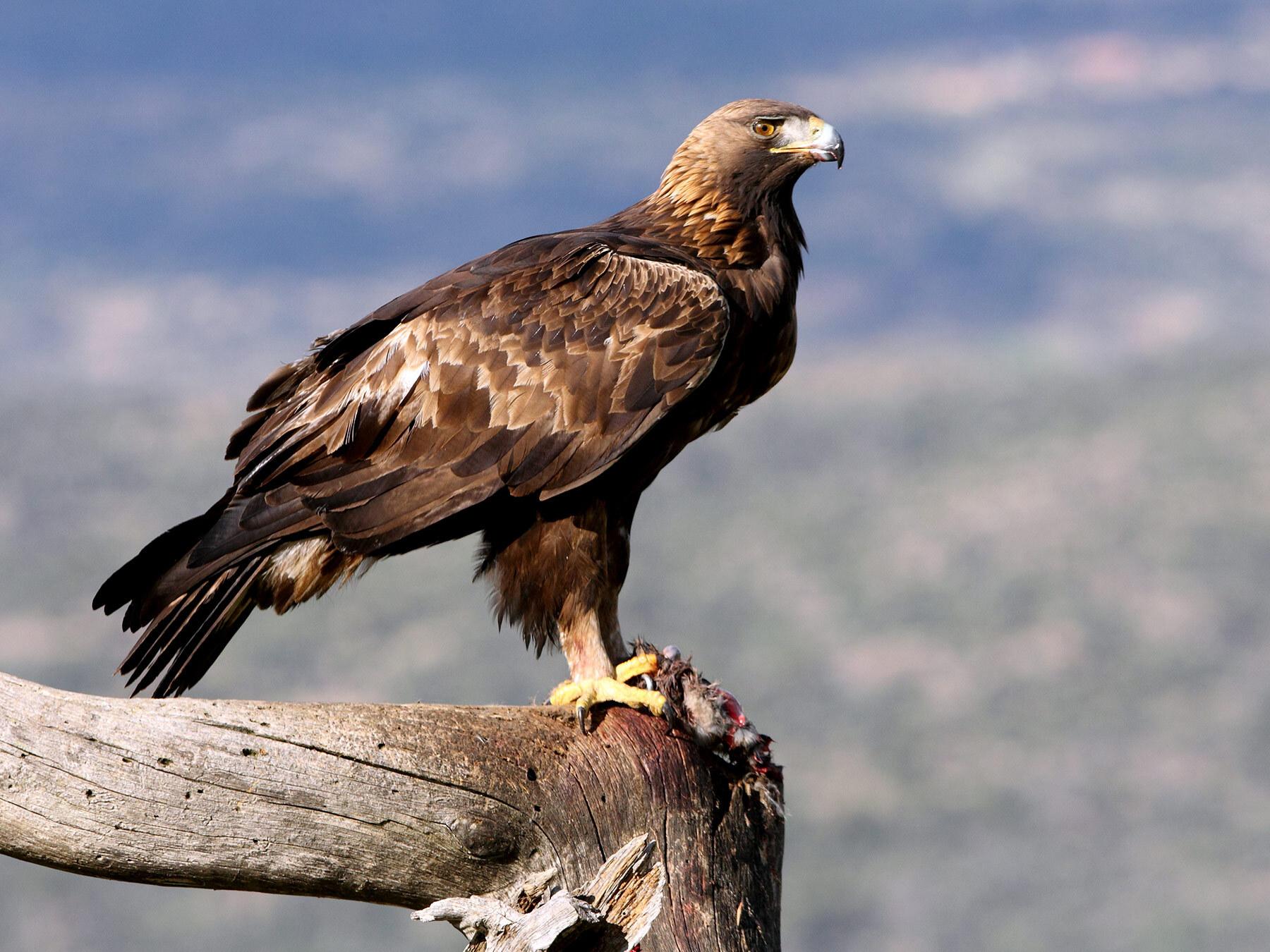
- Golden Eagle: also soars with raised wings, but never rocks, and has a golden nape.
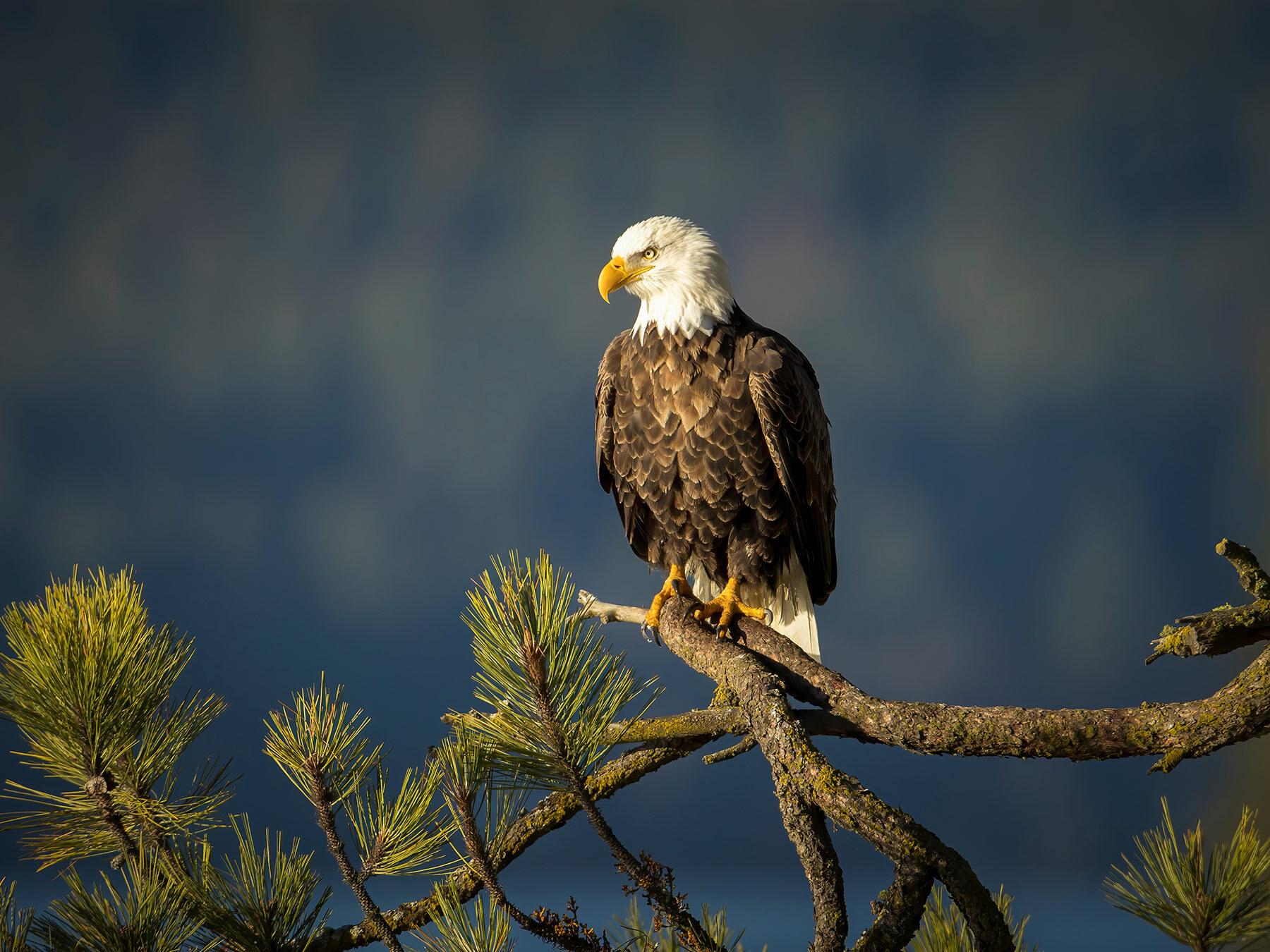
- Bald Eagle: young Bald Eagles are dark too and can be taken for vultures at a distance, but their massive size and bill usually show.2
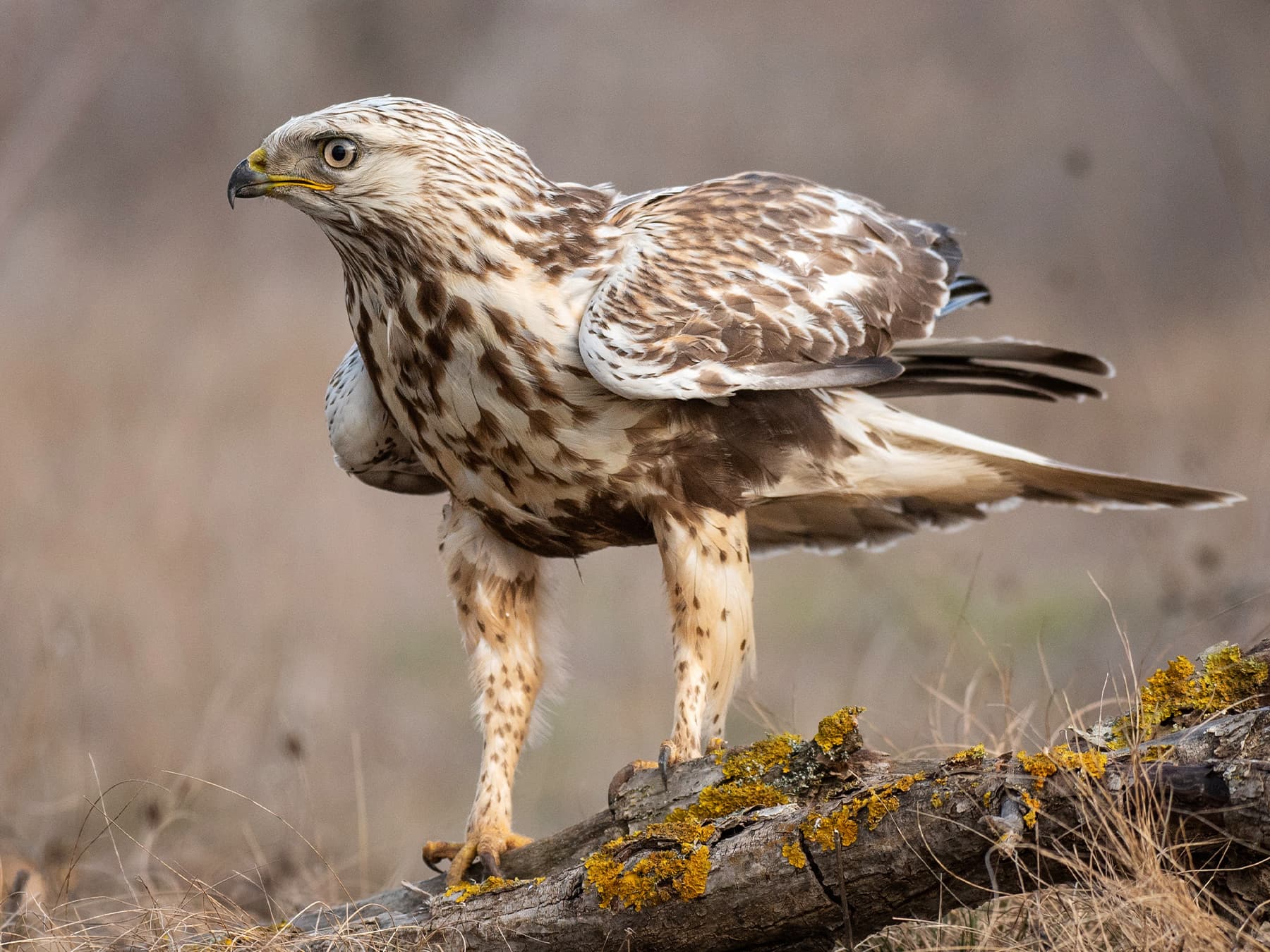
- Rough-legged Hawk and Swainson's Hawk: dark birds can soar with raised wings, but have shorter wings. A dark Rough-legged Hawk shows a dark band along the rear edge of the wing and a dark tail tip; a dark Swainson's Hawk shows white under the tail.
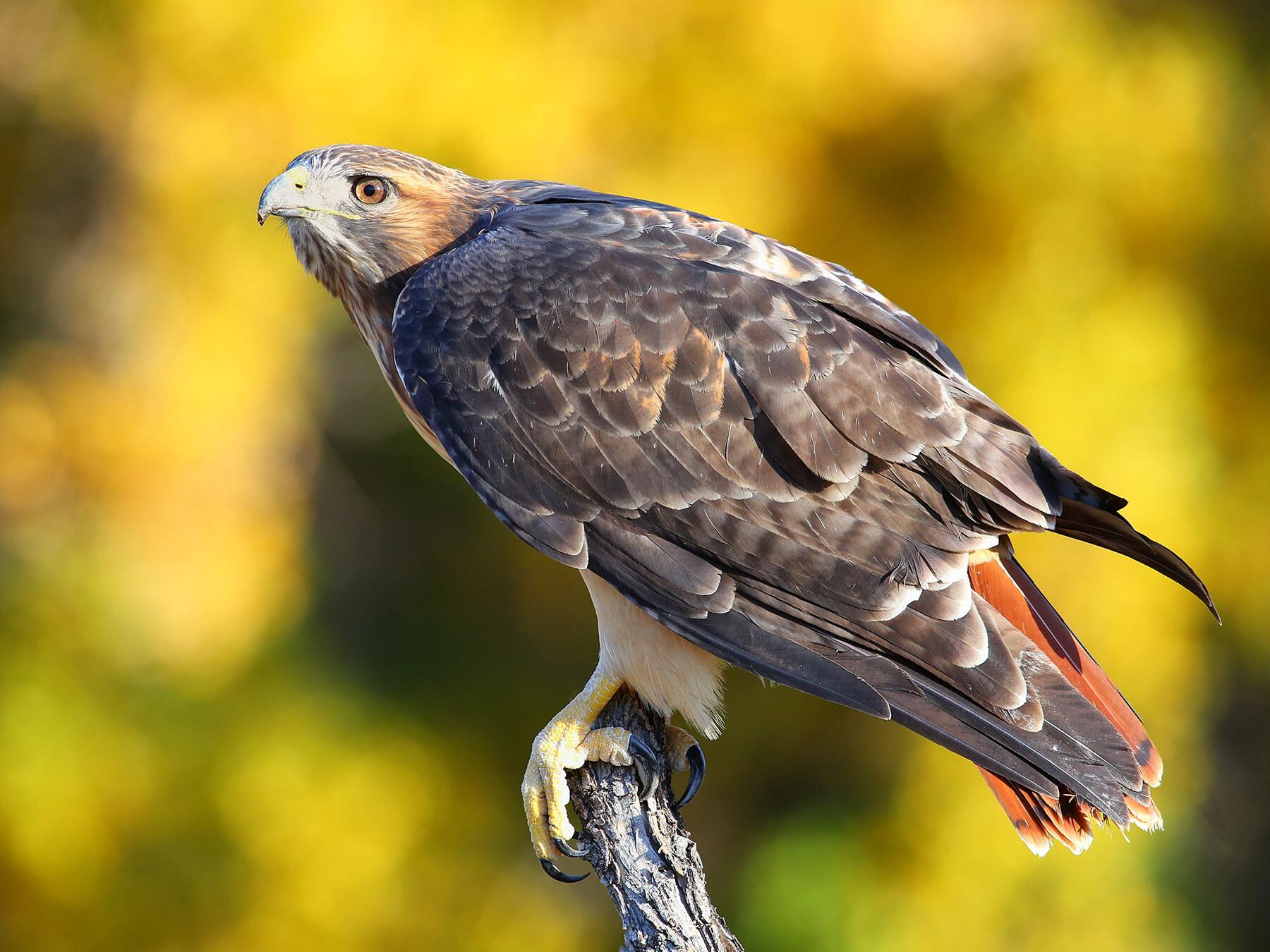
- Red-tailed Hawk: clearly smaller.
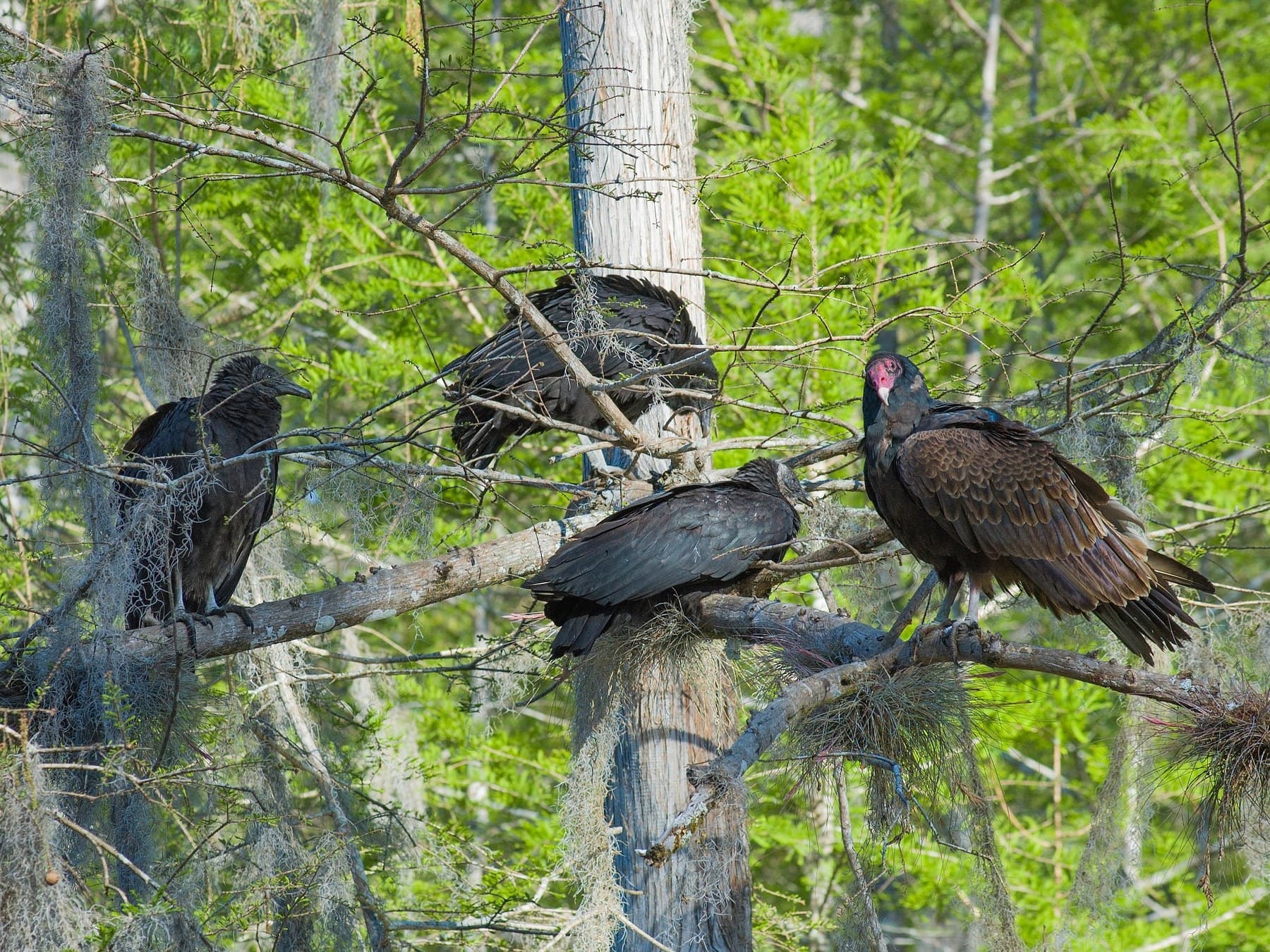
Not sure it’s a Turkey Vulture? Check your photo: Birdfact names the bird and shows the look-alike side by side.
Its size
Adults- Length
- 64–81 cm
- Wingspan
- 150–200 cm
- Weight
- 1430–2046 g
Its song and calls
Turkey Vultures have no song. They lack a syrinx, the voice box of other birds, and the muscles that work it, so they make only hisses and grunts.1 You are most likely to hear a guttural hiss when birds squabble at a carcass or jostle for space at a roost. Parents give soft grunts at the nest, and a short cough-like call as they arrive to feed their young.
Chicks are louder. From four to six days old they give a long wheezing hiss when disturbed, each lasting 3-7 seconds and repeated every few seconds; people have likened it to a snake's rattle or a rush of wind.1
Heard one and not sure? Let the bird song identifier listen.
When and where to see it
November
Leaving
The year across North America
Choose a place on the map to see its year, or find yours.
Most recorded in November
Up to 2.7% of a place’s bird records that monthHere in other months
How this map is made
Each county, state or province is shaded by the Turkey Vulture’s share of all the bird records there that month: the darker, the larger the share. A place with only a trace of records in a month is left unshaded. Shades compare places on this map with each other, not one bird with another. Records: GBIF eBird Observation Dataset, 2019–2024. Map: Natural Earth; place centres © OpenStreetMap contributors.
How often the Turkey Vulture turns up in the United States and Canada through the year, from birdwatchers' records.
United States
Resident · all year · most records in March
Canada
Summer visitor · all year · most records in April
Show as a table
| Month | United States | Canada |
|---|---|---|
| January | 1.2% (regular) | 0.073% (regular) |
| February | 1.3% (regular) | 0.10% (regular) |
| March | 1.7% (regular) | 0.77% (regular) |
| April | 1.6% (regular) | 1.4% (regular) |
| May | 1.2% (regular) | 0.98% (regular) |
| June | 1.3% (regular) | 0.85% (regular) |
| July | 1.3% (regular) | 0.93% (regular) |
| August | 1.4% (regular) | 0.96% (regular) |
| September | 1.5% (regular) | 1.2% (regular) |
| October | 1.4% (regular) | 0.88% (regular) |
| November | 1.2% (regular) | 0.15% (regular) |
| December | 1.1% (regular) | 0.090% (regular) |
Worldwide: recorded regularly in 32 countries
Countries where it was recorded in at least 3 of the 6 years 2019–2024. Linked countries have their own bird list.
North America (18)
- Bahamas
- Belize
- Canada
- Cayman Islands
- Costa Rica
- Cuba
- Dominican Republic
- El Salvador
- Guatemala
- Haiti
- Honduras
- Jamaica
- Mexico
- Nicaragua
- Panama
- Puerto Rico
- Trinidad & Tobago
- United States
Data: EOD – eBird Observation Dataset (Cornell Lab of Ornithology), accessed via GBIF.org, CC BY 4.0. Records from 2019–2024, aggregated and filtered by Birdfact. How these lists are made
The Turkey Vulture is the most widespread vulture in the Americas. It breeds across most of the Lower 48 states, though it is absent or very local in parts of the Great Plains and the interior Northwest, and into southern Canada from British Columbia to Nova Scotia, and south through Mexico and Central America to Tierra del Fuego. In winter it withdraws from the north to roughly the southern half of the US.
It uses almost every kind of country, from forest to desert, but is commonest where woods mix with pasture and open farmland. It avoids big row-crop areas and high mountains, and nests and roosts in woods, on cliffs and in old buildings.
The range has spread north since the 1920s. New York's second breeding bird atlas (2000-2005) found confirmed breeding in 330% more squares than the first (1980-85), and in the Maritime provinces the bird went from 7 atlas squares to 137.1
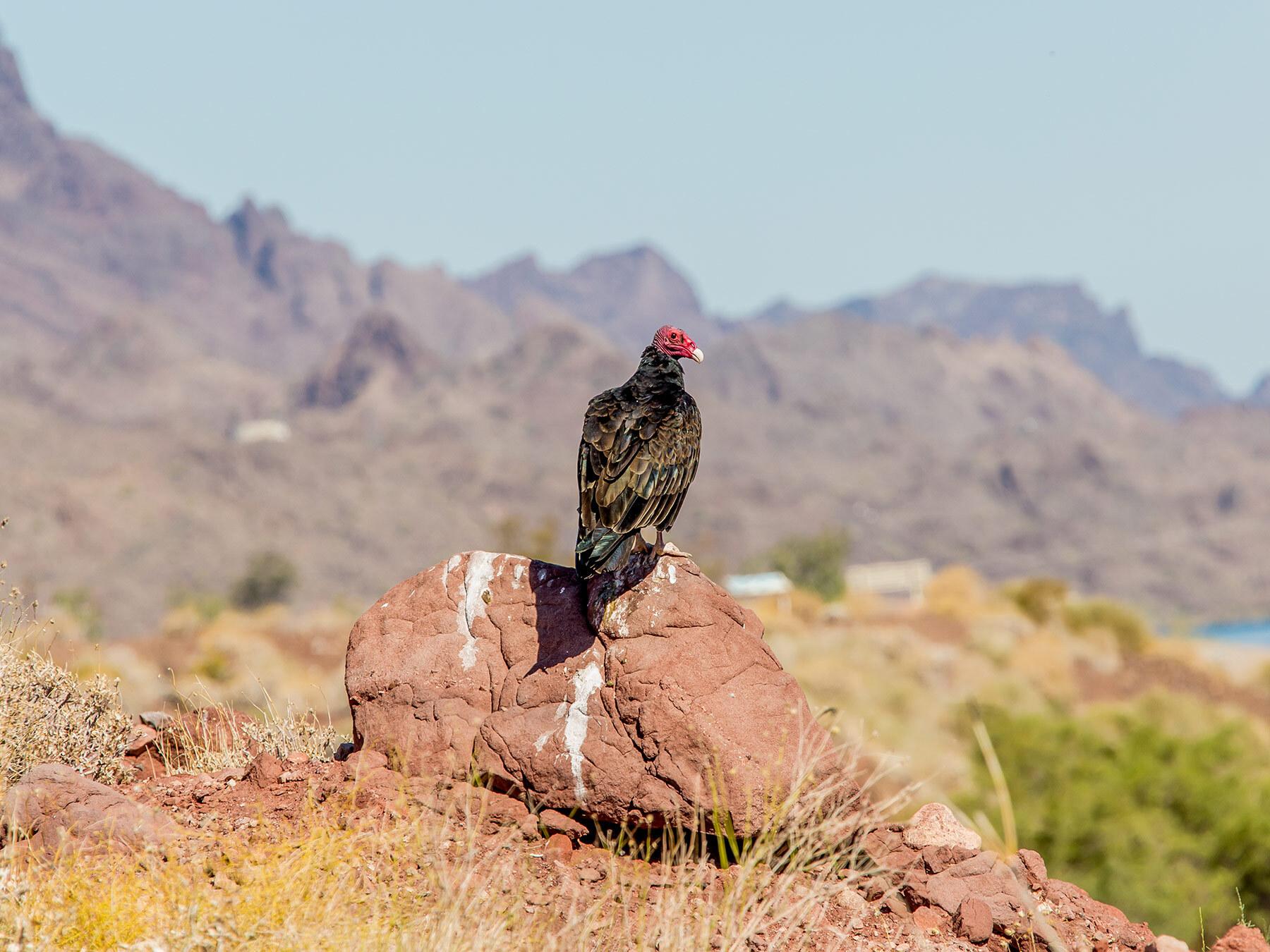
Do they migrate?
Some do. Turkey Vultures in Florida, along the Gulf Coast and in the Southeast and Southwest are largely resident, while birds from the north and west migrate, the first of them heading back north in late winter.
Northern breeders tend to winter farther south, a pattern called leapfrog migration. Satellite tracking of 24 birds found eastern ones making short trips, on average about 800 miles (1,287 km) south, while birds from the interior of North America flew about 4,500 miles (7,255 km) and western birds about 3,300 miles (5,300 km).3 Eastern birds winter mostly in the southeastern US, especially Florida; western birds winter in Mexico, Central America and South America, some as far as Colombia, Venezuela and beyond; one bird from Saskatchewan flew 3,737 miles (6,014 km) to the llanos of Venezuela.1
Northern birds seem to leave between late August and early November. Tracked birds from Ohio and Pennsylvania left on average around October 24, and western birds around October 4.1 They start back as early as February, reaching places such as southern Missouri, Pennsylvania and western Oregon in late February and arriving progressively farther north through March and early April.

How they migrate
Turkey Vultures migrate by day, soaring on thermals and updrafts and gliding from one to the next with barely a wingbeat. Because they avoid crossing big stretches of water, they funnel along ridges and coasts and through Mexico and Panama, where counts run into the millions: 2.2 million passed hawk counters at Veracruz, Mexico, in autumn 1997.1 Most climb several hundred yards on each thermal, but they can rise as high as 21,000 ft (6,400 m) above storms.1 Migrants crossing Central America seem to go without food: no one has seen them feeding, and no droppings or pellets are found under their night roosts in Panama.
Soaring seems to cost little energy: in one study the heart rate of a tagged bird rose only a little on days when it flew farther, and the longest straight-line distance any of its seven GPS-tagged birds covered in a day was 203 miles (327 km).4
Where they roost
Turkey Vultures sleep together at communal roosts all year, often with Black Vultures, in big trees (often conifers in winter), on cliffs, and more and more on towers and buildings. Most roosts hold fewer than 100 birds, but the largest, in Florida in winter, can hold thousands, and some roost sites are used for decades. In the morning the birds sit on dead trees, posts and towers to sun and preen, and leave to forage once the air starts to rise, an hour or more after sunrise.

Tips for seeing it
Look for a big dark bird soaring low with its wings held up in a shallow V and rocking from side to side, especially over roadsides and open country from mid-morning. In the early morning they sit on dead trees, posts and towers near their roosts, often with wings spread to the sun.
What it eats
Turkey Vultures eat carrion: dead animals of almost every kind, mostly mammals from mice and opossums to deer and livestock, but also birds, snakes and turtles, frogs, fish and insects. Road kill is a big part of the diet, and they eat a little plant food, such as rotting fruit and pumpkins. They prefer fairly fresh carcasses but cannot tear thick hide, so they often start at the eyes, mouth and other openings, or wait for a big carcass to soften.
Radio-tagged birds in southern Pennsylvania in 1983-84 fed on dead livestock 58% of the time, pigs most often, and on wild animals 42%, groundhogs most often.1

Finding food by smell
Unusually for a bird, the Turkey Vulture finds food by smell as well as by sight. In a study of three brains of each species, its olfactory bulbs, the brain's smell centers, were four times the size of a Black Vulture's, the largest of any bird measured, rivaled only by the Northern Fulmar's.5 Experiments and traps show it can find carcasses hidden under leaves or forest canopy, often approaching from downwind. In tropical forest on Barro Colorado Island, Panama, Turkey Vultures found 71 of 74 chicken carcasses within three days; they were slow to find freshly killed birds but quick to find day-old ones, and tended to reject rotten meat.6
How sensitive that sense is remains unsettled. Four captive birds tested in California reacted only to strong doses of three odors of decay, and the researchers doubted those were the cues wild vultures follow.7
Other vultures take advantage. Black Vultures, which find food by sight, often follow Turkey Vultures to a carcass and can then drive them off by sheer numbers.

Do they eat live animals?
Very rarely. A Turkey Vulture's feet are weak, and there are only a handful of records of wild birds taking live prey, such as a grouse chick, a fish and toadlets leaving a pond, and one bird in Ohio repeatedly attacked heron nestlings.1 Most reports of vultures attacking live animals, including newborn livestock, involve the Black Vulture.1
Nesting and breeding
Turkey Vultures build no nest. The female lays on bare ground, leaves, rotting wood or straw in a dark, sheltered spot: a cave, rock crevice or ledge, a hollow log, stump or tree, a dense thicket or brush pile, or an abandoned building such as a barn. The main need seems to be a place away from people. In the West most nests are in rock outcrops, while in the East thickets, outcrops and hollow logs and stumps are all used. Abandoned farm buildings have become more important in central Canada since 1980, helping the bird spread north.
Pairs may sit at the site for days or weeks before laying, and good sites are used for many years: one cave in Wisconsin held a nest in at least 14 of 19 years.1 In the southern US eggs can be laid from February but usually from mid-March, and later farther north, into May.

Eggs and young
The clutch is usually two eggs, sometimes one and rarely three: creamy white, blotched with reddish to chocolate brown. Both parents take turns incubating, in shifts that can last a day. Reported incubation periods run from 28 to 42 days, but carefully watched nests took 36-39 days in Saskatchewan and 37 days at a Missouri barn-loft nest camera.1
The chicks hatch a day or two apart in white down, with bare blackish faces. Both parents feed them by bringing up food. The young make their first flights at about 60-80 days old, stay around the nest for one to three weeks, still fed by their parents, and usually leave the area by about 12 weeks old; after that they depend on their parents only briefly. Pairs raise one brood a year.

Behaviour
A Turkey Vulture spends hours a day in the air, using very little energy. Its long wings and light body let it soar low over hills, trees and buildings on deflected wind, low enough to catch the smell of carrion, and it flaps mainly to take off, land or cross still air. It circles on thermals to gain height, which is why you so often see them turning in the sky: circling is how they climb.
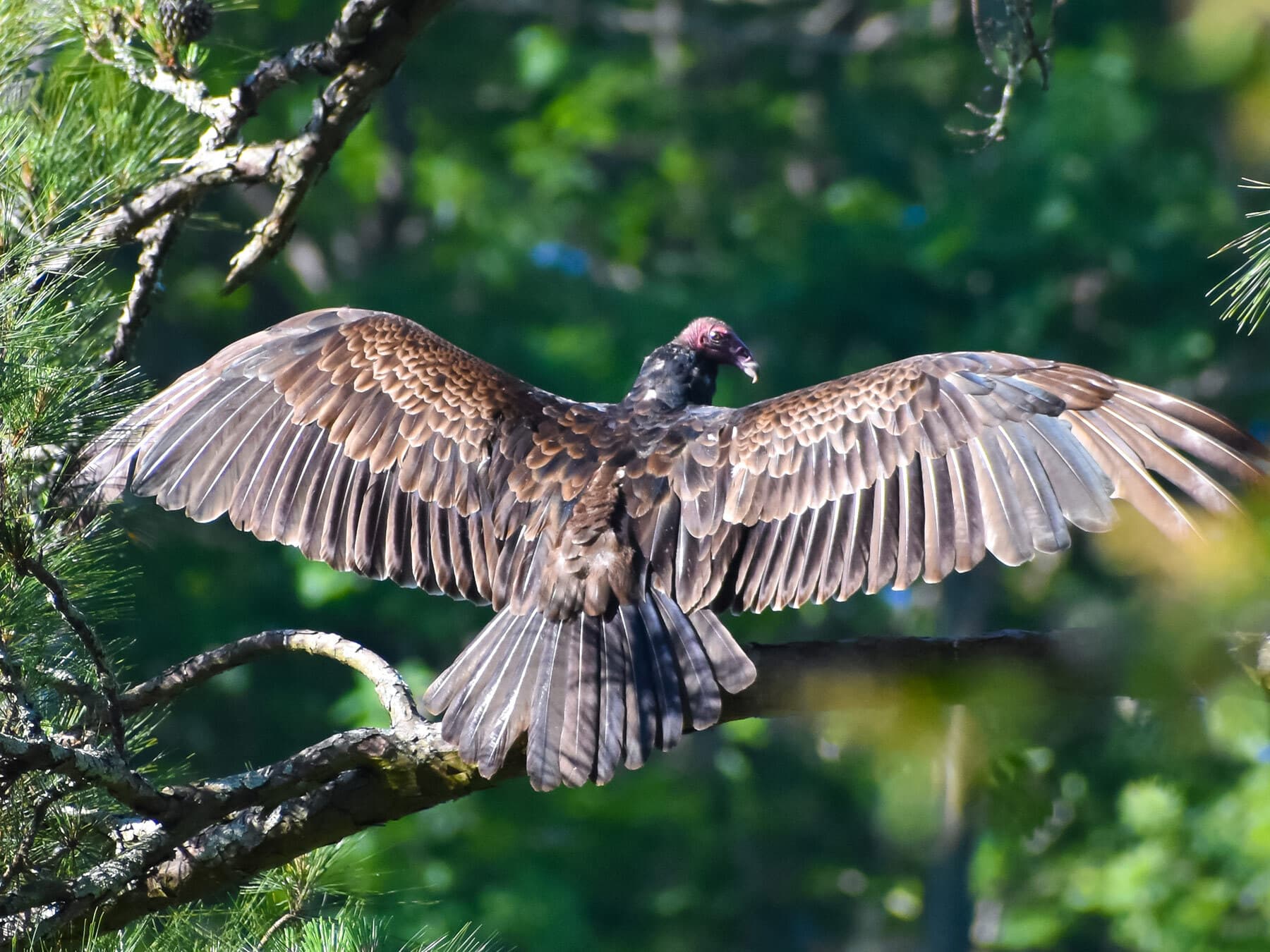
Spread-wing behavior
Turkey Vultures often stand with their wings held wide open, especially in the morning sun. The pose probably does different jobs at different times. At a roost in Arizona, birds spread their wings more as the morning sun grew stronger and more often when they were wet, which points to drying feathers and managing body heat.8
To cool off they also pant, stretch out their bare necks and excrete on their own legs, letting the liquid evaporate, a habit called urohidrosis. Wetting the legs cooled a hot bird in laboratory tests.9 In a test chamber where they could not stretch their necks, spread their wings or wet their legs, Turkey Vultures overheated above 104°F (40°C), probably for that reason.10
Defensive behavior
A Turkey Vulture's main defense is to vomit. A disturbed bird brings up its last meal, which smells even worse than the carrion it came from, and the lighter load may help it take off. Despite popular stories, the vomit just falls out; it is not aimed at anyone. Adults and chicks at the nest may also play dead, the color draining from the head. Turkey Vultures are not aggressive toward people.
Social behavior and pairing
Turkey Vultures are sociable at roosts and carcasses but forage alone or in small groups, and they defend their nest site, though there is little evidence of a wider territory. Pairs are believed to stay together for life, though there is no firm proof. In Wisconsin, marked breeders kept the same mate for up to five years in a row and took a new one only after the old one died or disappeared.1 In spring, pairs fly one behind the other in "follow flights", the trailing bird sometimes diving at the leader.
Lifespan and predators
Turkey Vultures can live a long time. The oldest on the USGS Bird Banding Laboratory's longevity list was at least 23 years and 4 months old: it was fitted with a marker as a full-grown bird in California in March 1997, and the marker was read on the living bird, still in California, in October 2019.11 The next oldest on the list, marked in Ohio in 1937, was found dead there in 1953, at least 16 years 10 months old.11
Grown birds survive well. Satellite-tracked adults from three North American populations survived 87% of years on average; the risk of dying rose with the density of roads, and was low in the western and central populations but 3.7 times greater in the eastern one.12 In human care, a Turkey Vulture has lived at the Lindsay Wildlife Experience in California since 1974, more than 48 years.1
Predators and other dangers
Adults have few natural predators. Bald and Golden Eagles rarely take one, and raccoons, foxes and other mammals are suspected of raiding nests. Known human causes of death include collisions with vehicles, lead poisoning, rodenticides, shooting and trapping. In California, of 23 birds found injured or dead in 2007-2009, 13 had hit something, mostly vehicles, five had lead poisoning and four rodenticide poisoning.1
Lead from bullet and shot fragments in carcasses is a widespread hazard. In California, 83 of 172 Turkey Vultures tested in 2008-2009 had raised lead levels in their blood, more of them during the deer-hunting season.13 At one site inside the California Condor's range, where a ban on lead ammunition began in 2008, the share fell from 23 of 38 birds before the ban to 3 of 33 a year after.14 At 94 wildlife rehabilitation centers in the US and Canada, 8% of Turkey Vultures admitted were suffering from lead poisoning, the fourth-highest rate of any species.1
DDT also left its mark. Eggs laid from 1947 on had shells 11% thinner in California, 12% in Florida and 18% in Texas than earlier ones; only the Texas thinning, from a small sample, was perhaps enough to affect breeding.15
Conservation
The Turkey Vulture is common and doing well over most of its range. The North American Breeding Bird Survey shows a rise of 1.4% a year from 1966 to 2025, a clear increase.16 The biggest gains were at the northern edge of the range, from the upper Midwest to New England and Canada; in Texas and Florida, where it was already common, numbers have changed little. The survey's index peaked in 2019 and has changed little over the last ten years.16
How many there are is hard to say, because vultures range widely and gather at roosts. Partners in Flight estimates about 28 million worldwide, 8.4 million of them in the US and Canada, figures that may be on the high side17, while a road-survey study across the Americas (2005-2018) came to about 13 million.1 It is rated Least Concern on the IUCN Red List.18
Conservation and the law
In the US the Turkey Vulture is protected under the Migratory Bird Treaty Act. Unless a regulation permits it, it is unlawful to kill, capture or possess one, or any part of one (a feather included), or its nest or eggs.19, 20 Federal protection dates from 1972, when an amendment to the 1936 treaty between the US and Mexico brought the New World vulture family under it.21 Anyone wanting to take one because of damage must first get a depredation permit of their own from the US Fish and Wildlife Service; no standing order covers vultures, and the statewide permits for protecting livestock from Black Vultures, formalized in 2026, do not cover Turkey Vultures.22, 23 In Canada, vultures are not covered by the federal Migratory Birds Convention Act and may be protected under provincial and territorial wildlife laws instead.24
It was not always so. Turkey Vultures were trapped, shot and poisoned as supposed carriers of livestock disease and killers of young animals, and in the first half of the 20th century Texas ranchers trapped and killed more than 100,000 vultures of the two species.1 Neither charge has held up for the Turkey Vulture: most attacks on newborn livestock are by Black Vultures.1
Conservation value: nature's clean-up crew
By clearing carcasses from fields and roadsides, vultures recycle what would otherwise rot. One recent estimate put the value of the waste Turkey Vultures remove at more than $700 million a year.1 In a summer experiment in South Carolina, 80% of rabbit carcasses kept away from Black and Turkey Vultures were not eaten by any other vertebrate, against 5% of those the vultures could reach.25
A Turkey Vulture's very acidic stomach destroys the active bacteria of anthrax and the hog cholera virus, and probably most other germs in carrion, and nothing suggests it has ever passed disease on to people or animals to any real extent. In vultures from Tennessee, the gut held few kinds of bacteria and the DNA of the carrion eaten was completely broken down in most birds.26 Unlike several Old World vultures, whose numbers crashed because of the veterinary drug diclofenac, it appears to tolerate that drug.1
Similar birds
Often mistaken for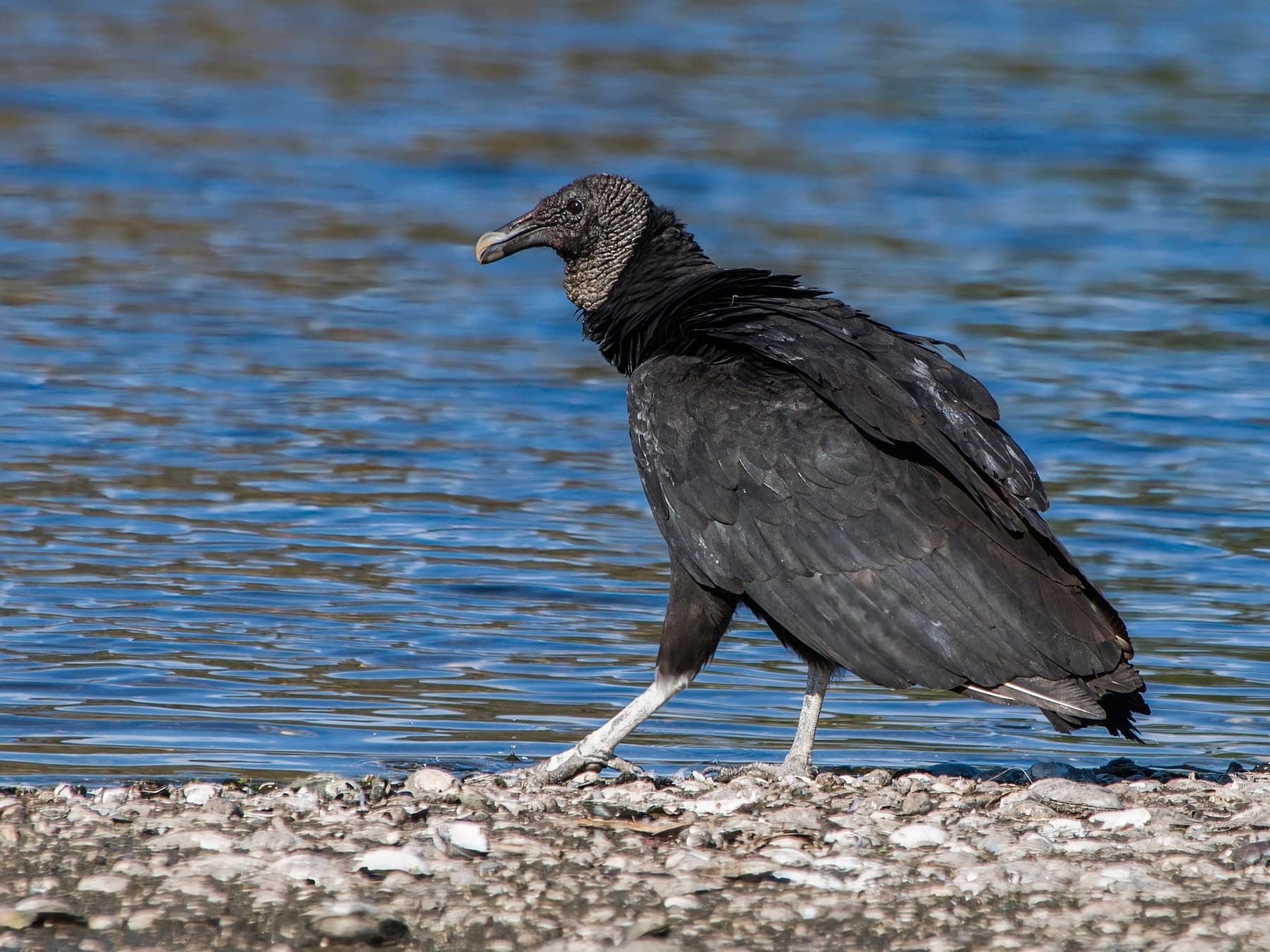
More photos
1 photos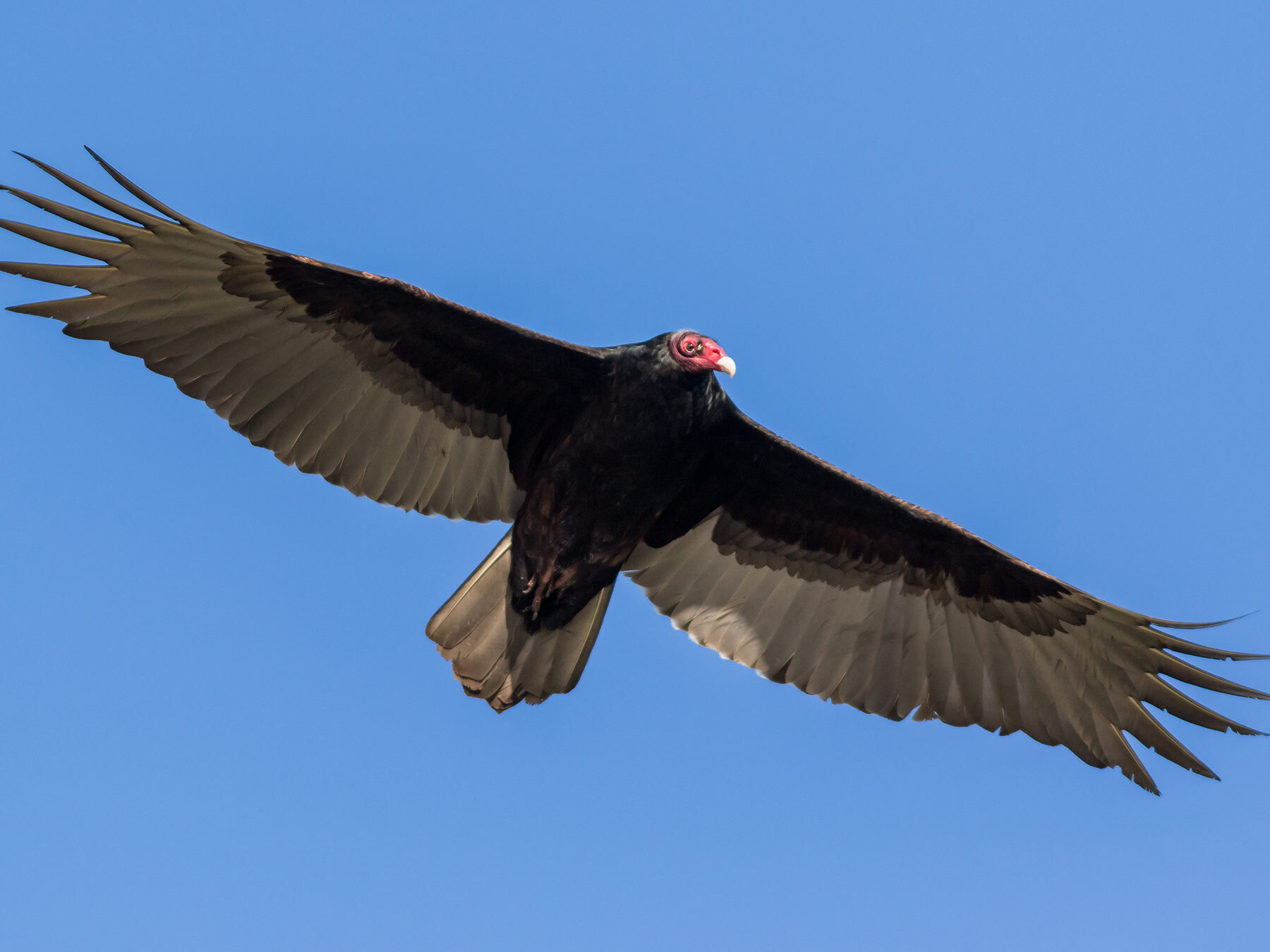
Turkey Vulture guides
3 guidesQuick facts
- Length
- 64–81 cm
- Wingspan
- 150–200 cm
- Weight
- 1430–2046 g
- Lifespan
- oldest recorded 23 years 4 months
- Family
- New World Vultures
- Migration
- Partial migrant
- Global status (IUCN)
- Least Concern
- World population
- About 13-28 million (road surveys; Partners in Flight)
- Population trend
- Common and increasing
- Also called
- Turkey Buzzard, Buzzard
- Scientific name
- Cathartes aura
Questions
4Are Turkey Vultures dangerous to people or pets?
No. Turkey Vultures are not aggressive toward people, even at the nest, and very rarely kill anything. Their feet are too weak to carry a heavy load, so they are not built to carry off a cat or a small dog; they feed on animals that are already dead.
Are Turkey Vultures birds of prey?
They were long grouped with the hawks, eagles and falcons, and look like them in the air, but the New World vultures are now often placed in an order of their own, Cathartiformes, as close relatives of the hawks and eagles. Unlike hawks, they have weak feet and do not hunt.
Why do Turkey Vultures have bald heads?
The bare head and loose skin of the neck let the bird stretch its head well out of its collar of feathers when it feeds, preens or gets hot, and bare skin helps it shed heat: a hot bird's head and legs seem to flush brighter red. The adult's red head may also be a signal to other vultures, brightening when it feeds.
How far can a Turkey Vulture smell?
No one knows. Claims that it can smell a small carcass from a mile or more away are guesswork, but experiments show it finds carcasses hidden under leaves and forest canopy, often flying low and coming in from downwind.
Sources
30- 1Kirk, D. A. et al. (2024). Turkey Vulture (Cathartes aura), version 2.0. Birds of the World (N. D. Sly, P. G. Rodewald and B. K. Keeney, editors). Cornell Lab of Ornithology. doi:10.2173/bow.turvul.02 (opens in a new tab)
- 2Buehler, D. A. (2022). Bald Eagle (Haliaeetus leucocephalus), version 2.0. Birds of the World (P. G. Rodewald and S. G. Mlodinow, editors). Cornell Lab of Ornithology. doi:10.2173/bow.baleag.02 (opens in a new tab)
- 3Dodge, S. et al. (2014). Environmental drivers of variability in the movement ecology of turkey vultures ( <i>Cathartes aura</i> ) in North and South America. Philosophical Transactions of the Royal Society B: Biological Sciences 369: 20130195. doi:10.1098/rstb.2013.0195 (opens in a new tab)
- 4Mandel, J. T., Bildstein, K. L., Bohrer, G. and Winkler, D. W. (2008). Movement ecology of migration in turkey vultures. Proceedings of the National Academy of Sciences 105: 19102-19107. doi:10.1073/pnas.0801789105 (opens in a new tab)
- 5Grigg, N. P. et al. (2017). Anatomical evidence for scent guided foraging in the turkey vulture. Scientific Reports 7: 17408. doi:10.1038/s41598-017-17794-0 (opens in a new tab)
- 6Houston, D. C. (1986). Scavenging Efficiency of Turkey Vultures in Tropical Forest. The Condor 88: 318-323. doi:10.2307/1368878 (opens in a new tab)
- 7Smith, S. A. and Paselk, R. A. (1986). Olfactory Sensitivity of the Turkey Vulture (Cathartes aura) to Three Carrion-associated Odorants. The Auk 103: 586-592. doi:10.1093/auk/103.3.586 (opens in a new tab)
- 8Clark, R. G. and Ohmart, R. D. (1985). Spread-Winged Posture of Turkey Vultures: Single or Multiple Function?. The Condor 87: 350-355. doi:10.2307/1367215 (opens in a new tab)
- 9Hatch, D. E. (1970). Energy Conserving and Heat Dissipating Mechanisms of the Turkey Vulture. The Auk 87: 111-124. doi:10.2307/4083662 (opens in a new tab)
- 10Arad, Z. and Bernstein, M. H. (1988). Temperature Regulation in Turkey Vultures. The Condor 90: 913-919. doi:10.2307/1368848 (opens in a new tab)
- 11USGS Bird Banding Laboratory. Longevity records of North American birds. USGS Eastern Ecological Science Center, Bird Banding Laboratory. Accessed 12 November 2026. Source (opens in a new tab)
- 13Kelly, T. R. and Johnson, C. K. (2011). Lead Exposure in Free-Flying Turkey Vultures Is Associated with Big Game Hunting in California. PLoS ONE 6: e15350. doi:10.1371/journal.pone.0015350 (opens in a new tab)
- 14Kelly, T. R. et al. (2011). Impact of the California Lead Ammunition Ban on Reducing Lead Exposure in Golden Eagles and Turkey Vultures. PLoS ONE 6: e17656. doi:10.1371/journal.pone.0017656 (opens in a new tab)
- 15Wilbur, S. R. (1978). Turkey Vulture eggshell thinning in California, Florida, and Texas. Wilson Bulletin 90: 642-643. Accessed 12 November 2026. Source (opens in a new tab)
- 16Hostetler, J. A. et al. (2026). The North American Breeding Bird Survey, Analysis Results 1966-2025. U.S. Geological Survey data release. doi:10.5066/P1OSNSFC (opens in a new tab)
- 17Partners in Flight (2024). Avian Conservation Assessment Database (version 2024.05.23, global). Bird Conservancy of the Rockies. Accessed 12 November 2026. Source (opens in a new tab)
- 18BirdLife International (2018). Cathartes aura. The IUCN Red List of Threatened Species 2018: e.T22697627A131941613. IUCN Red List. Accessed 12 November 2026. Source (opens in a new tab)
- 19United States Congress. 16 U.S. Code 703: Taking, killing, or possessing migratory birds unlawful (Migratory Bird Treaty Act). United States Code, 2023 Edition, via govinfo. Accessed 12 November 2026. Source (opens in a new tab)
- 20U.S. Fish and Wildlife Service. 50 CFR 10.13: List of Birds Protected by the Migratory Bird Treaty Act. Electronic Code of Federal Regulations. Accessed 12 November 2026. Source (opens in a new tab)
- 21U.S. Fish and Wildlife Service (1972). Protection provided to 32 additional families of birds in convention with Mexico. U.S. Department of the Interior news release, 23 April 1972. Accessed 12 November 2026. Source (opens in a new tab)
- 22U.S. Fish and Wildlife Service. 50 CFR 21.100: Depredation permits. Electronic Code of Federal Regulations. Accessed 12 November 2026. Source (opens in a new tab)
- 23U.S. Fish and Wildlife Service (2026). Migratory Bird Permit Memorandum MBPM-7-02: Black Vulture Livestock Protection Permitting Framework. U.S. Fish and Wildlife Service, Migratory Bird Program, 6 February 2026. Accessed 12 November 2026. Source (opens in a new tab)
- 24Environment and Climate Change Canada (2025). Birds protected in Canada. Government of Canada. Accessed 12 November 2026. Source (opens in a new tab)
- 25Hill, J. E. et al. (2018). Effects of vulture exclusion on carrion consumption by facultative scavengers. Ecology and Evolution 8: 2518-2526. doi:10.1002/ece3.3840 (opens in a new tab)
- 26Roggenbuck, M. et al. (2014). The microbiome of New World vultures. Nature Communications 5. doi:10.1038/ncomms6498 (opens in a new tab)
- 27Cornell Lab of Ornithology. Turkey Vulture. All About Birds. Accessed 12 November 2026. Source (opens in a new tab)
- 28National Audubon Society. Turkey Vulture. Guide to North American Birds. Accessed 12 November 2026. Source (opens in a new tab)
- 29AviList Core Team (2025). AviList: The Global Avian Checklist, v2025b. doi:10.2173/avilist.v2025b (opens in a new tab)
- 30Stager, K. E. (1964). The role of olfaction in food location by the turkey vulture (Cathartes aura). Contributions in science 81: 1-63. doi:10.5962/p.241029 (opens in a new tab)

Checked by
Nathan Cope, founder and editor
Nathan founded Birdfact and leads its writers and contributors in the UK, the US and Canada. He has watched and studied birds for more than ten years, and checks every article and species guide before it’s published.