
Atlantic Puffin
Puffin, Common Puffin · Fratercula arctica
By the Birdfact teamChecked by Nathan Cope
On this page13 sections
How to recognise it
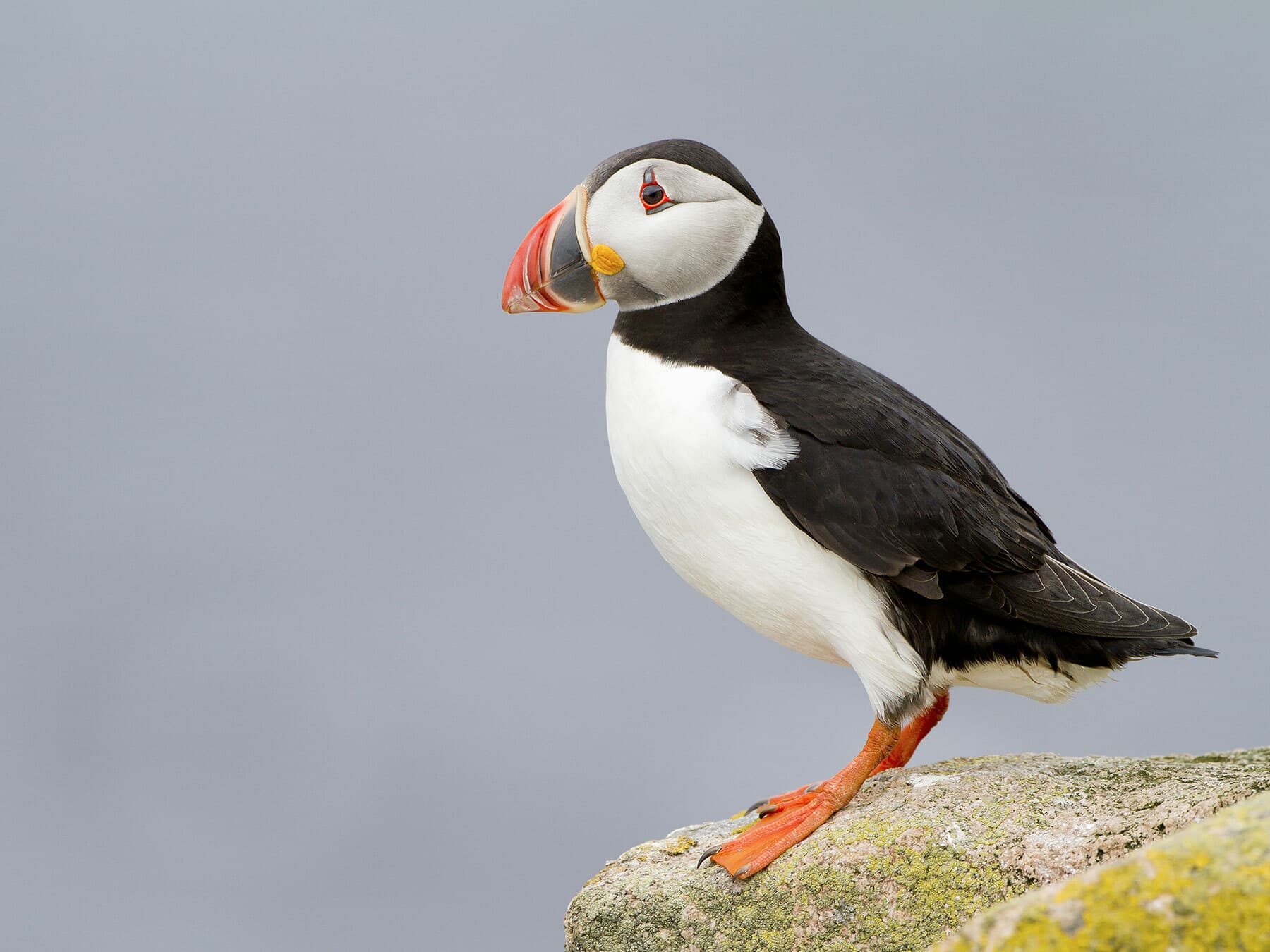
In summer a Puffin at its colony is easy to pick out: black above and white below, with a big, brightly coloured bill and orange legs. It stands on the turf of a cliff-top or island slope, and in the air it flies fast on rapidly beating wings.
The back and collar are black and the crown dark grey, against white underparts and a pale grey-white face with a thin dark line behind the eye. A red ring circles the eye, with a small blue-grey horny plate above it and another below. The bill is blue-grey at the base and scarlet at the tip, with a yellow band between, grooves across it and a yellow fleshy rosette at the corner of the mouth. The legs and feet are orange-red, and from below the underwing looks dark.
Appearance in winter
The famous bill is a summer outfit. After breeding, the bird sheds the bright outer plates of the bill and the horny pieces by the eye, leaving a smaller, shallower bill with a step in its depth at the base, dull brown with an orange-red tip. The face turns dark grey, with blackish lores (the patch between bill and eye), the rosette shrinks and the legs fade to orange-yellow, while the underparts stay white. Few people see this plumage, because in winter puffins are far out at sea.
Puffins also drop all their main flight feathers at once in winter and cannot fly until new ones grow, a flightless spell that falls between January and March. Loggers on four Skomer birds suggested that two of them, which made the longer migrations (over 2,000 km), replaced their flight feathers twice in one winter and spent as much as 77 days flightless in all, though the authors stress how small the sample was.1
Male, female and juvenile
Males and females look the same in every plumage. Males are slightly larger, with longer and deeper bills: in a sample from the Isle of May, males' bills averaged 46.5 mm long and females' 44.2 mm.2
Young birds in their first winter look like winter adults but smaller. Their bill is much smaller and dark grey-brown, turning reddish towards the tip, without full grooves; they are even darker around the eye, and their legs are duller and pinkish. The bill gains grooves with age, from a trace of one at a year old to two at four and sometimes more later, so they give a rough age, and after their fourth calendar year young birds are nearly impossible to tell from adults.
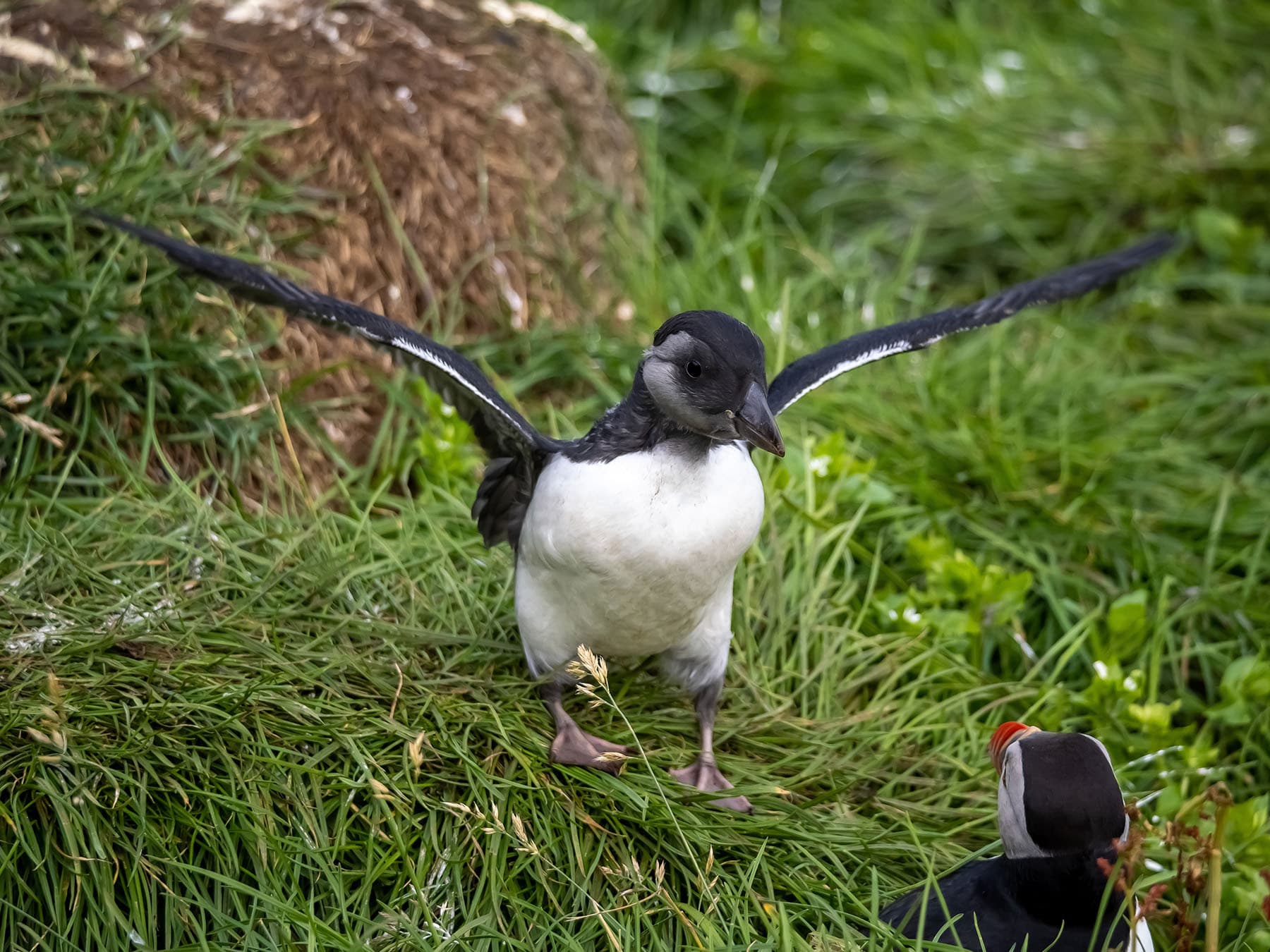
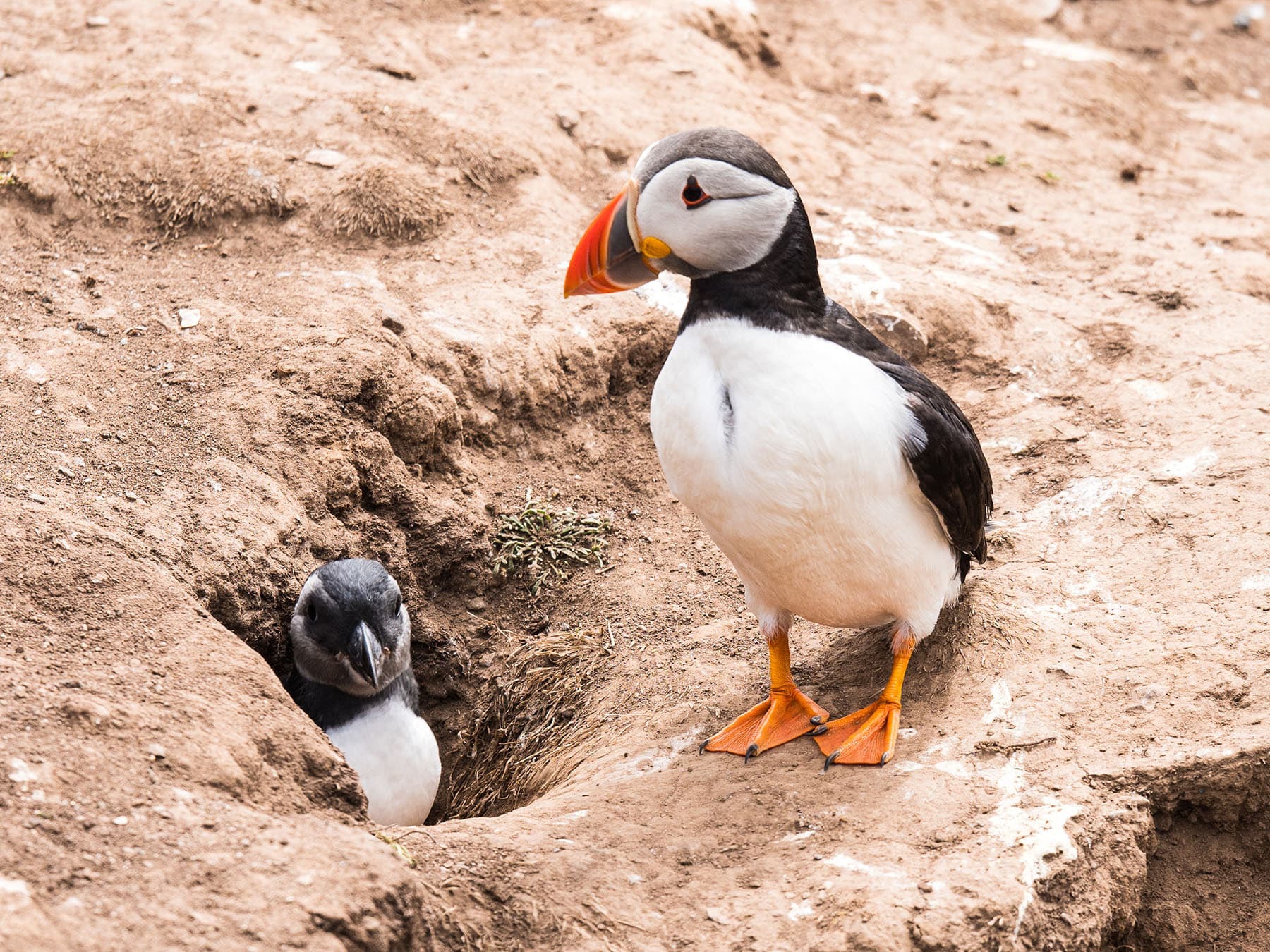
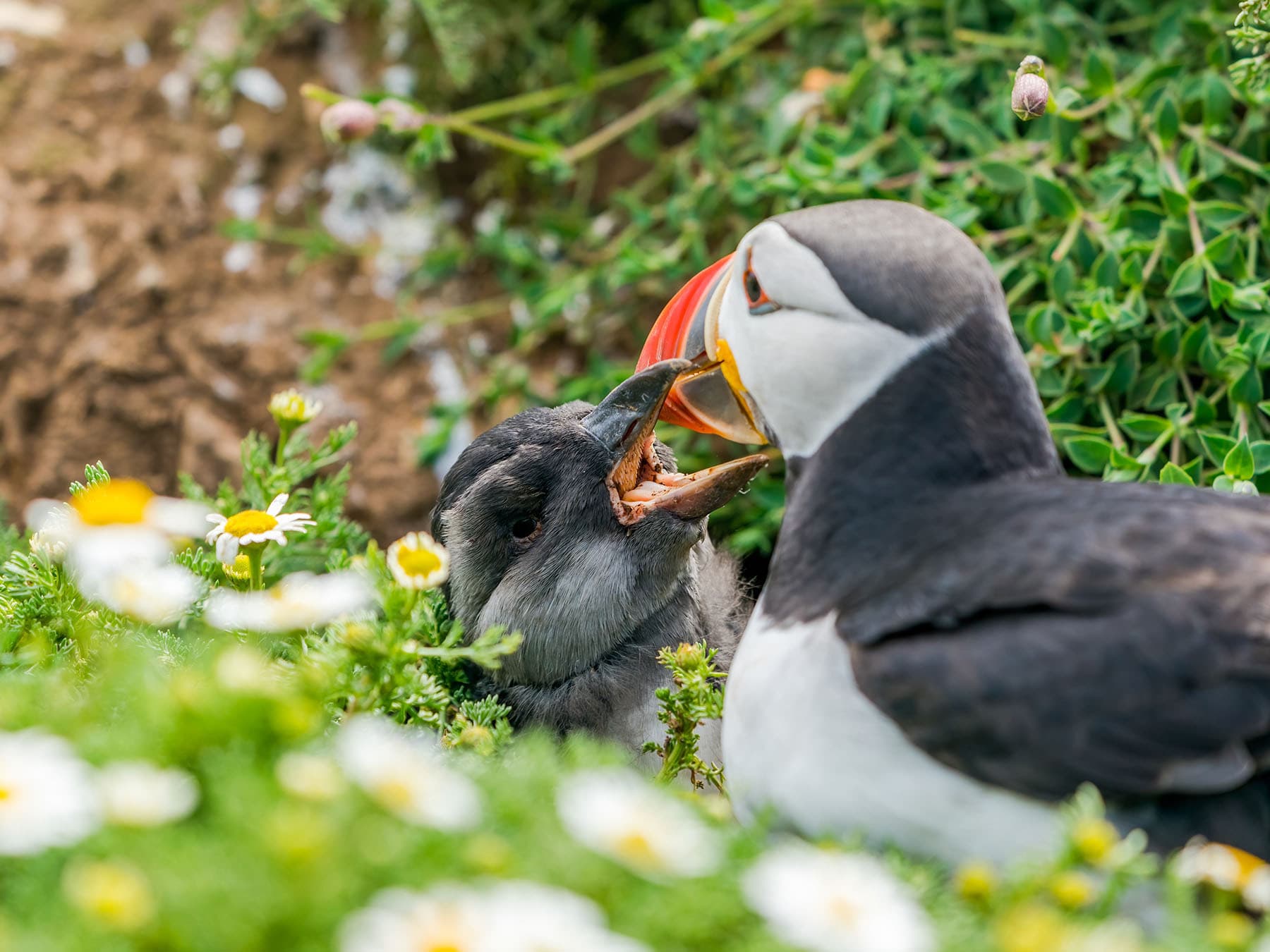
The chick, often called a puffling, is a ball of long, slaty-black down, white and shorter on the belly, with a stubby pale-tipped bill and black legs and feet. It loses the down between about 20 and 32 days old, the neck, rump and flanks last.
Size
A Puffin is 26-29 cm long, with a wingspan of 47-63 cm. Live adults weighed by ringers in Britain and Ireland average 386.9 g, and most of the 467 birds weighed 325-450 g.3 Puffins get bigger from south to north, at least on the European side of the Atlantic: British and Irish birds belong to the smallest race, and the largest live in the High Arctic.
Identifying it from similar birds
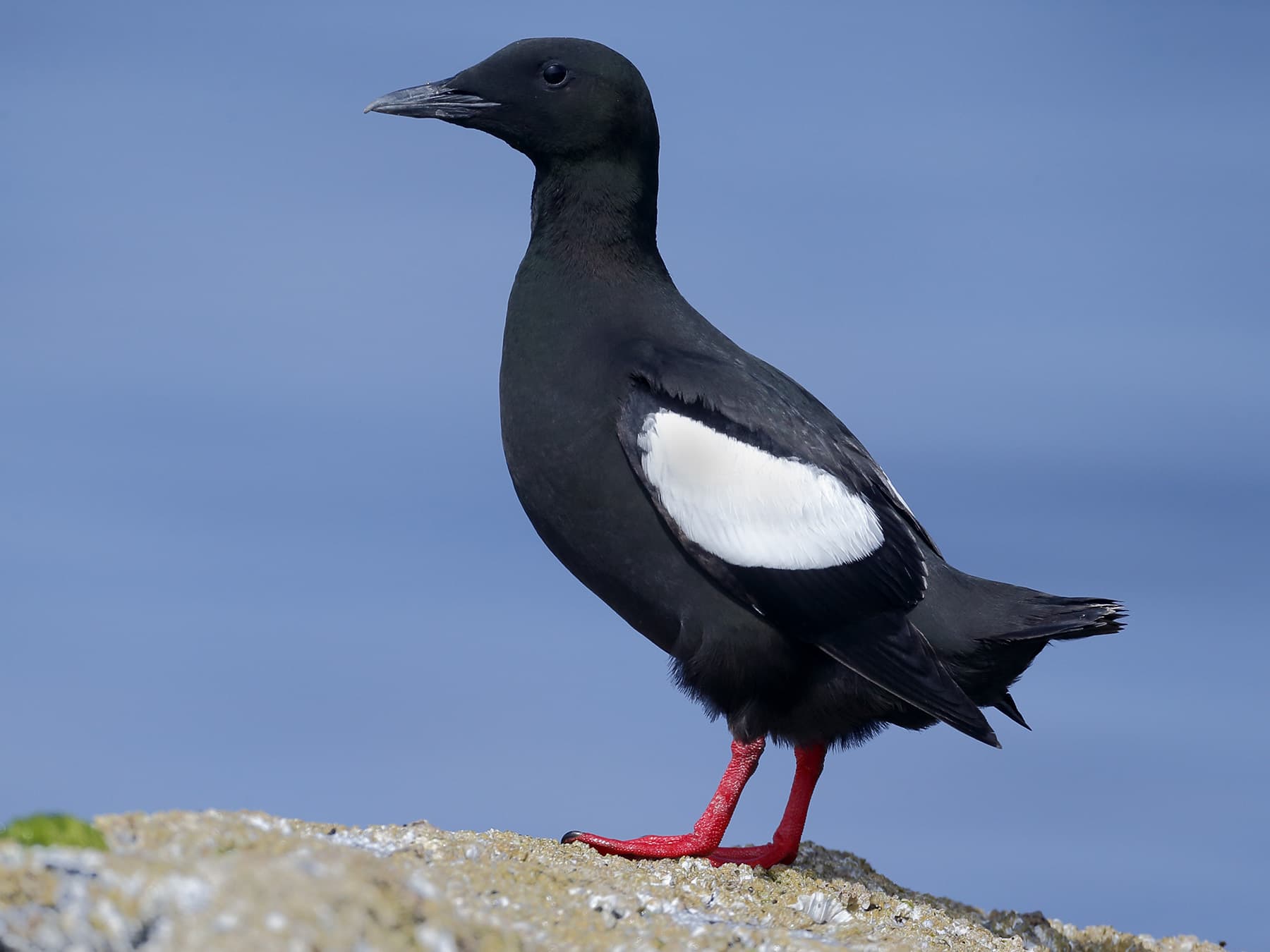
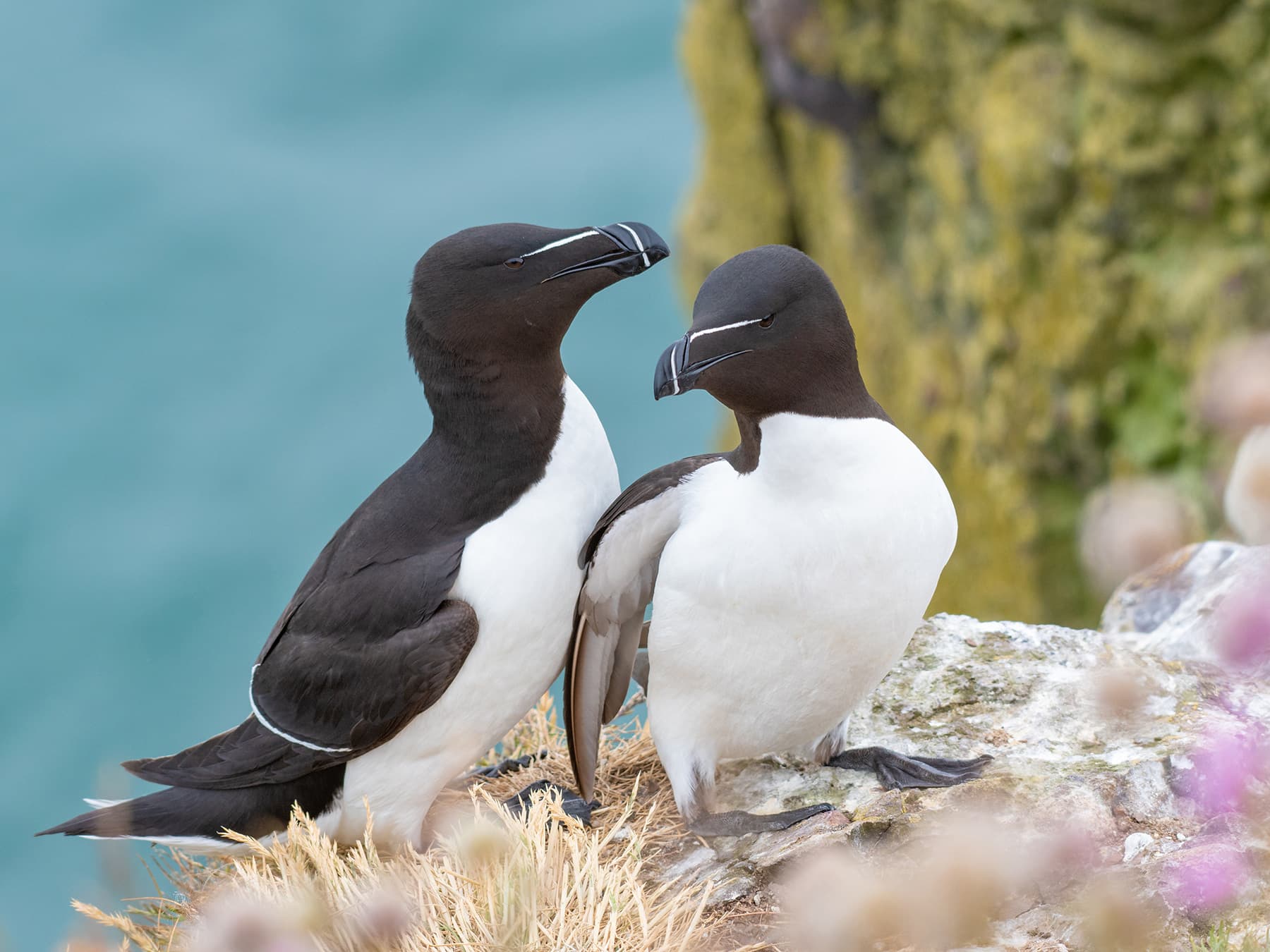
A young puffin seen at a distance can be taken for a young Razorbill, but it has a dark underwing, a greyer face and rounder wings. An adult Razorbill is bigger, with a deep black bill crossed by a white line, a white line from bill to eye in summer, black legs and white under the front of the wing. The Guillemot is much bigger and slimmer, browner above, with streaked flanks and a long, pointed, all-black bill. The Black Guillemot has a slim black bill, bright red legs and a big white patch on each wing, and in summer the rest of it is all black.
The two other puffins live only in the North Pacific. The Horned Puffin, its closest relative, has a bright yellow bill with a red tip and a small fleshy horn above each eye. The Tufted Puffin is dark below as well as above, with a white face, long golden head plumes and a mostly orange bill.
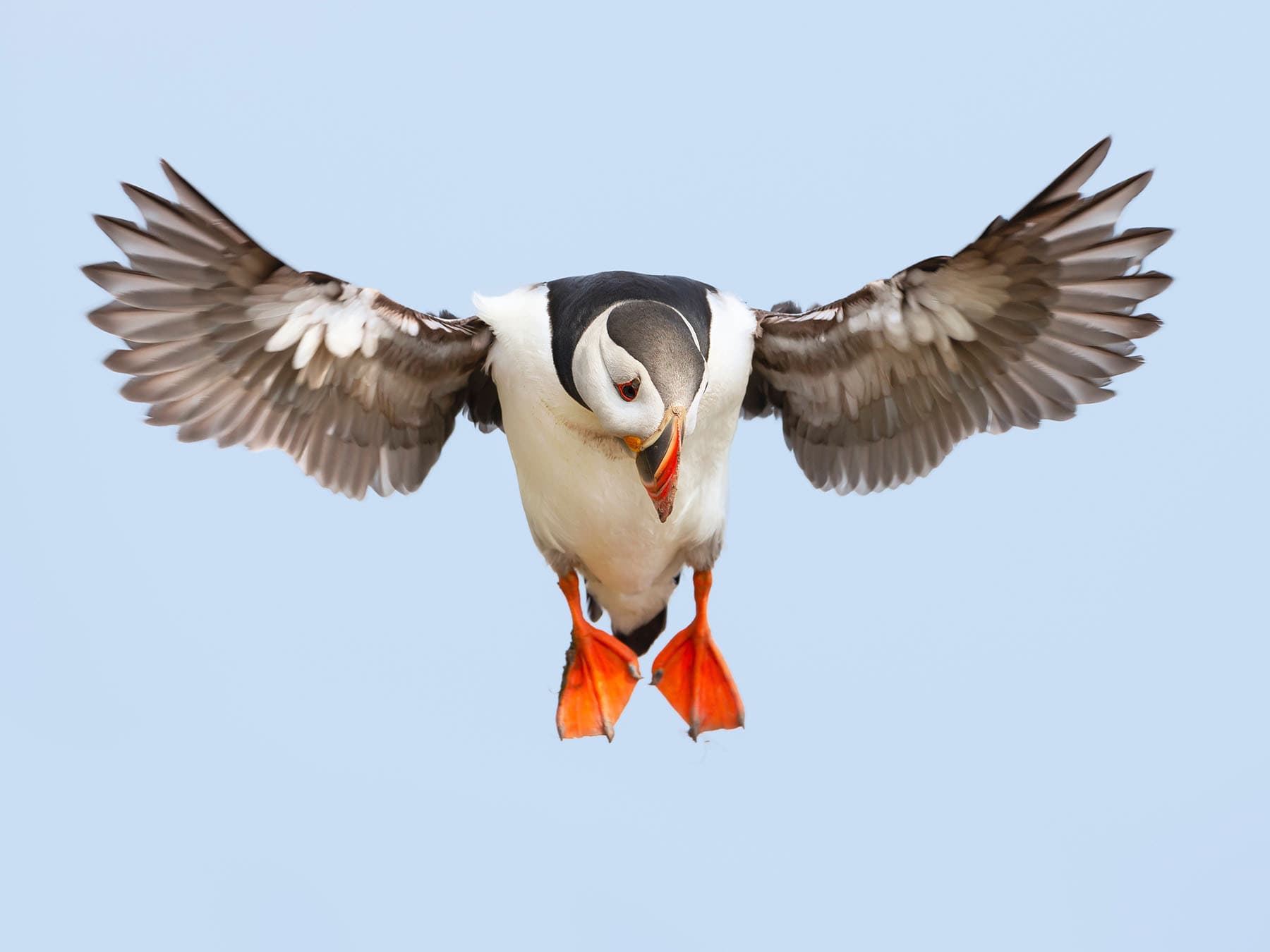
Not sure it’s a Atlantic Puffin? Check your photo: Birdfact names the bird and shows the look-alike side by side.
Its size
Adults- Length
- 26–29 cm
- Wingspan
- 47–63 cm
- Weight
- 325–450 g
Its song and calls
Away from the burrow, puffins are mostly silent, and the main handbook account records nothing of their calls at sea.2 The usual call is a slow, nasal, groaning moan that rises and then falls over a run of syllables. Both sexes give it, almost always from the burrow and most often early in the season: one bird calls at the entrance and its mate answers from inside.
In fights there is a deep growl, and a male flicking his head to attract a female gives a faint, pig-like grunt. A parent carrying fish into the burrow makes a clicking call, and in bill-gaping contests the birds give a faint creak. Chicks call "chip-chip-chip" when they are fed or expect food, and whine when hungry or handled.
- Calls at a colony0:00 / 1:04
Recorded in Skokholm Island, United Kingdom
Lawrence Shove / The British Library Board · Wikimedia Commons · CC BY-SA 4.0
- Call (heard, not seen)0:00 / 0:04
Recorded in United Kingdom · June 2023
Heard one and not sure? Let the bird song identifier listen.
When and where to see it
November
Arriving
The year across the UK and Ireland
Choose a place on the map to see its year, or find yours.
Most recorded in November
Up to 1.4% of a place’s bird records that monthHere in other monthsThe way its records moved since last month
How this map is made
Each county, state or province is shaded by the Atlantic Puffin’s share of all the bird records there that month: the darker, the larger the share. A place with only a trace of records in a month is left unshaded. The arrow follows the middle of the bird’s records from last month to this one, and the faint line its path through the year: it shows where the records move, not any one bird’s route. Shades compare places on this map with each other, not one bird with another. Records: GBIF eBird Observation Dataset, 2019–2024. Map: Natural Earth; place centres © OpenStreetMap contributors.
How often the Atlantic Puffin turns up in the UK, Ireland, the United States and Canada through the year, from birdwatchers' records.
United Kingdom
Summer visitor · regularly Mar–Nov · most records in June
Ireland
Summer visitor · regularly Apr–Oct · most records in July
United States
Summer visitor · regularly May–Mar · most records in July
Canada
Passage migrant · regularly Jun–Nov · most records in July
Show as a table
| Month | United Kingdom | Ireland | United States | Canada |
|---|---|---|---|---|
| January | 0.001% | 0.004% | 0.002% (regular) | <0.001% |
| February | 0.002% | 0.001% | 0.005% (regular) | <0.001% |
| March | 0.015% (regular) | 0.012% | 0.002% (regular) | <0.001% |
| April | 0.039% (regular) | 0.081% (regular) | <0.001% | <0.001% |
| May | 0.088% (regular) | 0.19% (regular) | 0.002% (regular) | 0.001% |
| June | 0.16% (regular) | 0.31% (regular) | 0.009% (regular) | 0.014% (regular) |
| July | 0.16% (regular) | 0.35% (regular) | 0.010% (regular) | 0.038% (regular) |
| August | 0.046% (regular) | 0.14% (regular) | 0.005% (regular) | 0.033% (regular) |
| September | 0.018% (regular) | 0.048% (regular) | 0.002% (regular) | 0.033% (regular) |
| October | 0.016% (regular) | 0.023% (regular) | <0.001% (regular) | 0.011% (regular) |
| November | 0.021% (regular) | 0.001% | <0.001% | 0.004% (regular) |
| December | 0.007% | 0.001% | <0.001% (regular) | 0.002% |
Recorded regularly in
Worldwide: recorded regularly in 23 countries
Countries where it was recorded in at least 3 of the 6 years 2019–2024. Linked countries have their own bird list.
Europe (19)
- Denmark
- Faroe Islands
- France
- Germany
- Gibraltar
- Guernsey
- Iceland
- Ireland
- Isle of Man
- Italy
- Jersey
- Netherlands
- Norway
- Portugal
- Russia
- Spain
- Svalbard & Jan Mayen
- Sweden
- United Kingdom
North America (4)
Data: EOD – eBird Observation Dataset (Cornell Lab of Ornithology), accessed via GBIF.org, CC BY 4.0. Records from 2019–2024, aggregated and filtered by Birdfact. How these lists are made
In Britain puffins return to their colonies from March, or from mid to late February on the east coast of Scotland, and leave quickly in August. For the rest of the year they are out at sea and rarely seen from land.
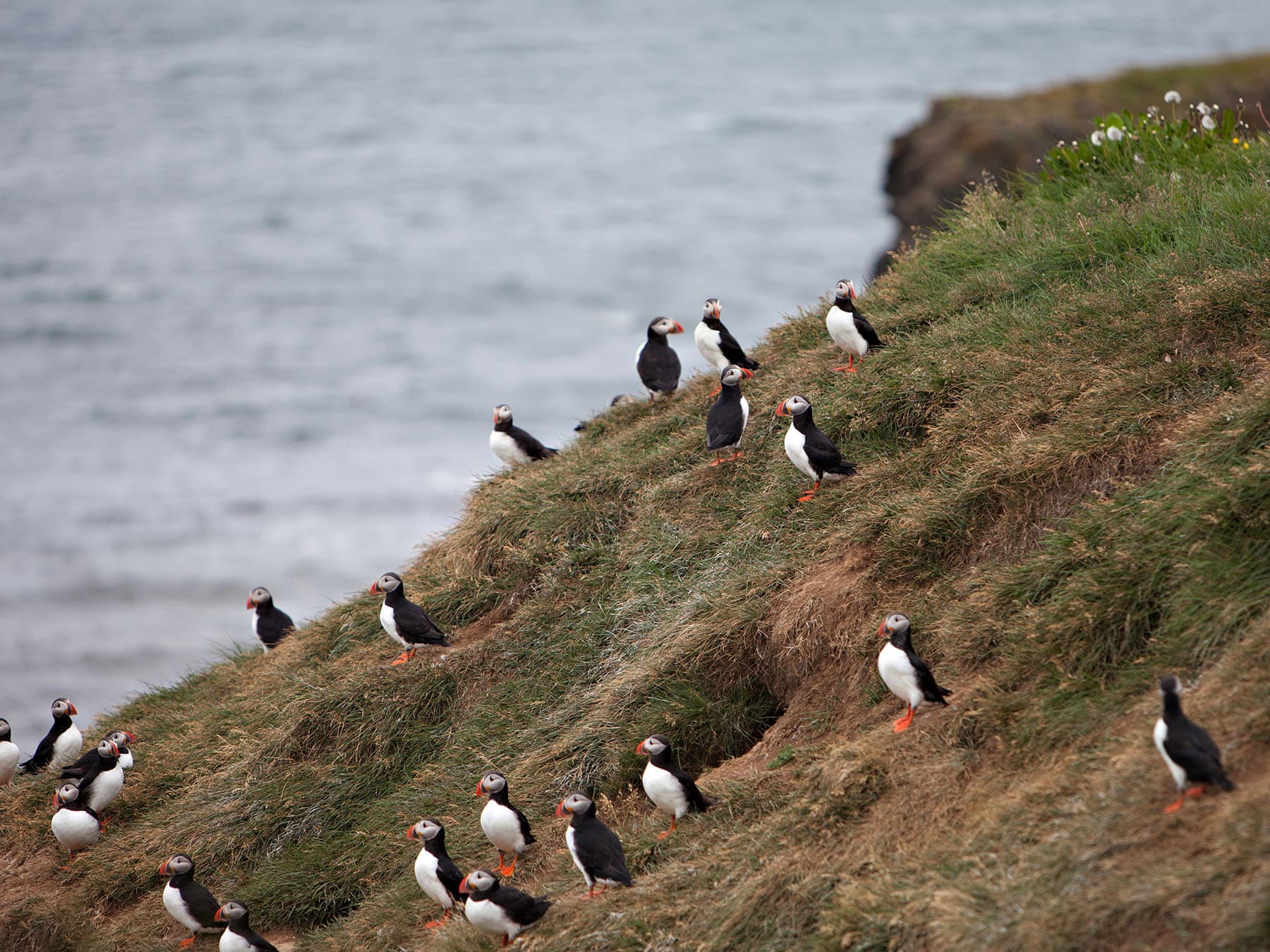
Most British and Irish puffins breed in the Northern Isles, on St Kilda, down the North Sea coast to Yorkshire, in south-west Wales and in western Ireland, and Scotland holds most of the UK population. It is the most localised of Britain's breeding auks, with more than half the UK population at ten or fewer sites.3, 4
Where to see them in Britain and Ireland
Places where puffins can be seen include Sumburgh Head, North Hill on Papa Westray, Hoy, Noup Cliffs, Dunnet Head, Troup Head, Fowlsheugh, the Mull of Galloway, Bempton Cliffs, South Stack and Rathlin Island.5 The 2015-21 census counted apparently occupied burrows. St Kilda is the largest colony in Britain and Ireland, with about 98,800 across its islands in 2018-19, 44,200 of them on Boreray and its stacs. The biggest single-site counts elsewhere were Sule Skerry (about 47,700, 2018), Eilean Mor in the Flannan Isles (about 47,700, 2021), the Farne Islands (about 43,800, 2019), Garbh Eilean in the Shiant Isles (about 41,800, 2015) and the Isle of May (39,200, 2017).6, 7 On Skomer, the 2024 whole-island count was 41,605 birds (a count of individuals, not burrows).7
In Ireland, where puffins are summer visitors from March to September, they nest mainly on the west coast, with a few east-coast sites. Great Saltee, the Cliffs of Moher and Horn Head are accessible, and the Skelligs hold one of the largest colonies.8
Range and habitat
Puffins are entirely marine. They breed on islands and coasts with turf slopes, cliff-tops, crevices and boulder fields, preferring offshore islands that are safe from mammals, and spend the rest of the year on the open sea, out to the edge of the continental shelf.
The breeding range runs round the North Atlantic from Brittany (50°N) to about 80°N: north-west France, Britain, Ireland, the Faroes, Iceland, Norway, Murmansk, Svalbard, Novaya Zemlya and Greenland, and in North America from Maine (43°N) to Nunavut. Iceland holds more Atlantic Puffins than any other country, about 2 million pairs in post-2000 estimates,2 and the other biggest populations are in Norway, Canada and the Faroes.7
In the UK, Bird Atlas 2007-11 found puffins in 161 of the 10-km squares in the breeding season and in 74 in winter. The breeding range shrank by 26.8% between 1968-72 and 2008-11, and the winter range by 53.4% between 1981-84 and 2007-11.3 Burrowing can also wear a colony away: on Grassholm, Wales, an estimated 250,000 birds in 1890 fell to two pairs by 1973 after the soil eroded and collapsed, and no breeding has been confirmed there since.7
Three weakly marked races are recognised, apparently told apart only by average size. British and Irish birds belong to the smallest, grabae, which is probably best merged with the northern race, arctica. A 2021 genome study of 72 puffins from 12 colonies found four genetic groups that do not match the three races, with Canadian birds and those from the Isle of May each forming a group of their own.9
Where do they go in winter?
British and Irish birds range across the North Atlantic and the North Sea, and a few reach the Mediterranean;7 ringing suggests the range extends over the eastern Atlantic as far south as north-west Africa.3 Birds from eastern Britain mostly stay in the North Sea, while Irish Sea birds and some from northern Britain head south to the Bay of Biscay. Young birds travel furthest, as far as Greenland and Newfoundland.2
Ringing records hold 842 reports from abroad of puffins ringed in Britain and Ireland, most from France (356) and Spain (107); one bird can be reported more than once.10 On Skomer, geolocators on 39 puffins, 30 of them tracked for two to six years, showed that each bird kept to its own type of winter route. Some stayed fairly local, some went out into the Atlantic, and 7 of the 39 reached the Mediterranean; only 1 of the 30 birds tracked over several years switched.11
Tips for seeing it
What it eats
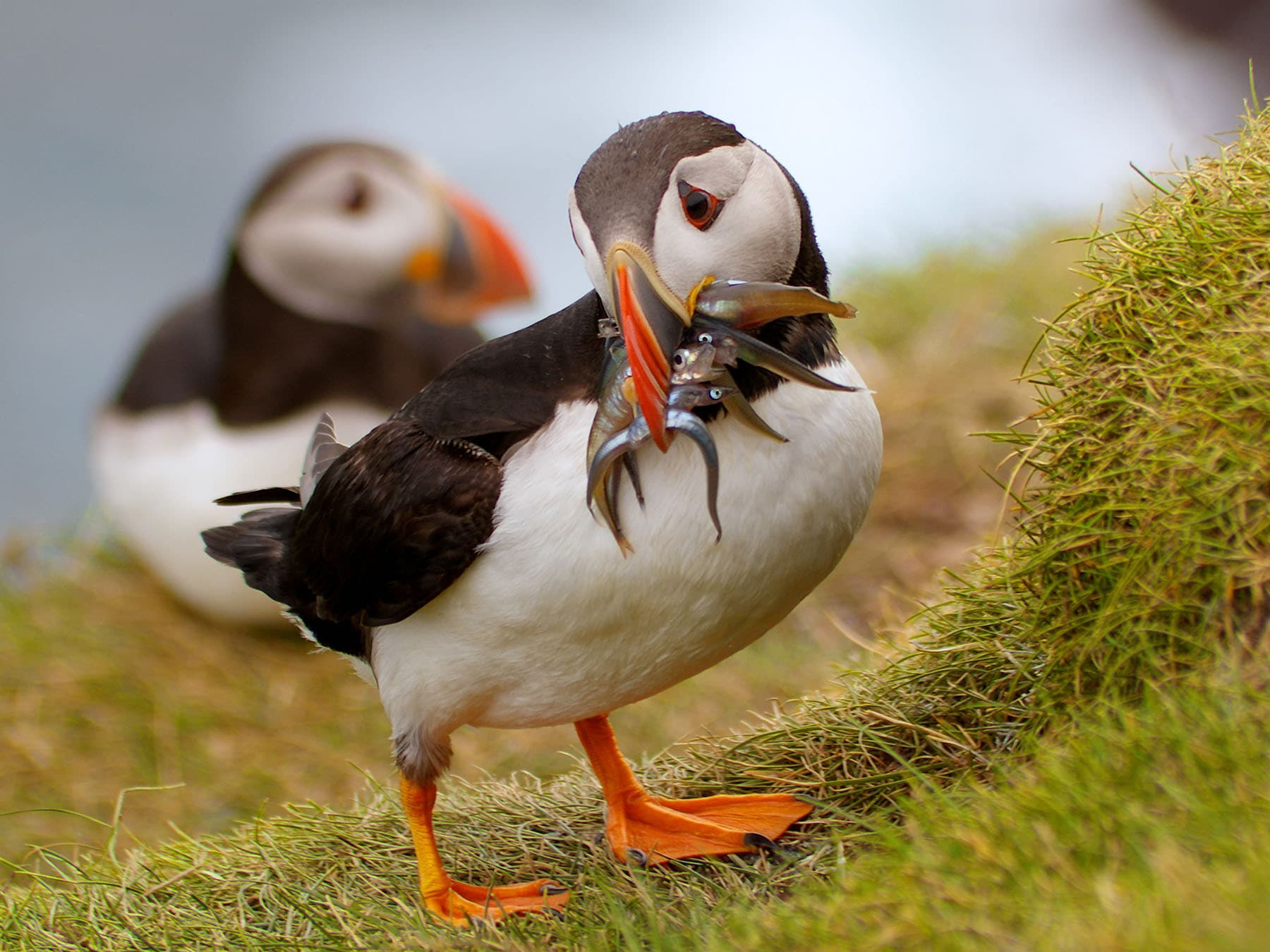
Puffins eat small fish that swim in shoals, mostly 5-15 cm long. In Britain the main ones are sandeels and sprats, with herring, young fish of the cod family and rocklings, and anything else is rare. Further north and west the main fish change: capelin off Newfoundland and northern Norway, and herring and hake in the Gulf of Maine. The adults' winter diet is poorly known.
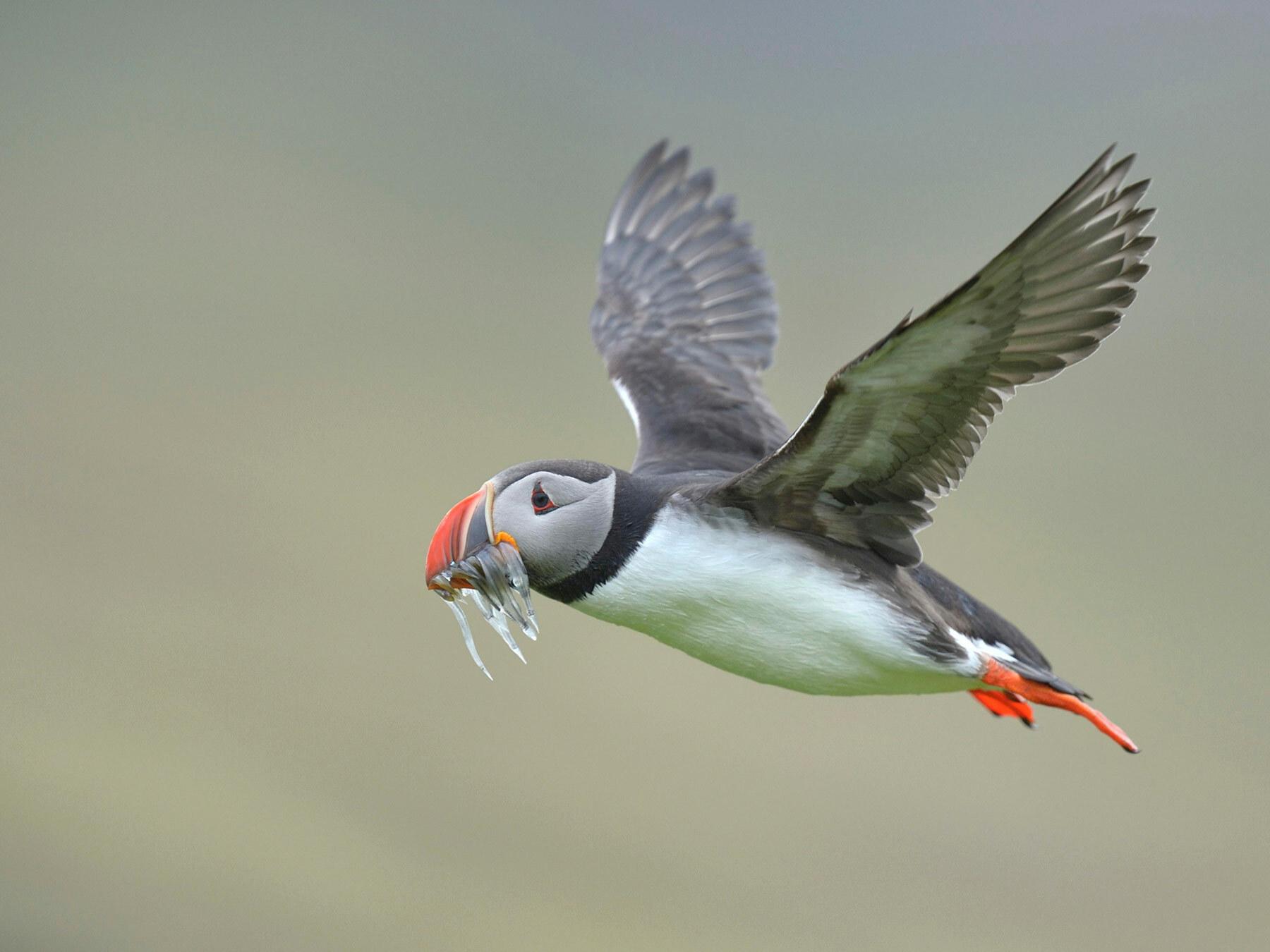
A puffin can catch several fish on one dive. It holds each one against the roof of its mouth with its tongue, both of which carry backward-pointing spines, while it chases the next. The popular idea that the fish end up with heads and tails alternating because the bird zig-zags through the shoal is wrong.
In older studies of chick diets, sandeels made up 79-100% by weight in 9 of 11 years on Shetland, and 85% of the fish brought to chicks on the Farne Islands, at 5-15 cm long. When breeding, a puffin usually feeds within 7-10 km of the colony, but at Røst in Norway birds travelled at least 137 km after the herring stock nearby crashed.2
Nesting and breeding
Puffins nest in burrows. A pair digs its own in turf with bill and feet, the male doing most of the work, or takes over a rabbit or Manx Shearwater burrow, or uses a rock crevice or a gap under boulders. Burrows are usually 70-110 cm long, with a nest chamber at the end and often a side tunnel used as a latrine. The egg is laid on a scrape, often lined with dry grass and feathers, and burrows are used again in later years, especially after a successful nest. More on burrows is on our page about puffin nests.
After first landing, pairs spend two to three weeks reclaiming, repairing or digging burrows. Most eggs in Britain are laid from mid-April to early June. In studies from the 1970s and 1980s, the main laying period was 18 April to 2 May on the Isle of May and 8 May to 4 June on St Kilda, and eggs were laid from late April to late May on Skomer.2
Breeding pairs and courtship
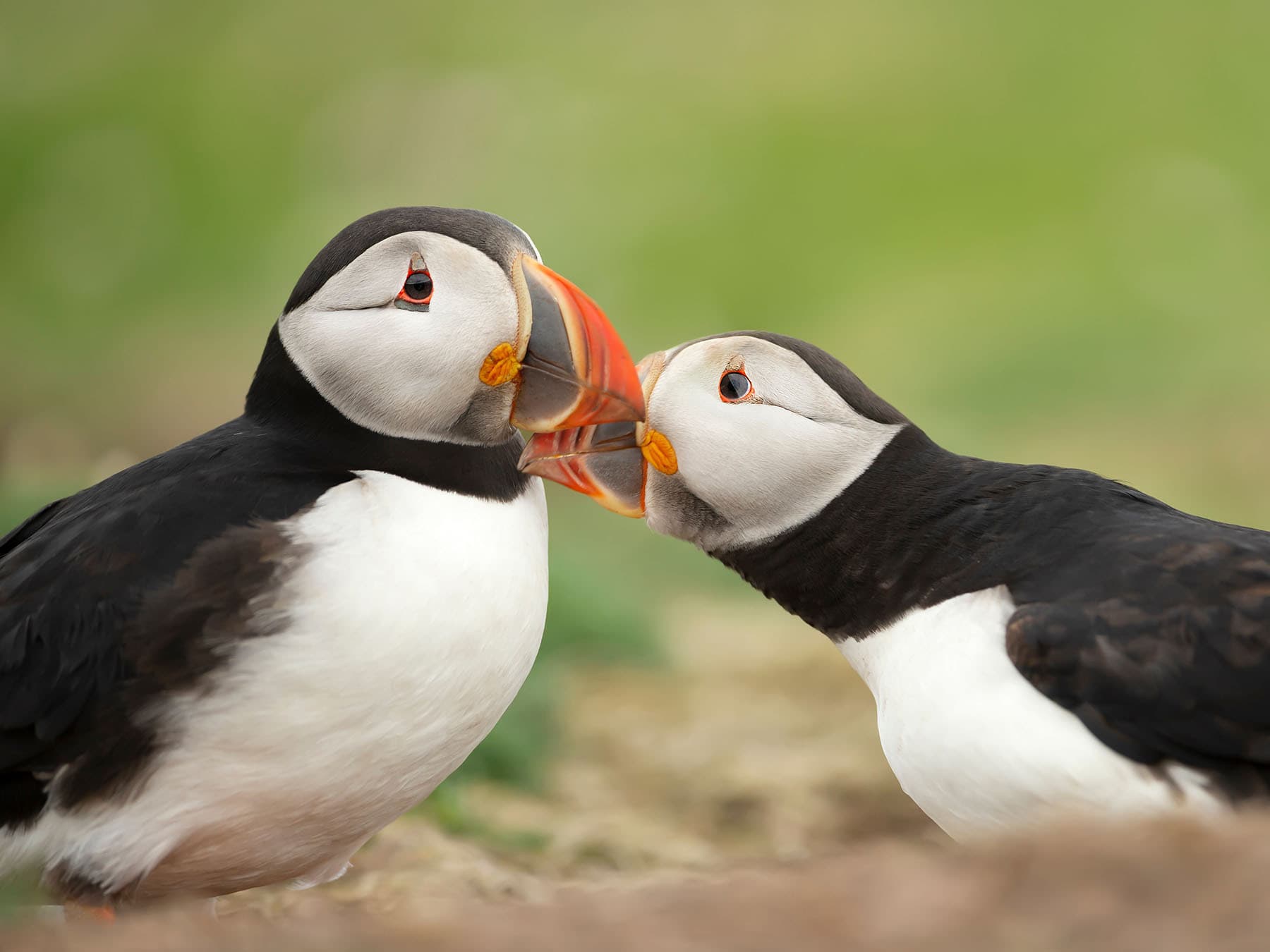
Puffins are monogamous, and most pairs re-form each year: on Skomer, pairs re-formed in 131 of 142 pair-years.2 The main handbook account records nothing of pairs outside the breeding season. Experienced pairs court and mate on the sea, so they may arrive at the colony almost ready to lay. Pairs knock their bills together, known as billing. There is more on pair bonds on our page do puffins mate for life?
Puffins usually breed for the first time at four or five years old, five being typical, sometimes at three and often later, and then breed every year.2, 3 Before then young birds visit the colonies. One-year-olds are rare and stay on the rocks, two-year-olds peer into burrows, and three-year-olds defend burrows but are usually soon evicted. Most young return to breed close to where they hatched, but on the Isle of May 9 of 39 recruits came from other colonies.2
Eggs and young
Each pair lays a single egg, dull white and sometimes faintly spotted, and raises one brood a year. Isle of May eggs average 61.5 x 42.8 mm and weigh about 62 g fresh. A lost egg is sometimes replaced: on Skomer, 7 of 75 failed eggs were followed by a second about two weeks later.2
Incubation takes about five to six weeks, 39 days on average on Skomer (36-43). The main sources differ on who does it: Birds of the World says both parents incubate, with males doing more (40 of 65 incubating birds of known sex were male), while the BTO gives the female, occasionally the male.2, 3
The chick hatches downy and stays in the burrow, and both parents bring it fish. On Skomer, chicks were fed about 2.5 times a day when 0-4 days old and about 9.5 times a day at 24-28 days, dropping to under twice a day just before fledging. Chicks reach a peak of 70-80% of adult weight at 28-30 days, then lose a little before they leave.2
The young puffin typically leaves the burrow at night and goes straight out to sea at about 38-44 days old, independent of its parents from then on. Mean nestling periods were 38 days on Skomer, 41 on the Isle of May and 44 on St Kilda, and most young leave through July and early August.2 There is more on chicks on our page about baby puffins.
UK breeding success dropped from the mid-1990s, bottomed out in 2007 and then rose overall until 2021; in 2024 it was 0.56 chicks per pair across eight monitored sites.7
Behaviour
Puffins both fly and dive well. In the air they are fast, at about 300-400 wingbeats a minute and 77-82 km/h. Underwater they swim with their wings and steer with their feet, and dives usually last 20-30 seconds, rarely up to a minute. On land a puffin walks with a rolling gait.
It feeds within 70 m of the surface, usually much shallower. Ten birds off Newfoundland reached maximum depths of about 40-68 m, and of 171 puffins drowned in gill-nets, 144 were caught at 1-10 m and none deeper than 60 m.2 Depth tags on puffins from Skellig Michael, County Kerry, recorded dives to about 60 m at most in 2021 and about 40 m in 2023.12
Behaviour
Puffins breed in colonies and often feed in small groups of two to seven. Numbers at a colony change from day to day: on some days few birds are there, on others masses appear. They roost mostly at sea, sometimes on land at the edge of the colony.
Over the colony they fly in great wheeling circuits. In one British study, over half the birds caught in these flights were immatures or non-breeders (56 of 101), against 3 of 137 caught flying to or from burrows.2 Owners strut and stamp at their burrows, and fights at the burrow can send two locked rivals tumbling down the slope.
Lifespan and predators
Puffins are long-lived. For a puffin that reaches breeding age, the BTO gives a typical life expectancy of 18 years, and an adult survival rate of 0.924 a year.3 On Skomer, several decades of ringing show adults surviving the winter at a rate of 0.918 on average, lowest in the storm winter of 2013/14 and lower in winters with warmer seas; the authors tentatively suggest that long, frequent storms hit auks hardest.13
The oldest puffin on the BTO's longevity list for Britain and Ireland was ringed as an adult on Skomer on 26 June 1977. It was seen alive there, its colour rings read, on 17 July 2019: 42 years 21 days after ringing, so it was older than that.14 The European list of ringing records has an Icelandic-ringed puffin at the top, at 45 years 0 months; it counts age from the likely hatching year, which for a bird ringed full-grown is a minimum.15
Predators
Great Black-backed Gulls are the main predator of adults at colonies. Herring and Lesser Black-backed Gulls and Great Skuas take them less often, and Peregrines, Gyrfalcons and, occasionally, buzzards, eagles, owls and Common Ravens have also been recorded. Foxes, otters, mink and cats will take adults where they can reach a colony, and introduced foxes, mink and rats have cut or wiped out colonies. Birds of the World knows of only one report of a predator at sea, an anglerfish.
Large gulls and Arctic Skuas also chase puffins carrying fish and take what they drop, which can cut the food reaching the chicks. On the Isle of May, Great Black-backed Gulls killed an estimated 1,120 puffins in 2017; a population model found this was not enough to cause a decline, and about 3,000 a year would be needed.16 Rats have been implicated in declines at several British colonies, and after rats were removed from Lundy in 2004, puffin numbers there rose quickly.7
Conservation
The Puffin is Red-listed in the UK's fifth Birds of Conservation Concern review (2021) and again in its 2024 seabird addendum, because of its global threat status, its threat status in Europe and its concentration at few sites (the 2021 review also cited a moderate decline in breeding range). It was Amber-listed in 1996, 2002 and 2009 and moved to Red in 2015.4, 17
Worldwide it is Vulnerable on the IUCN Red List; it was not considered of concern until it was listed as Vulnerable in 2015.18, 2 It is Endangered on the 2021 European Red List, and Red-listed in Birds of Conservation Concern in Ireland 2020-2026.19, 20 On Great Britain's own Red List, the 2024 addendum moved it from Least Concern to Critically Endangered. That rating rests on models that projected a large future fall under climate change, not on a count, and the authors note that many of the predictions were highly uncertain.17
Population trends
About 580,000 pairs bred in the UK at the Seabird 2000 census (1998-2002), the latest complete UK total we found.21 Britain and Ireland hold about 8% of the world's and 9% of Europe's breeding puffins.7
Too few colonies are monitored each year for a valid annual UK index, so the trend comes from censuses. The 2015-21 Seabirds Count census found 24% fewer apparently occupied burrows than Seabird 2000 at the 185 sites counted the same way in both, from 332,805 to 254,162, at sites spread across the Channel Islands, the Isle of Man, Britain and Ireland. These are comparable sites, not complete counts.6, 7 Before that, UK numbers had risen by 37% from 1969-70 to Seabird 2000, for reasons not known, followed by large falls at the Farne Islands and the Isle of May between 2003 and 2008/09.3 The 2024 seabird addendum describes the UK breeding population as currently in decline.17
BirdLife's 2021 European Red List gives 7.4-8.24 million mature individuals in Europe, decreasing.19 Its 2015 assessment, reported in Birds of the World, calculated that the European population was declining by 50-79% over three generations (65 years), mostly because of recent falls in Iceland and Norway, which together hold about 80% of Europe's puffins.2
Causes of population change
Less food in the breeding season is thought to have contributed to declines at a number of colonies. Rising sea temperatures affect sandeels, and when prey is short, parents forage further and fewer chicks fledge; it is likely that UK colonies are affected by sea temperatures changed by climate change. Food shortage and burrows flooded by heavy rain were both implicated in low breeding success in 1998-2013, and winter storms may also be affecting numbers.3, 7
A one-year comparison of four colonies found that puffins at declining colonies, in southern Iceland and north-west Norway, foraged much further and fed their chicks less often than those at stable colonies in northern Iceland and Wales. The authors suggest this is presumably because fish are scarce near the declining colonies.22 The RSPB reports that a UK ban on industrial sandeel fishing in Scottish waters and the English part of the North Sea came in during 2024, and that the EU challenged it.5
Other threats named include offshore wind farms, a potential threat through displacement or barrier effects, oil spills, fishing nets and plastic.7 A 1994 study found elastic in about 10% of North Sea puffins.2 In 2022, tests on 25 dead puffins confirmed bird flu (HPAI) in six, and its effect on puffins is unknown.7 In 2023, 16 of 44 puffins tested on the Isle of May had antibodies, a sign of past exposure.23
Legal status
Like all wild birds, the Puffin is protected by law. In Great Britain and Northern Ireland it is an offence to intentionally kill, injure or take one, to take, damage or destroy a nest in use or being built, or to take or destroy its eggs, and in Scotland and Northern Ireland acting recklessly is an offence too. It is not on Schedule 1 in Great Britain, but in Northern Ireland it is a Schedule 1 Part I bird, protected by special penalties at all times.24, 25 In the Republic of Ireland it is a protected wild bird under the Wildlife Act 1976.26
Similar birds
Often mistaken for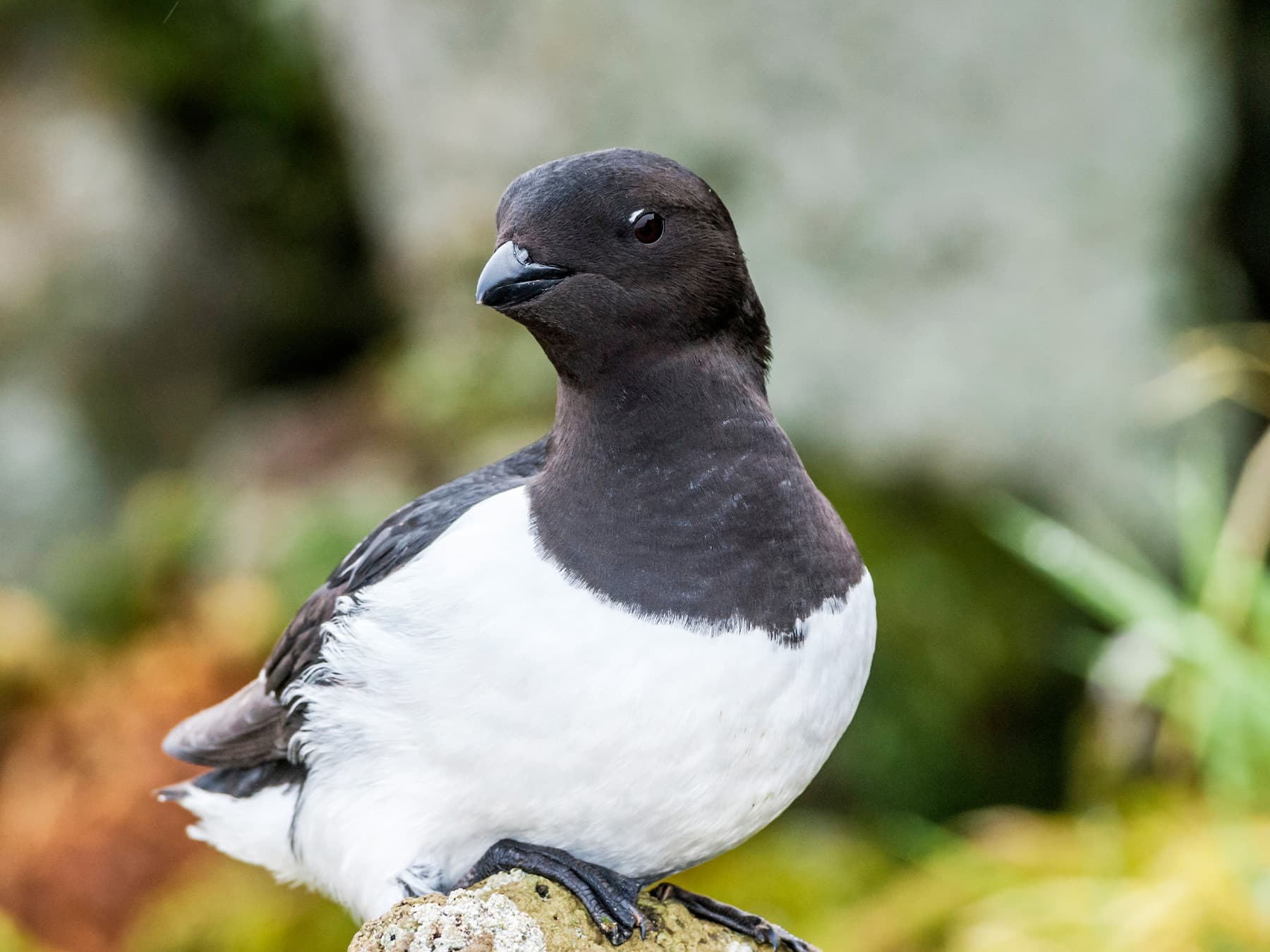
Quick facts
- Length
- 26–29 cm
- Wingspan
- 47–63 cm
- Weight
- 325–450 g
- Lifespan
- 18 years · oldest recorded 42 years 21 days
- Family
- Auks & Puffins
- Migration
- Partial migrant
- Global status (IUCN)
- Vulnerable
- World population
- About 580,000 pairs in the UK (Seabird 2000, 1998-2002)
- Population trend
- Declining: the latest census found about a quarter fewer occupied burrows than 20 years earlier at sites counted the same way
- Also called
- Puffin, Common Puffin
- Scientific name
- Fratercula arctica
Questions
3What is a baby puffin called?
A young puffin is often called a puffling. It spends about six weeks in its burrow and then leaves for the sea at night, independent from then on. See eggs and young, or our page on baby puffins.
Do puffins mate for life?
Largely, yes: they pair with one mate, and the same two usually breed together again the next year. We found no measured divorce rate in the sources we read. See breeding pairs and courtship, or our page do puffins mate for life?
Do puffins lose their beaks?
Not the whole bill. After breeding they shed its bright outer plates, leaving a smaller, dull brown bill with an orange-red tip for the winter. See appearance in winter.
Sources
33- 1Darby JH et al. (2022). A new biologging approach reveals unique flightless molt strategies of Atlantic puffins. Ecology and Evolution 12. doi:10.1002/ece3.9579 (opens in a new tab)
- 2Lowther, P. E. et al. (2020). Atlantic Puffin (Fratercula arctica), version 1.0. Birds of the World (S. M. Billerman, Editor). Cornell Lab of Ornithology, Ithaca, NY, USA. doi:10.2173/bow.atlpuf.01 (opens in a new tab)
- 3British Trust for Ornithology. Puffin. BirdFacts. Accessed 20 November 2026. Source (opens in a new tab)
- 4Stanbury, A. et al. (2021). The status of our bird populations: the fifth Birds of Conservation Concern in the United Kingdom, Channel Islands and Isle of Man and second IUCN Red List assessment of extinction risk for Great Britain. British Birds 114: 723-747. Accessed 20 November 2026.
- 5RSPB. Puffin Bird Facts | Fratercula Arctica. RSPB. Accessed 20 November 2026. Source (opens in a new tab)
- 6Burnell, D. et al. (2023). Seabirds Count Dataset: Seabirds Count - Seabird 2000 comparative data (version 20240708). JNCC; census published as Burnell et al. 2023, Seabirds Count: a census of breeding seabirds in Britain and Ireland (2015-2021), Lynx Nature Books. Accessed 20 November 2026.
- 7Harris, S. J. et al. (2026). Seabird Population Trends and Causes of Change: 1986-2024. The annual report of the Seabird Monitoring Programme. BTO Research Report 795. BTO, Thetford. Accessed 20 November 2026.
- 8BirdWatch Ireland. Puffin. BirdWatch Ireland. Accessed 20 November 2026. Source (opens in a new tab)
- 9Kersten O et al. (2021). Complex population structure of the Atlantic puffin revealed by whole genome analyses. Communications Biology 4. doi:10.1038/s42003-021-02415-4 (opens in a new tab)
- 10Robinson, R. A., Leech, D. I. and Clark, J. A. (2026). Puffin (EURING 6540): ringing and recovery summary, all years. The Online Demography Report: Bird ringing and nest recording in Britain & Ireland in 2025 (BTO, Thetford). Accessed 20 November 2026. Source (opens in a new tab)
- 11Fayet AL et al. (2016). Drivers and fitness consequences of dispersive migration in a pelagic seabird. Behavioral Ecology 27: 1061-1072. doi:10.1093/beheco/arw013 (opens in a new tab)
- 12Dedieu A et al. (2026). The 'aukward' use of hidden Markov models in a pursuit-diving seabird: semi-supervised HMMs improve behavioural classification and energetic inference in auks. Movement Ecology 14. doi:10.1186/s40462-026-00658-6 (opens in a new tab)
- 13Laurenson K et al. (2025). Long-term multi-species demographic studies reveal divergent negative impacts of winter storms on seabird survival. Journal of Animal Ecology 94: 139-153. doi:10.1111/1365-2656.14227 (opens in a new tab)
- 14Robinson, R. A., Leech, D. I. and Clark, J. A. (2026). Longevity records for Britain & Ireland in 2025. The Online Demography Report: Bird ringing and nest recording in Britain & Ireland in 2025 (BTO, Thetford). Accessed 20 November 2026. Source (opens in a new tab)
- 15Fransson, T., Kolehmainen, T., Moss, D. and Robinson, R. (2023). EURING list of longevity records for European birds (list dated 2023-09-01). Accessed 20 November 2026.
- 16Langlois Lopez S et al. (2023). Quantifying the impacts of predation by Great Black-backed Gulls Larus marinus on an Atlantic Puffin Fratercula arctica population: implications for conservation management and impact assessments. Marine Environmental Research 188. doi:10.1016/j.marenvres.2023.105994 (opens in a new tab)
- 17Stanbury, A. J. et al. (2024). The status of the UK's breeding seabirds: an addendum to the fifth Birds of Conservation Concern in the United Kingdom, Channel Islands and Isle of Man and second IUCN Red List assessment of extinction risk for Great Britain. British Birds 117: 471-487. Accessed 20 November 2026.
- 18BirdLife International (via GBIF IUCN Red List checklist). Fratercula arctica: IUCN Red List category. GBIF API. Accessed 20 November 2026. Source (opens in a new tab)
- 19BirdLife International (2021). European Red List of Birds. Publications Office of the European Union, Luxembourg. Accessed 20 November 2026.
- 20Gilbert, G., Stanbury, A. and Lewis, L. (2021). Birds of Conservation Concern in Ireland 4: 2020-2026. Irish Birds 43: 1-22. Accessed 20 November 2026.
- 21Woodward, I. et al. (2020). Population estimates of birds in Great Britain and the United Kingdom (APEP 4), summary leaflet. BTO (summary of Woodward et al. 2020, British Birds 113: 69-104). Accessed 20 November 2026.
- 22Fayet AL et al. (2021). Local prey shortages drive foraging costs and breeding success in a declining seabird, the Atlantic puffin. Journal of Animal Ecology 90: 1152-1164. doi:10.1111/1365-2656.13442 (opens in a new tab)
- 23Greco F et al. (2025). Asymptomatic infection and antibody prevalence to co-occurring avian influenza viruses vary substantially between sympatric seabird species following H5N1 outbreaks. Scientific Reports 15. doi:10.1038/s41598-025-85152-6 (opens in a new tab)
- 24UK Parliament. Wildlife and Countryside Act 1981, section 1 and Schedules 1, 1A, A1, ZA1, 2 (England, Wales and Scotland texts). legislation.gov.uk. Accessed 20 November 2026. Source (opens in a new tab)
- 25UK Government. Wildlife (Northern Ireland) Order 1985, article 4 and Schedules 1-3. legislation.gov.uk. Accessed 20 November 2026. Source (opens in a new tab)
- 26Law Reform Commission. Wildlife Act 1976 (revised), section 22 and Third Schedule. Revised Acts. Accessed 20 November 2026. Source (opens in a new tab)
- 27AviList Core Team (2026). AviList: The Global Avian Checklist, v2025b. doi:10.2173/avilist.v2025b (opens in a new tab)
- 28Lavers, J., Hipfner, J. M. and Chapdelaine, G. (2020). Razorbill (Alca torda), version 1.0. Birds of the World (S. M. Billerman, Editor). Cornell Lab of Ornithology, Ithaca, NY, USA. Accessed 20 November 2026. Source (opens in a new tab)
- 29Ainley, D. G., Nettleship, D. N. and Storey, A. E. (2021). Common Murre (Uria aalge), version 2.0. Birds of the World (S. M. Billerman, Editor). Cornell Lab of Ornithology, Ithaca, NY, USA. Accessed 20 November 2026. Source (opens in a new tab)
- 30Butler, R. G. et al. (2020). Black Guillemot (Cepphus grylle), version 1.0. Birds of the World (S. M. Billerman, Editor). Cornell Lab of Ornithology, Ithaca, NY, USA. Accessed 20 November 2026. Source (opens in a new tab)
- 31Piatt, J. F. and Kitaysky, A. S. (2020). Horned Puffin (Fratercula corniculata), version 1.0. Birds of the World (S. M. Billerman, Editor). Cornell Lab of Ornithology, Ithaca, NY, USA. Accessed 20 November 2026. Source (opens in a new tab)
- 32Piatt, J. F. and Kitaysky, A. S. (2020). Tufted Puffin (Fratercula cirrhata), version 1.0. Birds of the World (S. M. Billerman, Editor). Cornell Lab of Ornithology, Ithaca, NY, USA. Accessed 20 November 2026. Source (opens in a new tab)
- 33Fayet AL, Hansen ES and Biro D (2020). Evidence of tool use in a seabird. Proceedings of the National Academy of Sciences 117: 1277-1279. doi:10.1073/pnas.1918060117 (opens in a new tab)

Checked by
Nathan Cope, founder and editor
Nathan founded Birdfact and leads its writers and contributors in the UK, the US and Canada. He has watched and studied birds for more than ten years, and checks every article and species guide before it’s published.