Facts · Updated 27 Oct 2026
What Do Sparrowhawks Eat? Prey, Hunting and Garden Birds
By the Birdfact teamChecked by Nathan Cope
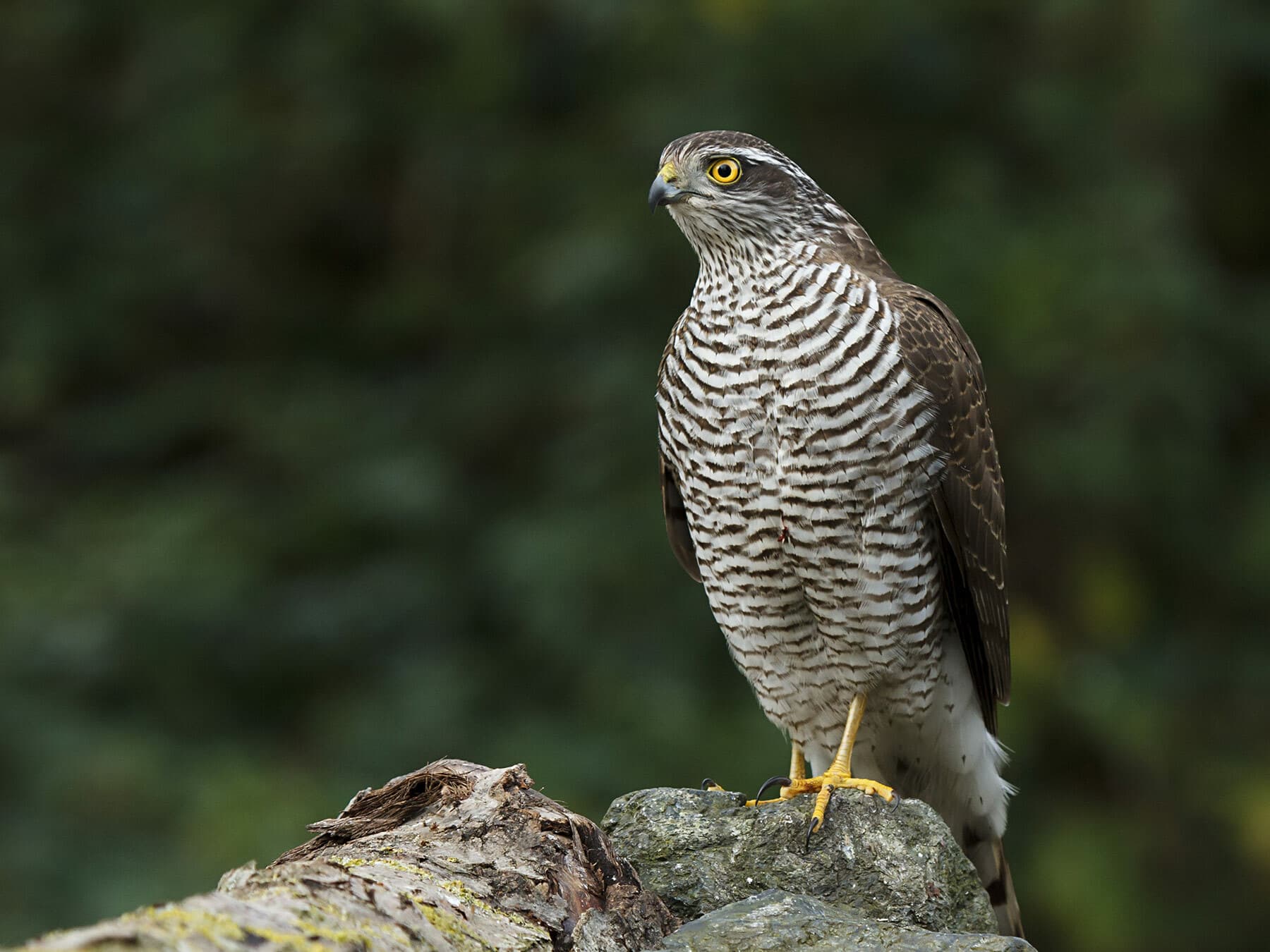
Sparrowhawks eat almost nothing but birds, mostly small ones such as finches, sparrows and tits; females can take pigeons. They hunt by surprise, and in the studies that measured it most attacks failed. National studies have found no evidence that their return caused the wider songbird declines, though one could not rule it out for Tree Sparrows.
On this page14 sections
- What do Sparrowhawks eat?
- Do Sparrowhawks eat pigeons?
- Males and females take different prey
- Young birds and the breeding season
- Mammals and other prey
- How they hunt
- Hunting success
- What time of day do Sparrowhawks hunt?
- How much they eat
- Feeding the chicks
- At garden feeders
- Sparrowhawks and songbird numbers
- The law
- Sources

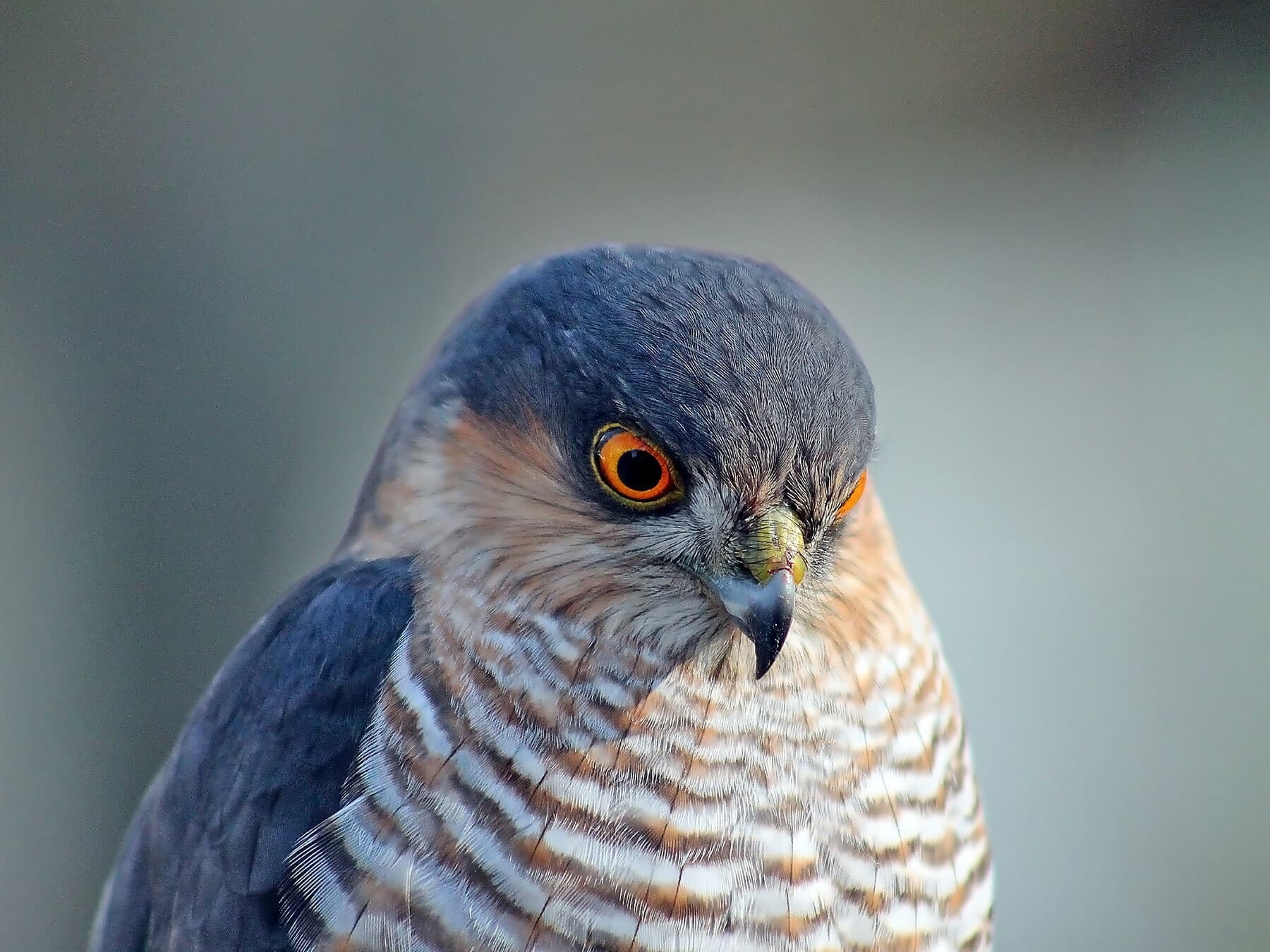
Sparrowhawks live on other birds. This page covers what they catch, how males and females differ, how they hunt and how often they succeed, how much they eat, and what the studies say about their effect on garden and songbird numbers. For the bird itself, see the Sparrowhawk guide.
What do Sparrowhawks eat?
Almost entirely small and medium-sized birds, mostly small ones, and rarely anything over about 120 g. In Europe the commonest prey are finches, especially Chaffinches, sparrows, buntings, tits, Tree Pipits and larks; thrushes and Starlings are often taken, and conspicuous birds, such as those feeding on the ground, make up more of the catch.1
The menu changes through the year: the hawks switch from one prey species to another as the season goes on, and in spring and summer they take large numbers of young birds just out of the nest.2
Do Sparrowhawks eat pigeons?

Males and females take different prey
The male is much smaller and takes smaller birds on average, hunting more in dense woodland; the female hunts more in the open and takes larger species.1 The sources we read describe the pattern but give no settled reason for it.
Young birds and the breeding season
Sparrowhawks time their nesting to the songbirds' young. In a ten-year study in southern Scotland, the first hawks laid within five to ten days of the first fledglings appearing, so their own chicks were in the nest when fledglings were most plentiful.2
Mammals and other prey
Mammals and other animals are rare prey. Voles matter only in vole outbreak years in the far north; young rabbits and hares, shrews, bats, lizards, frogs and toads and insects are occasional extras. One young Sparrowhawk in Hungary made 15 attempts, all unsuccessful, to catch koi in a part-frozen pond.1
How they hunt
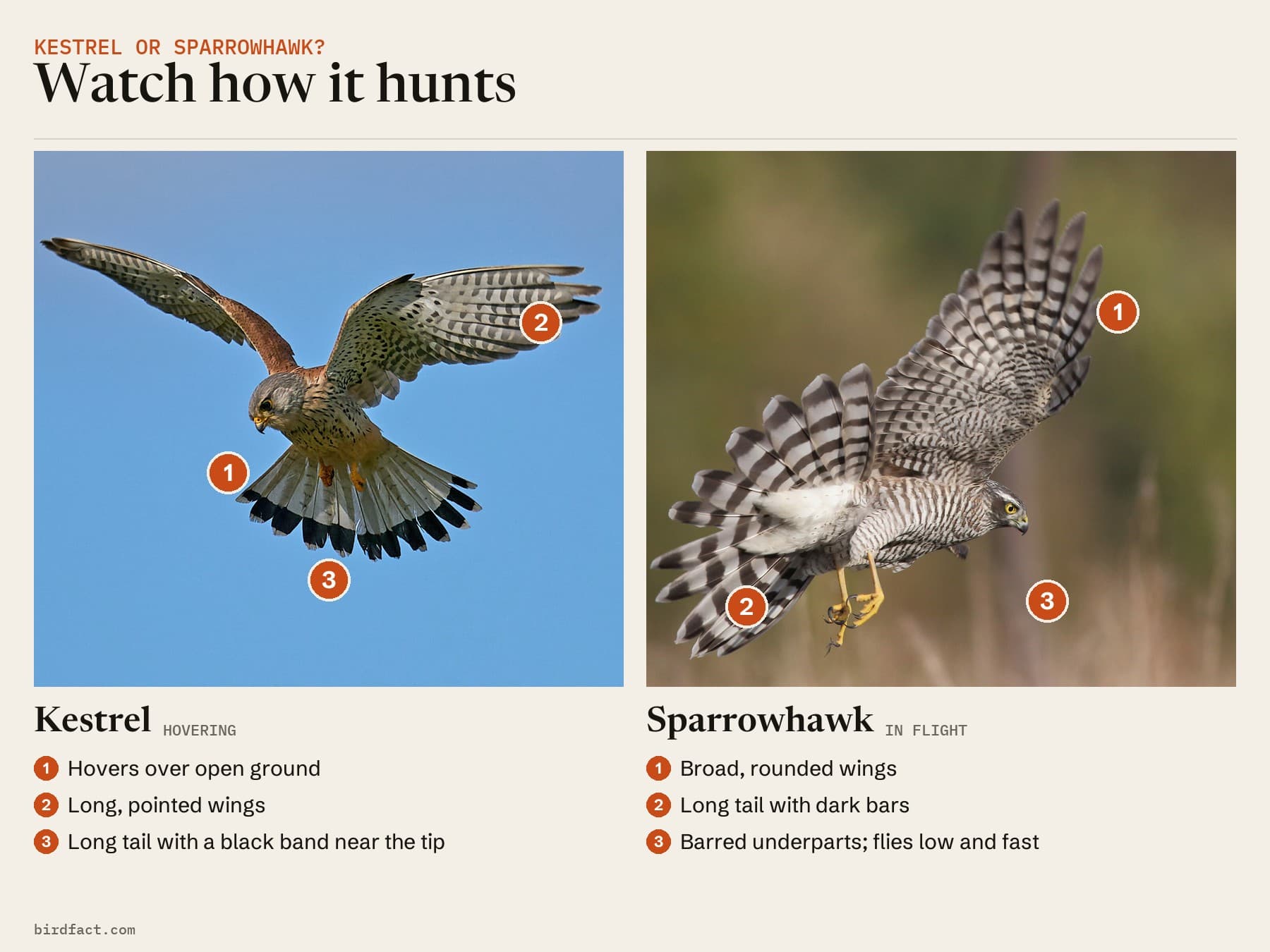
Sparrowhawks hunt by surprise. A Sparrowhawk flies fast between trees and bushes, using them and buildings as cover,4 or makes short flights between hidden perches,1 then dashes at a bird that has not seen it. On a Scottish estuary in winter, most hunts lasted under a minute: usually a single attack from a perch at birds on the ground, typically within 100 m, with a chase of under five seconds, between long spells of rest.5
They pick their moment. Hunting Redshanks, Sparrowhawks caught more when the flocks were small and close to the cover the hawk was hiding behind, and they attacked the more vulnerable group twice as often as not.6 Occasionally two hunt together over open ground.1

Hunting success
In the studies that measured it, most attacks failed. Measured success rates come from studies of Sparrowhawks hunting waders on Scottish estuaries in winter: about 10% of attacks on Redshanks and Dunlins succeeded, and 3% on Skylarks;5 at Tyninghame the success rate on waders was 11.6%.7 We found no measured success rate for hunts in gardens or woods.
What time of day do Sparrowhawks hunt?
How much they eat
For most of the year a Sparrowhawk eats one to three large meals a day, with long fasts between.8 The Wytham Wood study near Oxford assumed a male needs about two small birds a day, a figure from falconers' captive males; on that basis a pair needs about four birds a day while the female incubates, and roughly three times as many with young.9
Feeding the chicks
At three nests in south-west Scotland, the male caught almost all the food for the first seven or eight days, and later both parents brought about the same number of items; the broods ate 5,900-13,800 g of prey in the 32 days from hatching.3 See Sparrowhawk nesting for the whole nesting season.

At garden feeders
Gardens with feeders gather small birds in the open, which suits a hawk built to hunt in tight spaces. Often the only sign is the small birds' alarm calls and a sudden scatter from the feeder.4
Sparrowhawks and songbird numbers
As far as the studies can tell, Sparrowhawks have not reduced songbird numbers nationally, though they kill many small birds. The question grew as Sparrowhawks recovered from the pesticide crash at the same time as many songbirds declined, and researchers have tested it several ways:10
| Study | What it looked at | What it found |
|---|---|---|
| Thomson et al. 1998 | 23 songbird species on about 200 farmland and woodland census plots, 1965-95 | No link between the hawks' presence and songbird declines once yearly swings were allowed for |
| Newson et al. 2010 | 29 English bird populations, national surveys 1967-2005 | Predators together (Sparrowhawk, Kestrel, Buzzard and nest predators): no evidence of an effect for 22 species; effects not ruled out for the other 7, Tree Sparrow the strongest |
| Newton, Dale & Rothery 1997 | Songbirds counted at Bookham Common almost every year 1949-79, through the hawks' decline and return | No convincing evidence of an effect |
| Perrins & Geer 1980 | Tits in Wytham Wood near Oxford, 1976-78 | An estimated 18-34% of young tits taken, but no clear effect on tit numbers |
| Dhondt et al. 1998 | Blue Tits in one study plot | Adult survival fell after a pair of Sparrowhawks moved in; the number of breeding Blue Tits did not |
| Swallow et al. 2019 | Winter counts at garden feeders, 1970-2005 | Slightly fewer House Sparrows, Starlings and Blue Tits at feeders with Sparrowhawks about; likely a contributory factor in House Sparrow and Starling declines, not the main cause |
The national studies compared sites and years with and without Sparrowhawks. Using the BTO's Common Birds Census, Thomson and colleagues found that apparent links disappeared once national year-to-year changes were allowed for, and they pointed instead to changes in farming, while not ruling out effects on a few species or in particular places.11 Newson and colleagues, using national surveys to 2005 and testing Sparrowhawks alongside other predators, found no evidence that more predators meant fewer prey for 22 species; for the other seven they could not rule an effect out, but a strong negative link between Sparrowhawks and Tree Sparrows "could indicate a causal relationship".12
Local studies show heavy predation without falling numbers. In Wytham Wood an estimated 18-34% of young tits and 14% of adults were taken in the hawks' breeding season, with no clear effect on tit numbers;9 at Bookham Common, songbirds counted through the hawks' disappearance and return showed no convincing effect.13 In one Blue Tit study plot, adult Blue Tits' yearly survival dropped from 0.485 to 0.376 once Sparrowhawks began nesting in the plot, yet the number of breeding Blue Tits did not fall; there were fewer non-breeding birds waiting for a territory instead.14
Garden counts are mixed. One analysis of the BTO's winter feeder counts found year-to-year links, negative for Starlings, Chaffinches and Greenfinches and positive for Great Tits, Blue Tits and Collared Doves, but no strong link to long-term declines.15 Another argued that Sparrowhawk predation "may be a sufficient explanation" for the House Sparrow's decline, though it did not allow for other factors such as weather.16 A later analysis, with weather and other factors allowed for, found Sparrowhawks linked to fewer House Sparrows, Starlings and Blue Tits at feeders, up to about a 3.6% smaller rate of change for each extra Sparrowhawk: likely a contributory factor in the House Sparrow's and Starling's declines rather than the main cause, and perhaps partly birds avoiding feeders where hawks hunt. Blue Tit numbers have stayed largely stable.17
The law
Sparrowhawks are protected like all wild birds. In England and Wales it is an offence to intentionally kill, injure or take one, or to take, damage or destroy its nest while in use or being built; in Scotland the same applies, intentionally or recklessly,18 and so it does in Northern Ireland.19 Illegal killing still happens: RSPB investigators confirmed 63 Sparrowhawks as victims of persecution in the UK between 2009 and 2023, 39 of them shot or shot at, 13 trapped and 6 poisoned.20
Sources
- Meyburg, B.-U., Marks, J. S., Garcia, E., Perlman, Y. (2025). Eurasian Sparrowhawk (Accipiter nisus), version 1.1. Birds of the World (J. del Hoyo, A. Elliott, J. Sargatal, D. A. Christie, E. de Juana and M. G. Smith, editors). Cornell Lab of Ornithology. doi:10.2173/bow.eurspa1.01.1
- Newton, I., Marquiss, M. (1982). Food, predation and breeding season in Sparrowhawks (Accipiter nisus). Journal of Zoology 197: 221-240. doi:10.1111/jzo.1982.197.2.221
- Newton, I. (1978). Feeding and development of Sparrowhawk Accipiter nisus nestlings. Journal of Zoology 184: 465-487. doi:10.1111/j.1469-7998.1978.tb03302.x
- RSPB. Sparrowhawk. RSPB Birds A-Z. Accessed 27 October 2026. Source
- Cresswell, W. (1996). Surprise as a winter hunting strategy in Sparrowhawks Accipiter nisus, Peregrines Falco peregrinus and Merlins F. columbarius. Ibis 138: 684-692. doi:10.1111/j.1474-919x.1996.tb04770.x
- Cresswell, W., Quinn, J. L. (2004). Faced with a choice, sparrowhawks more often attack the more vulnerable prey group. Oikos 104: 71-76. doi:10.1111/j.0030-1299.2004.12814.x
- Cresswell, W., Whitfield, D. P. (1994). The effects of raptor predation on wintering wader populations at the Tyninghame estuary, southeast Scotland. Ibis 136: 223-232. doi:10.1111/j.1474-919x.1994.tb01088.x
- Newton, I., Marquiss, M., Village, A. (1983). Weights, breeding, and survival in European Sparrowhawks. The Auk 100: 344-354. doi:10.1093/auk/100.2.344
- Perrins, C. M., Geer, T. A. (1980). The effect of Sparrowhawks on tit populations. Ardea 68: 133-142. Accessed 27 October 2026. Source
- BTO. Sparrowhawk Predation Work. BTO Garden BirdWatch research. Accessed 27 October 2026. Source
- Thomson, D. L., Green, R. E., Gregory, R. D., Baillie, S. R. (1998). The widespread declines of songbirds in rural Britain do not correlate with the spread of their avian predators. Proceedings of the Royal Society of London B 265: 2057-2062. doi:10.1098/rspb.1998.0540
- Newson, S. E., Rexstad, E. A., Baillie, S. R., Buckland, S. T., Aebischer, N. J. (2010). Population change of avian predators and grey squirrels in England: is there evidence for an impact on avian prey populations? Journal of Applied Ecology 47: 244-252. doi:10.1111/j.1365-2664.2010.01771.x
- Newton, I., Dale, L., Rothery, P. (1997). Apparent lack of impact of Sparrowhawks on the breeding densities of some woodland songbirds. Bird Study 44: 129-135. doi:10.1080/00063659709461048
- Dhondt, A. A., Kempenaers, B., Clobert, J. (1998). Sparrowhawk Accipiter nisus predation and Blue Tit Parus caeruleus adult annual survival rate. Ibis 140: 580-584. doi:10.1111/j.1474-919x.1998.tb04702.x
- Chamberlain, D. E., Glue, D. E., Toms, M. P. (2009). Sparrowhawk Accipiter nisus presence and winter bird abundance. Journal of Ornithology 150: 247-254. doi:10.1007/s10336-008-0344-4
- Bell, C. P., Baker, S. W., Parkes, N. G., Brooke, M. de L., Chamberlain, D. E. (2010). The role of the Eurasian Sparrowhawk (Accipiter nisus) in the decline of the House Sparrow (Passer domesticus) in Britain. The Auk 127: 411-420. doi:10.1525/auk.2009.09108
- Swallow, B., Buckland, S. T., King, R., Toms, M. P. (2019). Assessing factors associated with changes in the numbers of birds visiting gardens in winter: Are predators partly to blame? Ecology and Evolution 9: 12182-12192. doi:10.1002/ece3.5702
- UK Parliament (1981). Wildlife and Countryside Act 1981, section 1. Accessed 27 October 2026. Source
- UK Government (1985). The Wildlife (Northern Ireland) Order 1985, article 4. Accessed 27 October 2026. Source
- RSPB (2024). Birdcrime 2023: appendices. RSPB Investigations. Royal Society for the Protection of Birds, Sandy. Accessed 27 October 2026. Source