
Rock Dove
Feral Pigeon, Rock Pigeon, City Pigeon · Columba livia
By the Birdfact teamChecked by Nathan Cope
See it in 3D
3D model
An adult Rock Dove is 29–37 cm (11.5–14.5 in) long, bill to tail.
© 2026 NC Digital Limited (Birdfact). All rights reserved. This 3D model may be viewed on this page and shared by link only. Downloading, extracting, copying or reusing it, or using it to train machine-learning models, is not permitted without our written permission. Using our models
On this page16 sections
How to recognise it
The feral pigeon, the town pigeon found in cities all over the world, is a Rock Dove: the same species as the wild bird of sea cliffs, descended from domestic pigeons that escaped or were released.1 It is 31-34 cm (12-13.5 in) long and weighs 230-370 g (8-13 oz): smaller than a Woodpigeon.2
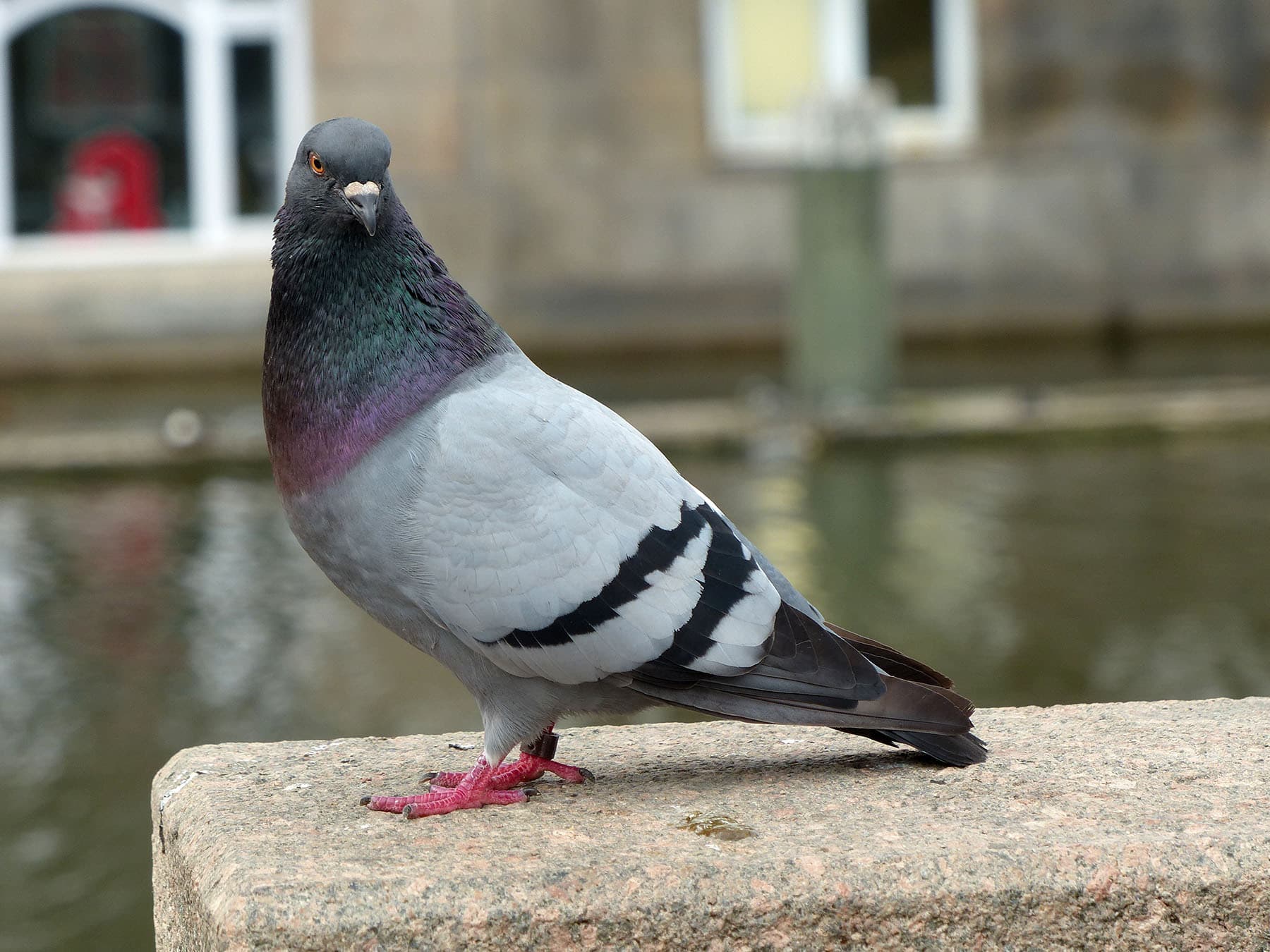
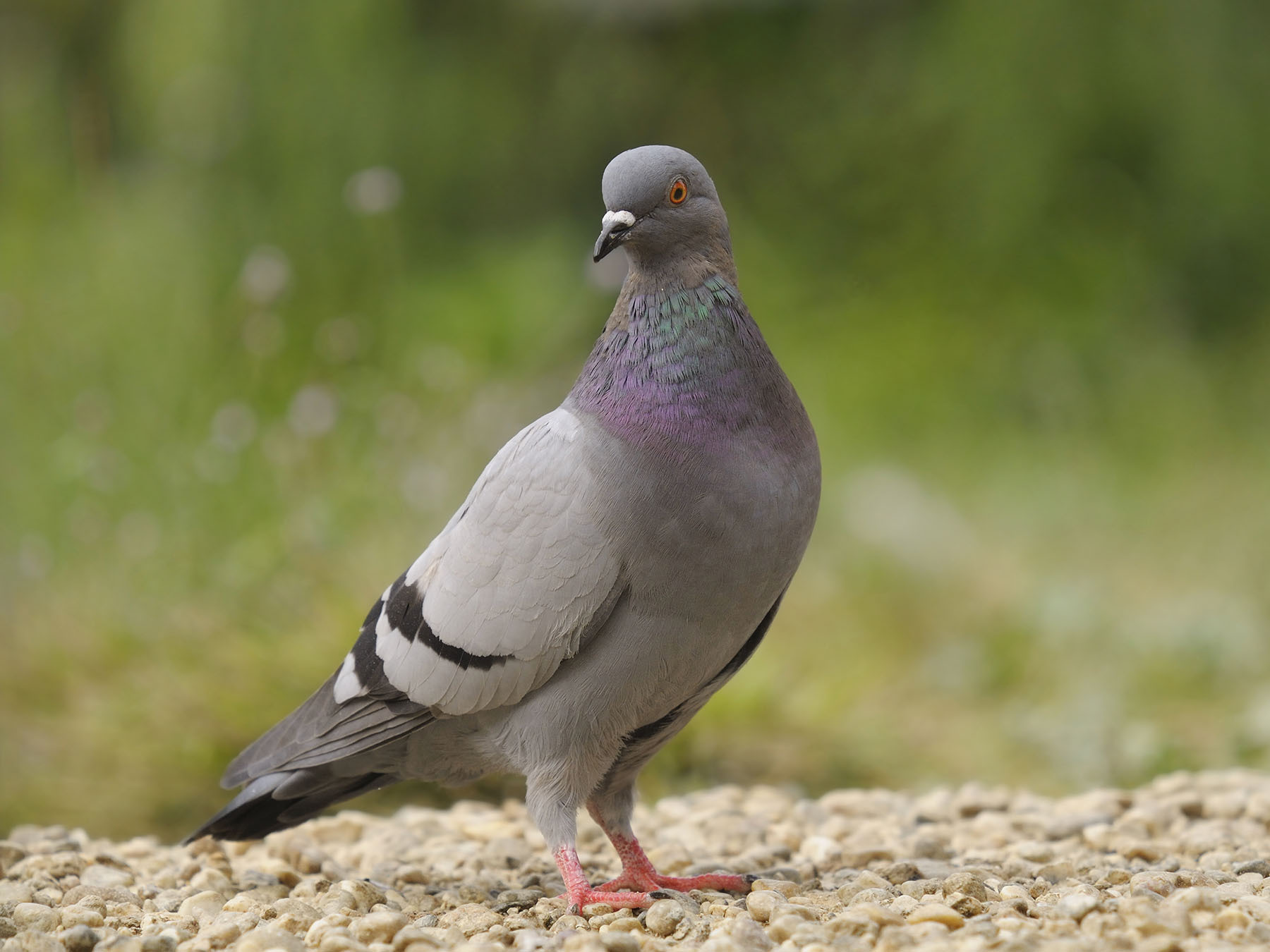
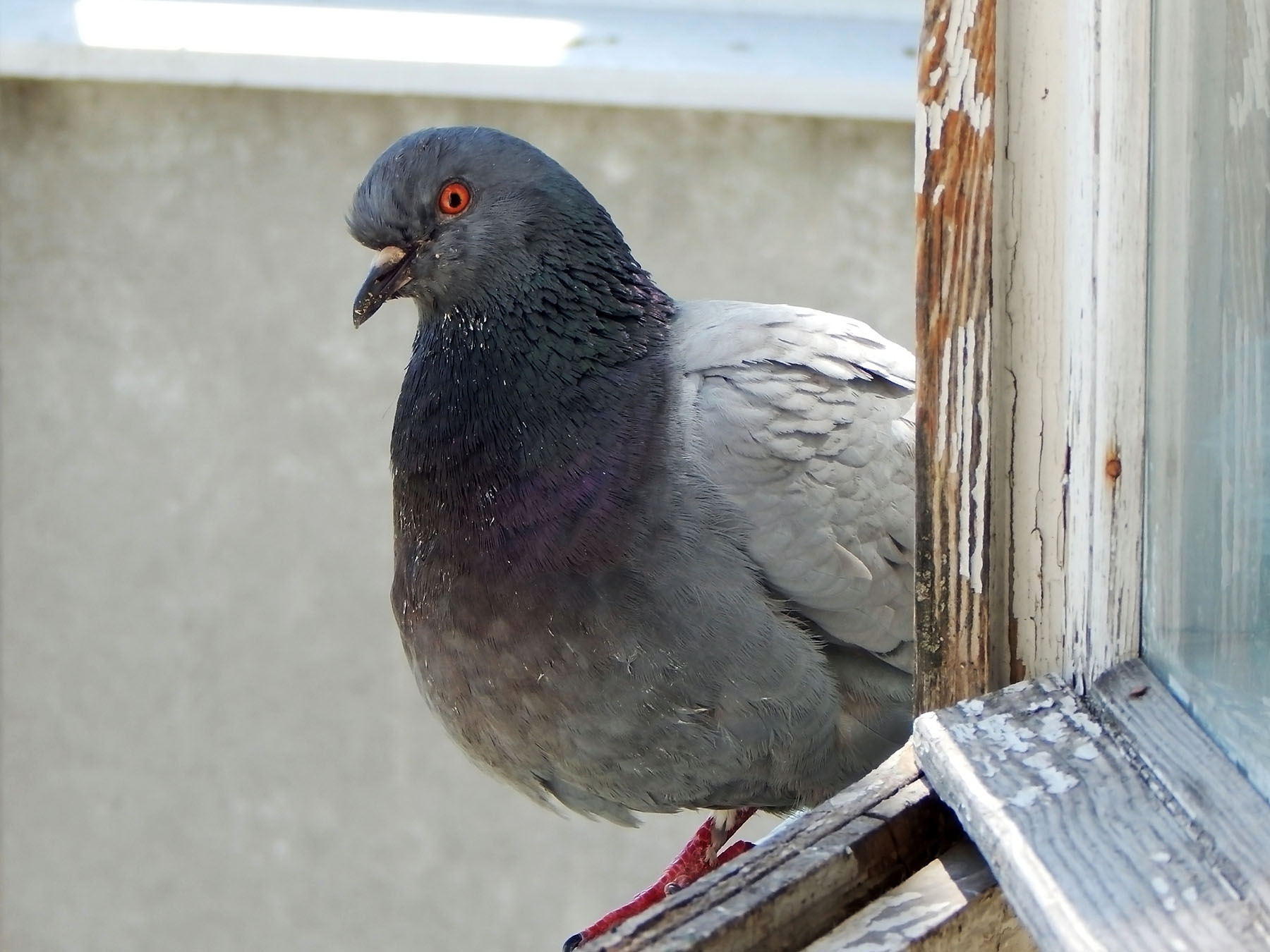
The wild type, which many town birds still match, is blue-grey, darkest on the head and palest on the wings, with two bold black bars across each wing, a green and purple sheen on the neck and upper breast, and a dark band near the end of the tail. In flight it shows white underwings and a white or greyish rump.3 The eye is orange to red-orange, the bill dark with a white, mealy cere (the fleshy bump at its base), and the legs red to pinkish red.
Plumage: town pigeon colours
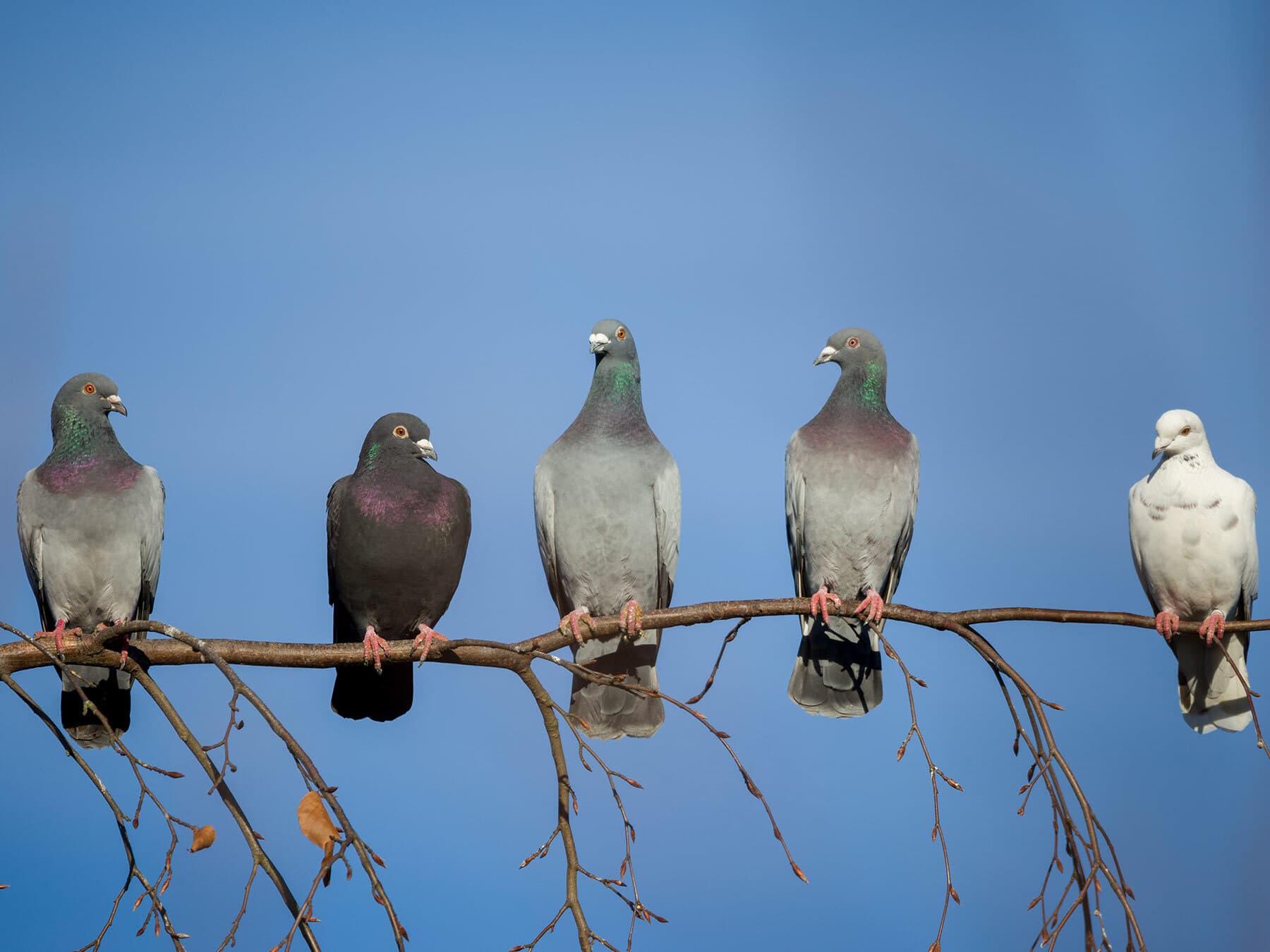
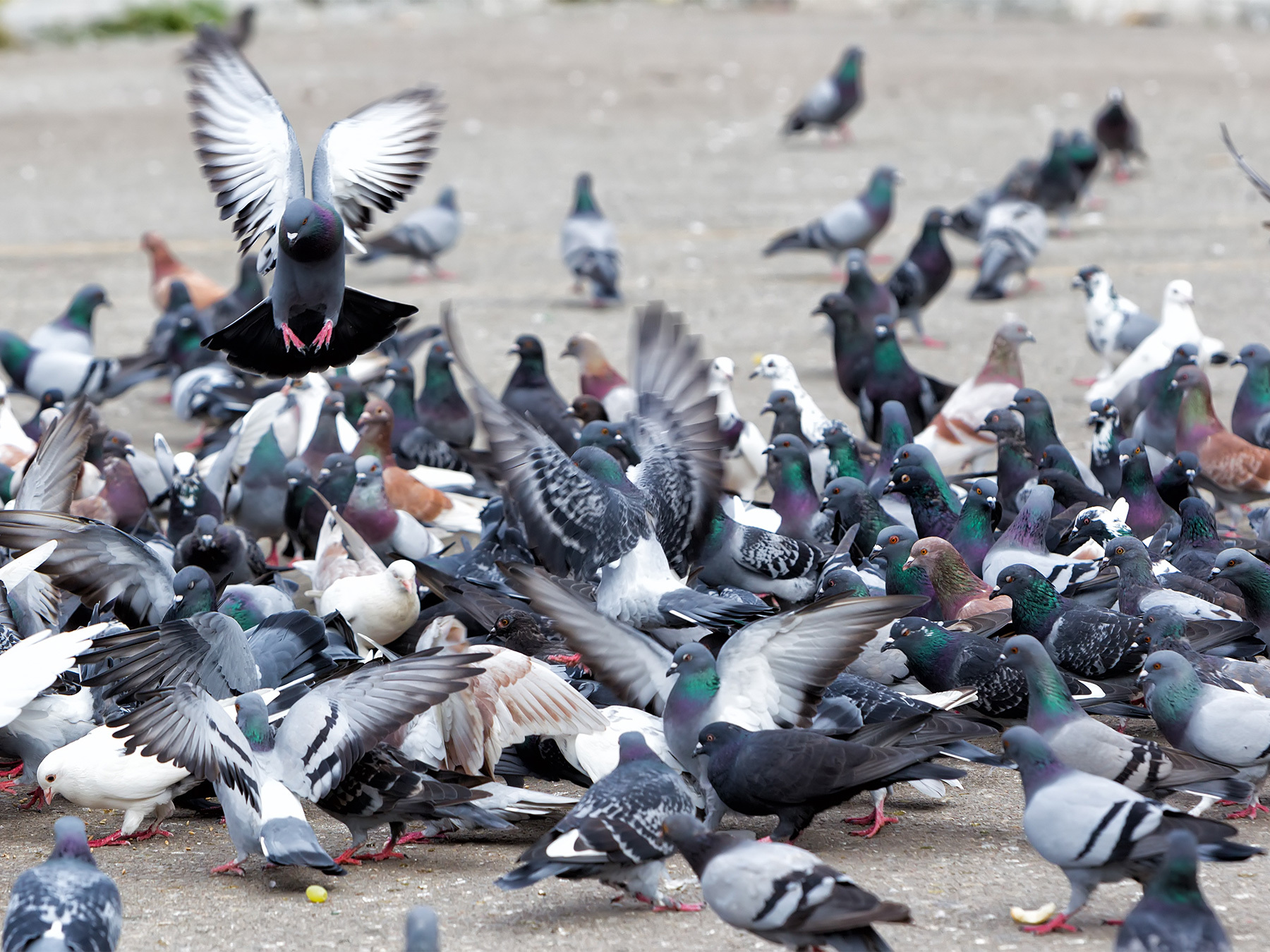
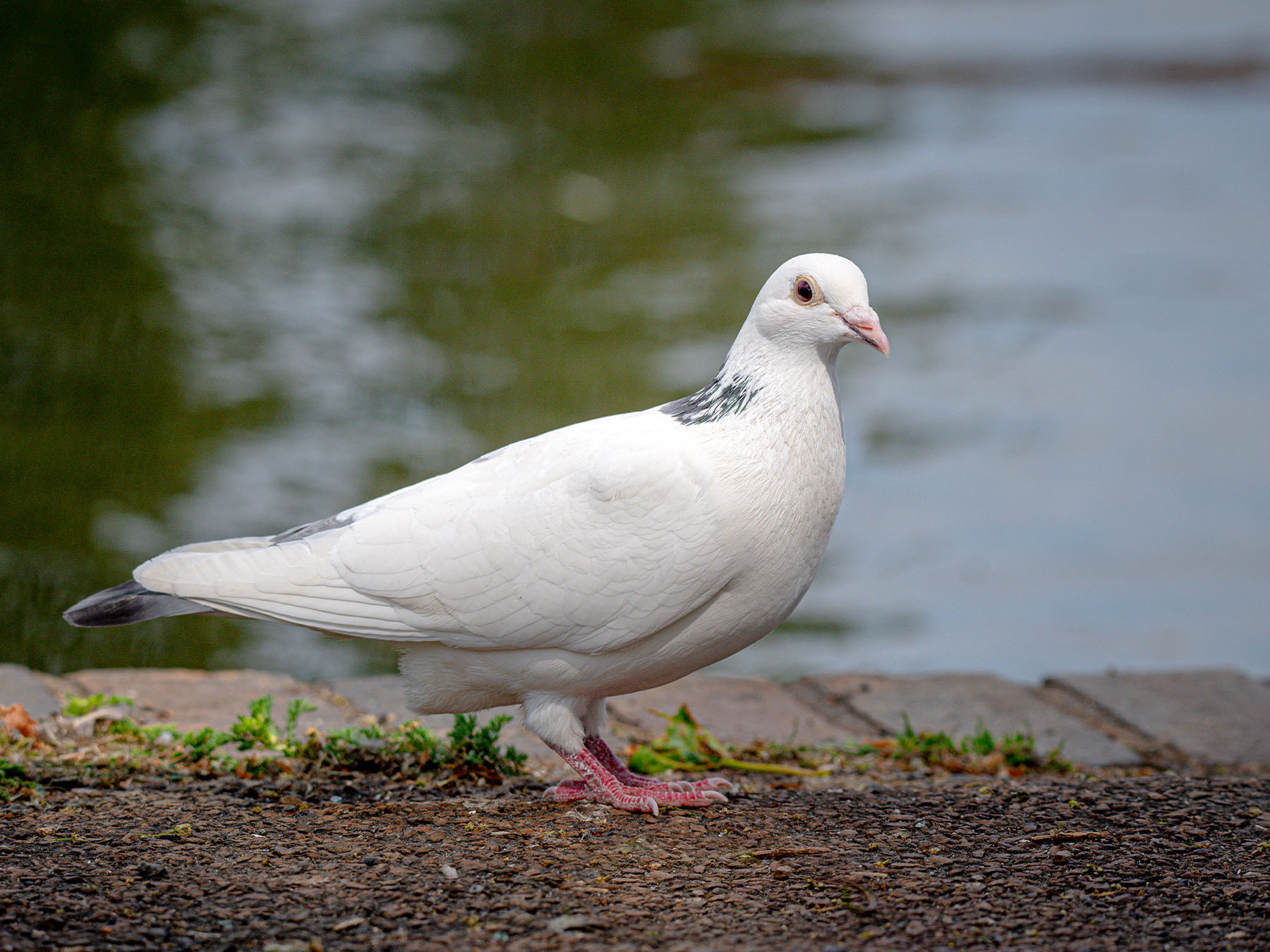
Town flocks mix every shade. Alongside the blue-bar birds there are chequers, with black spots across the wing instead of two neat bars; dark and all-black birds; red forms in cinnamon or brick-red; pied birds splashed with white; and some that are all white.4 The colours come from breeding by people, and an all-white "dove" in a town is usually a white feral pigeon. The variety in domestic and feral pigeons is almost without limit.
Wild Rock Doves come in one pattern only: blue-grey, with two black wing bars and a white patch on the lower back.5
Male, female and young
Males and females look alike. The female is slightly duller grey with less sheen on the neck. Males averaged about 6% larger in one study, and in Kansas breeding males averaged 369 g against 340 g for females.3 Behaviour is the better clue. It is the male who struts in circles around the female with his throat swollen and his tail fanned, bowing and cooing, and the male who picks the nest site and calls from it.
Young birds out of the nest are duller and washed with brown, with pale fringes to the wing feathers that give a scaly look, and a dark brown eye that turns orange at about 6-8 months old. More: baby pigeons, from egg to first flight.
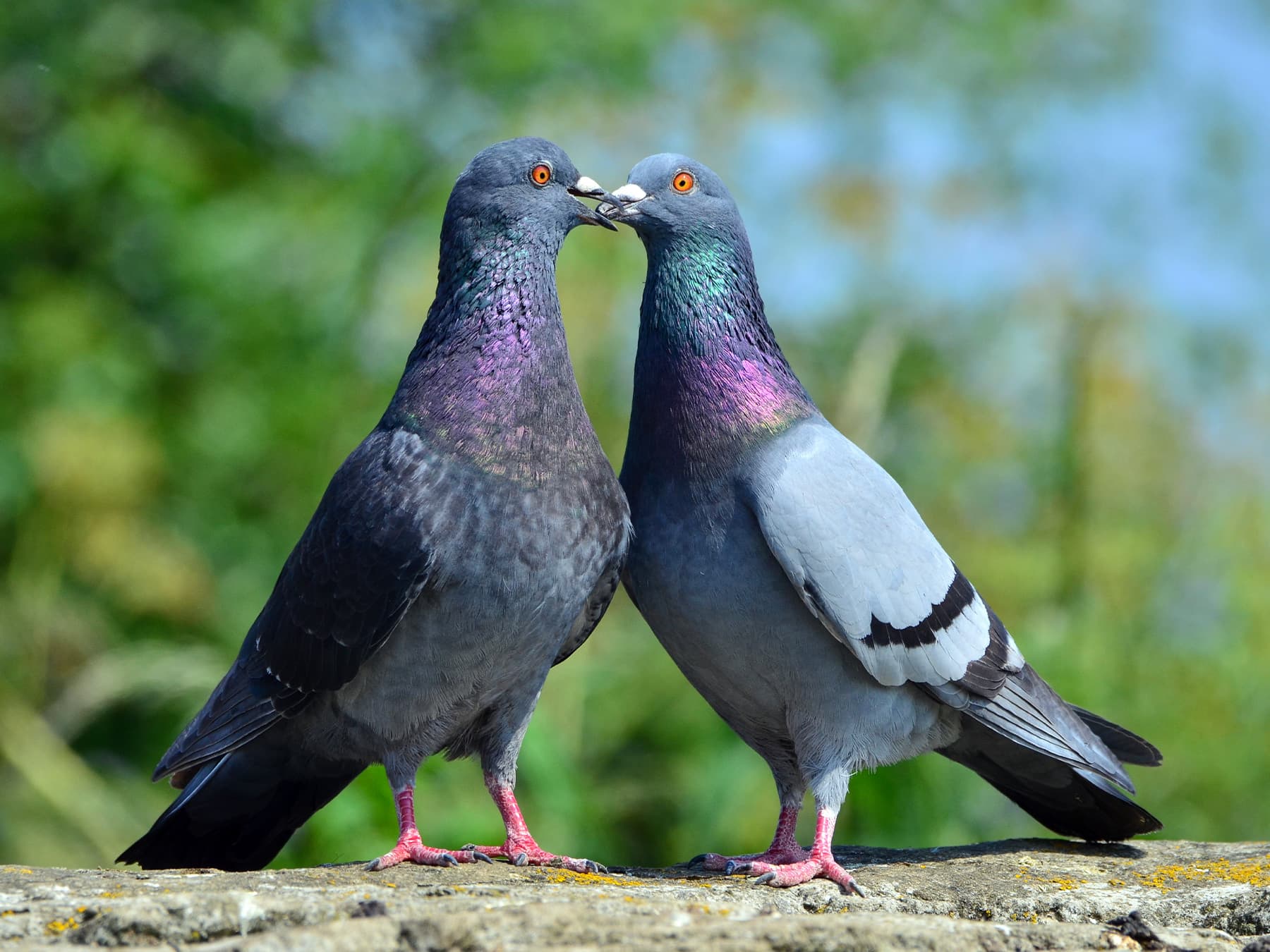
Identification: similar birds
Woodpigeon. Bigger, with a white patch on each side of the neck and broad white stripes across the wings that show in flight;1 a wild-type feral pigeon has black wing bars and no white neck patch.6
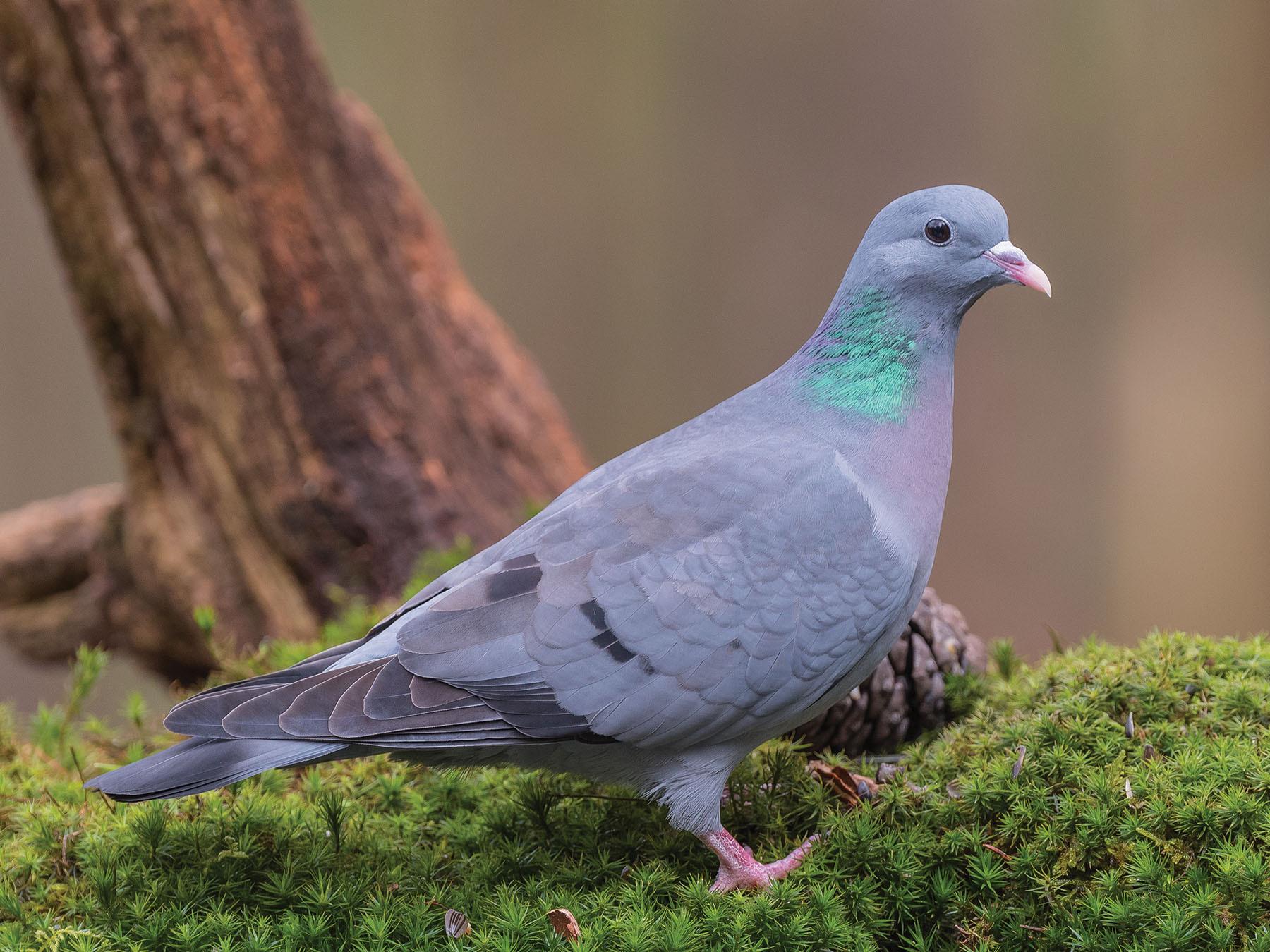
Stock Dove. Also blue-grey, with two neat black lines on the closed wing, but a bird of farmland and woodland that nests mostly in holes in old trees rather than on the ledges of town buildings;7 it is easily mistaken for feral pigeons.
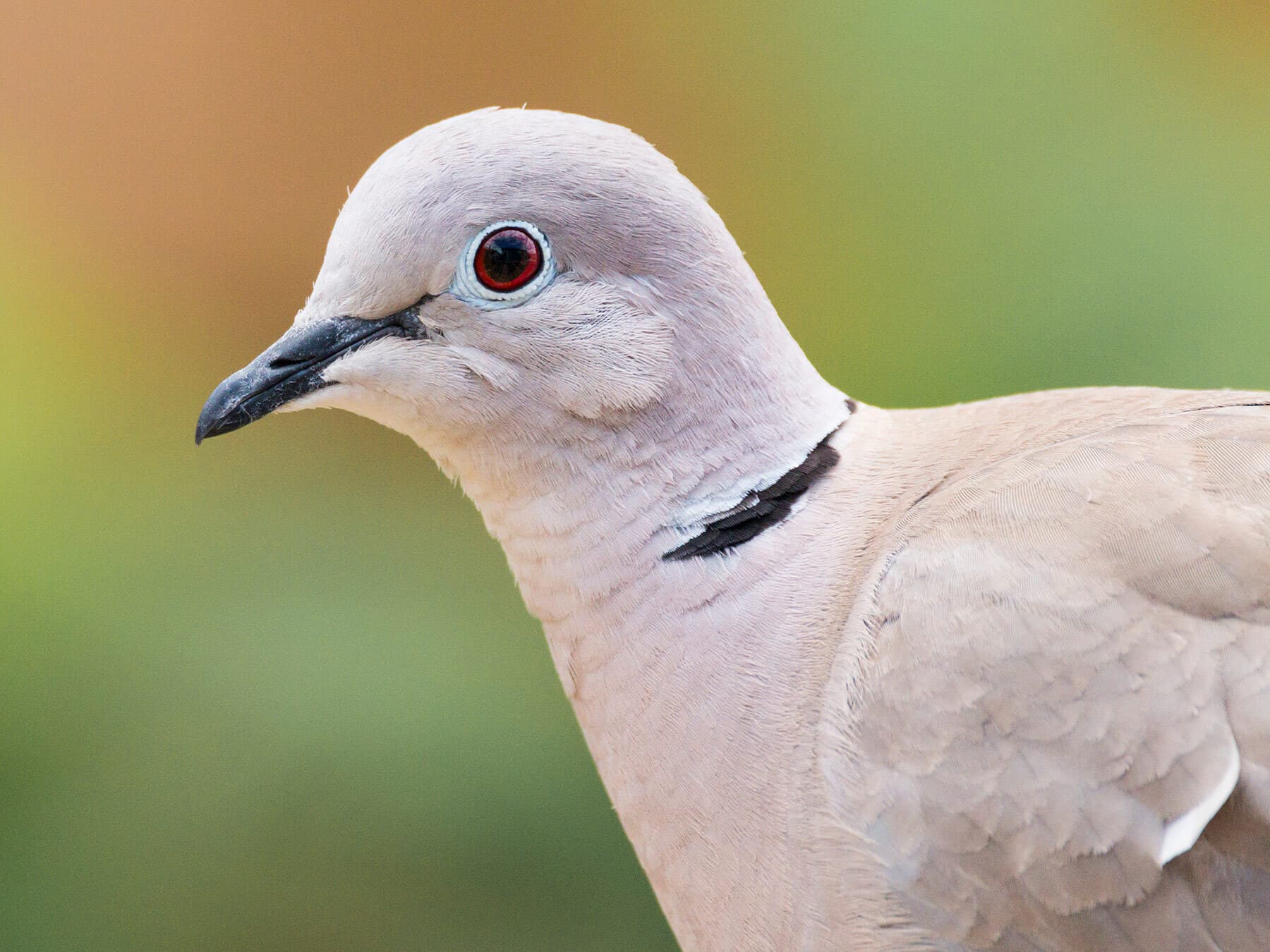
Collared Dove. Smaller and beige-grey, with a black collar edged with white on the neck.1
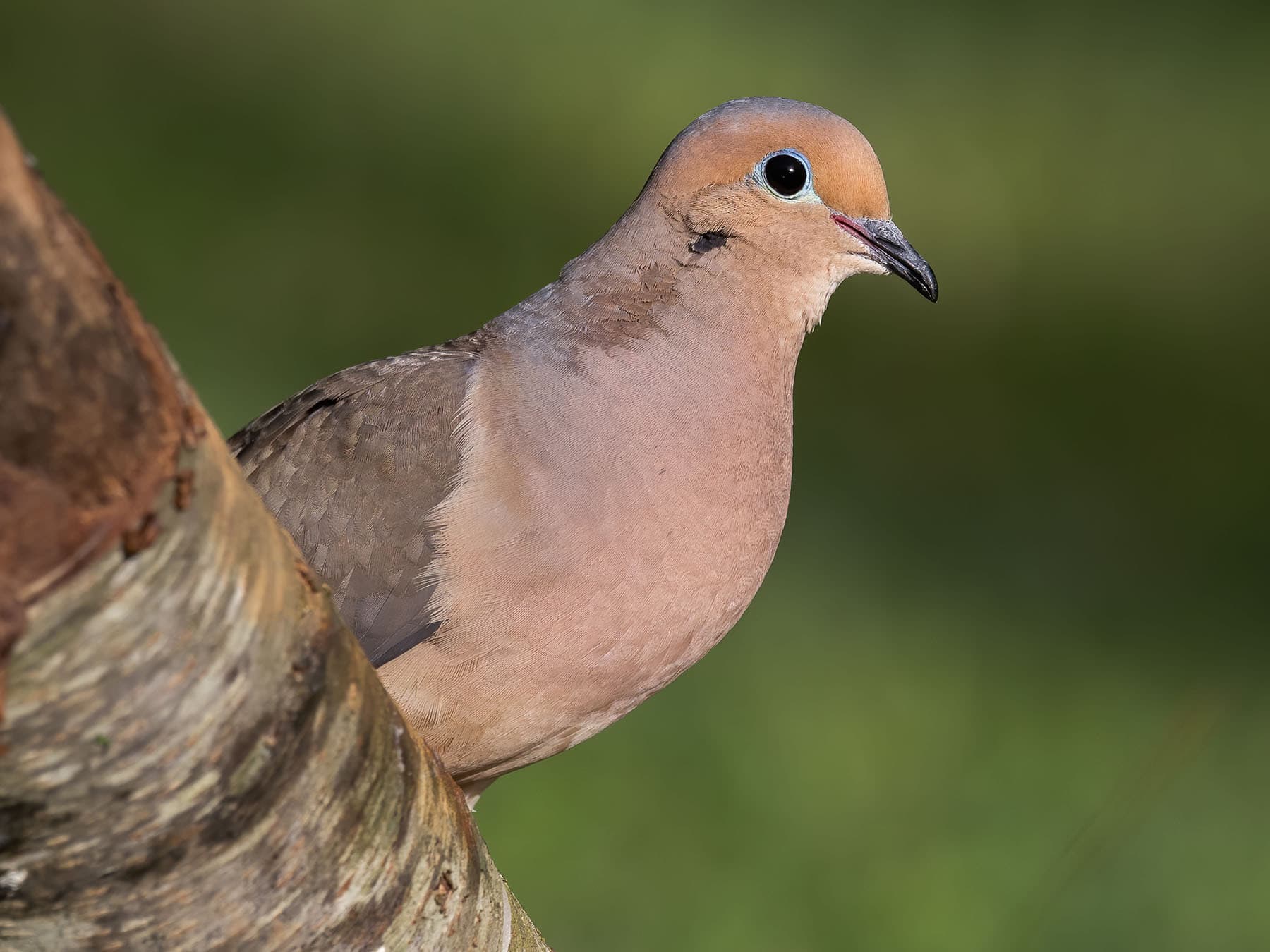
Mourning Dove (North America). Smaller, at 23-33 cm (9-13 in), mostly plain with black spots on the wings, and with a long, pointed tail that shows white spots along the edge in flight.8
Wild Rock Dove. On sight alone you cannot tell a true wild Rock Dove from a wild-type feral pigeon; where you are is the best guide. A genetic study of Scottish and Irish birds found that wild birds have, on average, longer, thinner bills and a more pronounced forehead.5
Not sure it’s a Rock Dove? Check your photo: Birdfact names the bird and shows the look-alike side by side.
Its size
Adults- Length
- 31–34 cm
- Wingspan
- 63–70 cm
- Weight
- 230–370 g
Its song and calls
Pigeons coo: low, soft, tremulous notes that are hard to place. The male's display coo goes with the bow-coo, as he struts and turns with his throat swollen and his tail spread, and it is aimed at rival males as well as at females. On the nest site a pigeon gives a nest call with head-bowing and wing-twitching, and a grunt is the alarm at a predator.3 Both sexes have the same calls, but males call more often and more loudly. Feral pigeons call all year and at any time of day, most of all in spring and summer.
Squabs (baby pigeons) squeak when they are fed and start to coo at 30-40 days old. Not every pigeon sound is a voice: the claps in a display flight are the wings, clapped on the upstroke. More: pigeon sounds, with recordings and spectrograms.
- Display coos0:00 / 0:14
Recorded in Glasgow, United Kingdom · April 2026
- Single coos0:00 / 0:28
Recorded in Île-de-France, France · April 2020
Heard one and not sure? Let the bird song identifier listen.
When and where to see it
November
Here all year
The year across the UK and Ireland
Choose a place on the map to see its year, or find yours.
Most recorded in November
Up to 4.0% of a place’s bird records that monthHere in other months
How this map is made
Each county, state or province is shaded by the Rock Dove’s share of all the bird records there that month: the darker, the larger the share. A place with only a trace of records in a month is left unshaded. Shades compare places on this map with each other, not one bird with another. Records: GBIF eBird Observation Dataset, 2019–2024. Map: Natural Earth; place centres © OpenStreetMap contributors.
How often the Rock Dove turns up in the UK, Ireland, the United States and Canada through the year, from birdwatchers' records.
United Kingdom
Resident · all year · most records in September
Ireland
Resident · all year · most records in August
United States
Resident · all year · most records in January
Canada
Resident · all year · most records in January
Show as a table
| Month | United Kingdom | Ireland | United States | Canada |
|---|---|---|---|---|
| January | 1.2% (regular) | 1.4% (regular) | 0.85% (regular) | 1.9% (regular) |
| February | 1.2% (regular) | 1.4% (regular) | 0.75% (regular) | 1.8% (regular) |
| March | 1.2% (regular) | 1.5% (regular) | 0.65% (regular) | 1.5% (regular) |
| April | 1.0% (regular) | 1.4% (regular) | 0.48% (regular) | 0.89% (regular) |
| May | 0.99% (regular) | 1.4% (regular) | 0.37% (regular) | 0.50% (regular) |
| June | 1.2% (regular) | 1.6% (regular) | 0.46% (regular) | 0.54% (regular) |
| July | 1.3% (regular) | 1.7% (regular) | 0.59% (regular) | 0.71% (regular) |
| August | 1.3% (regular) | 1.7% (regular) | 0.68% (regular) | 0.84% (regular) |
| September | 1.3% (regular) | 1.4% (regular) | 0.64% (regular) | 0.86% (regular) |
| October | 1.2% (regular) | 1.3% (regular) | 0.65% (regular) | 1.0% (regular) |
| November | 1.2% (regular) | 1.3% (regular) | 0.73% (regular) | 1.4% (regular) |
| December | 1.3% (regular) | 1.4% (regular) | 0.82% (regular) | 1.8% (regular) |
Recorded regularly in
Worldwide: recorded regularly in 212 countries
Countries where it was recorded in at least 3 of the 6 years 2019–2024. Linked countries have their own bird list.
Europe (51)
- Åland Islands
- Albania
- Andorra
- Austria
- Belarus
- Belgium
- Bosnia & Herzegovina
- Bulgaria
- Croatia
- Czechia
- Denmark
- Estonia
- Faroe Islands
- Finland
- France
- Germany
- Gibraltar
- Greece
- Guernsey
- Hungary
- Iceland
- Ireland
- Isle of Man
- Italy
- Jersey
- Kosovo
- Latvia
- Liechtenstein
- Lithuania
- Luxembourg
- Malta
- Moldova
- Monaco
- Montenegro
- Netherlands
- North Macedonia
- Norway
- Poland
- Portugal
- Romania
- Russia
- San Marino
- Serbia
- Slovakia
- Slovenia
- Spain
- Sweden
- Switzerland
- Ukraine
- United Kingdom
- Vatican City
Africa (48)
- Algeria
- Angola
- Benin
- Botswana
- Burkina Faso
- Cameroon
- Cape Verde
- Chad
- Comoros
- Congo - Kinshasa
- Côte d’Ivoire
- Djibouti
- Egypt
- Equatorial Guinea
- Eswatini
- Ethiopia
- Gabon
- Gambia
- Ghana
- Guinea
- Guinea-Bissau
- Kenya
- Lesotho
- Liberia
- Madagascar
- Malawi
- Mauritania
- Mauritius
- Morocco
- Mozambique
- Namibia
- Nigeria
- Réunion
- Rwanda
- São Tomé & Príncipe
- Senegal
- Seychelles
- Sierra Leone
- South Africa
- St Helena
- Sudan
- Tanzania
- Togo
- Tunisia
- Uganda
- Western Sahara
- Zambia
- Zimbabwe
Asia (50)
- Afghanistan
- Armenia
- Azerbaijan
- Bahrain
- Bangladesh
- Bhutan
- Brunei
- Cambodia
- China
- Cyprus
- Georgia
- Hong Kong SAR China
- India
- Indonesia
- Iran
- Iraq
- Israel
- Japan
- Jordan
- Kazakhstan
- Kuwait
- Kyrgyzstan
- Laos
- Lebanon
- Macao SAR China
- Malaysia
- Maldives
- Mongolia
- Myanmar (Burma)
- Nepal
- Oman
- Pakistan
- Palestinian Territories
- Philippines
- Qatar
- Saudi Arabia
- Singapore
- South Korea
- Sri Lanka
- Syria
- Taiwan
- Tajikistan
- Thailand
- Timor-Leste
- Turkey
- Turkmenistan
- United Arab Emirates
- Uzbekistan
- Vietnam
- Yemen
North America (37)
- Antigua & Barbuda
- Aruba
- Bahamas
- Barbados
- Belize
- Bermuda
- British Virgin Islands
- Canada
- Caribbean Netherlands
- Cayman Islands
- Costa Rica
- Cuba
- Curaçao
- Dominica
- Dominican Republic
- El Salvador
- Grenada
- Guadeloupe
- Guatemala
- Haiti
- Honduras
- Jamaica
- Martinique
- Mexico
- Nicaragua
- Panama
- Puerto Rico
- Sint Maarten
- St Kitts & Nevis
- St Lucia
- St Martin
- St Pierre & Miquelon
- St Vincent & the Grenadines
- Trinidad & Tobago
- Turks & Caicos Islands
- United States
- US Virgin Islands
South America (13)
Oceania (13)
- Australia
- Fiji
- French Polynesia
- Guam
- Kiribati
- New Caledonia
- New Zealand
- Norfolk Island
- Northern Mariana Islands
- Papua New Guinea
- Samoa
- Tonga
- Vanuatu
Data: EOD – eBird Observation Dataset (Cornell Lab of Ornithology), accessed via GBIF.org, CC BY 4.0. Records from 2019–2024, aggregated and filtered by Birdfact. How these lists are made
Feral pigeons live in most towns and cities on Earth, from Ushuaia in Tierra del Fuego to Alaska and on many oceanic islands, and in farmland with grain to eat and buildings to nest in. In North America they are rarely found far from people or agriculture. In the UK they are widespread but absent from many upland areas: the last Bird Atlas (2007-11) found them in 78% of 10-km squares in the breeding season, and their breeding range grew by 46% between 1968-72 and 2008-11.9
Wild Rock Doves probably once lived from the Faroes and Shetland across Europe, North Africa and the Middle East to India.3 Interbreeding with feral pigeons has replaced them in many places, and presumed wild birds now survive in relict populations, often on islands.5 The RSPB places Britain and Ireland's on the rocky coasts of north and west Scotland, offshore islands and Northern Ireland; the BTO thinks they are restricted to the coasts of north and west Scotland and of north, west and south Ireland. A 2022 genetic study found that the Rock Doves of the Outer Hebrides carry almost no feral ancestry.10
People have kept pigeons for more than 5,000 years, originally for food, and a genome study found evidence that the main breed groups originated in the Middle East.11 European settlers brought domestic pigeons to the Atlantic coast of North America between 1603 and 1607, and some went feral soon after.
Do they migrate?
No. Pigeons are sedentary. In a ringing study of feral pigeons, most of the birds found again (86%) had moved less than 90 m, and in one wild population in Britain birds moved up to 8 km, exceptionally 16 and 28 km.3 Some commute about 20 km a day between roost and feeding grounds. Finding their way home is another matter: see Flight and homing below.
Tips for seeing it
What it eats
Mostly seeds, grain and fruit, with the odd invertebrate. Away from towns that means wheat, barley, oats and maize, peas and beans, and the seeds of weeds, with snails, slugs, moth larvae and earthworms now and then. In towns pigeons also eat bread, popcorn, peanuts, cake and whatever else people drop or put out.12
The difference shows in their crops. In a 1960s study, bread and similar food was in 55-91% of feral pigeons' crops at Leeds, depending on the season, and in none of the crops of birds the study called wild Rock Doves, at Flamborough Head, which held barley, wheat and weed seeds instead (the wild samples were small).3 Pigeons feed mostly on the ground, walking and pecking, and drink by suction, using the bill like a straw. More: what pigeons eat, and whether to feed them bread.
Nesting and breeding
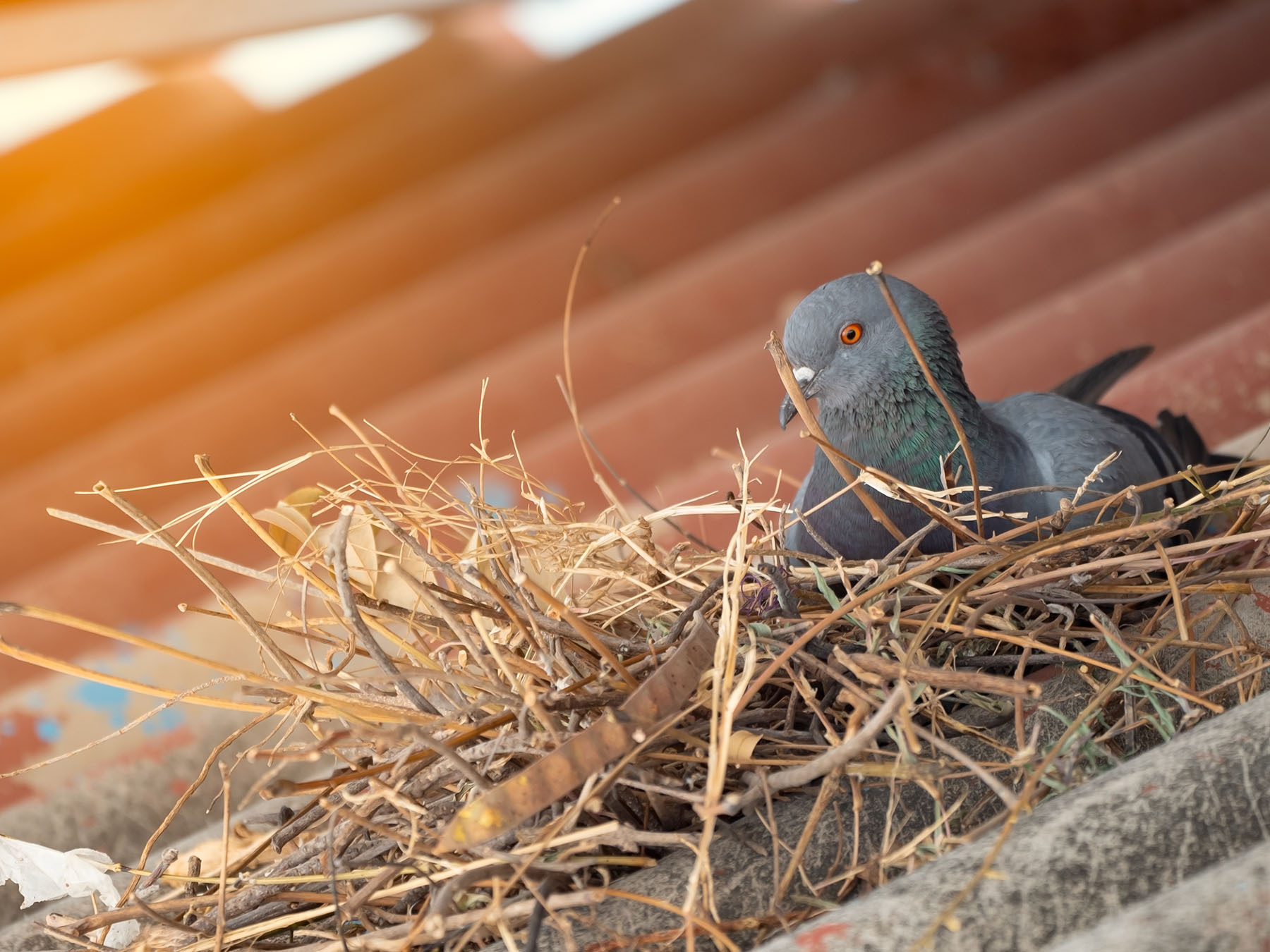
Pigeons usually nest on a flat ledge under cover: sea caves and cliff crevices for wild birds; ledges, nooks, gutters, eaves, barns and bridges for feral ones. The male picks the site and calls from it, then brings twigs and stems one at a time while the female tucks them around herself. The result is a loose platform with no real lining, but it grows: pairs usually reuse it, and the young's droppings, which the parents leave, cement it into a solid mound. More: why pigeon nests look so flimsy.
The clutch is two white eggs. Both parents incubate, the male by day and the female overnight, for 16-19 days,3 and both feed the young on crop milk, a secretion from the lining of the crop.13 Birds of the World gives 25-32 days in the nest in summer, longer in cold weather; the BTO gives 35-37 days. Pigeons can breed in any month, and pairs raise brood after brood: in Britain and Ireland nesting peaks in April and is lowest in July.
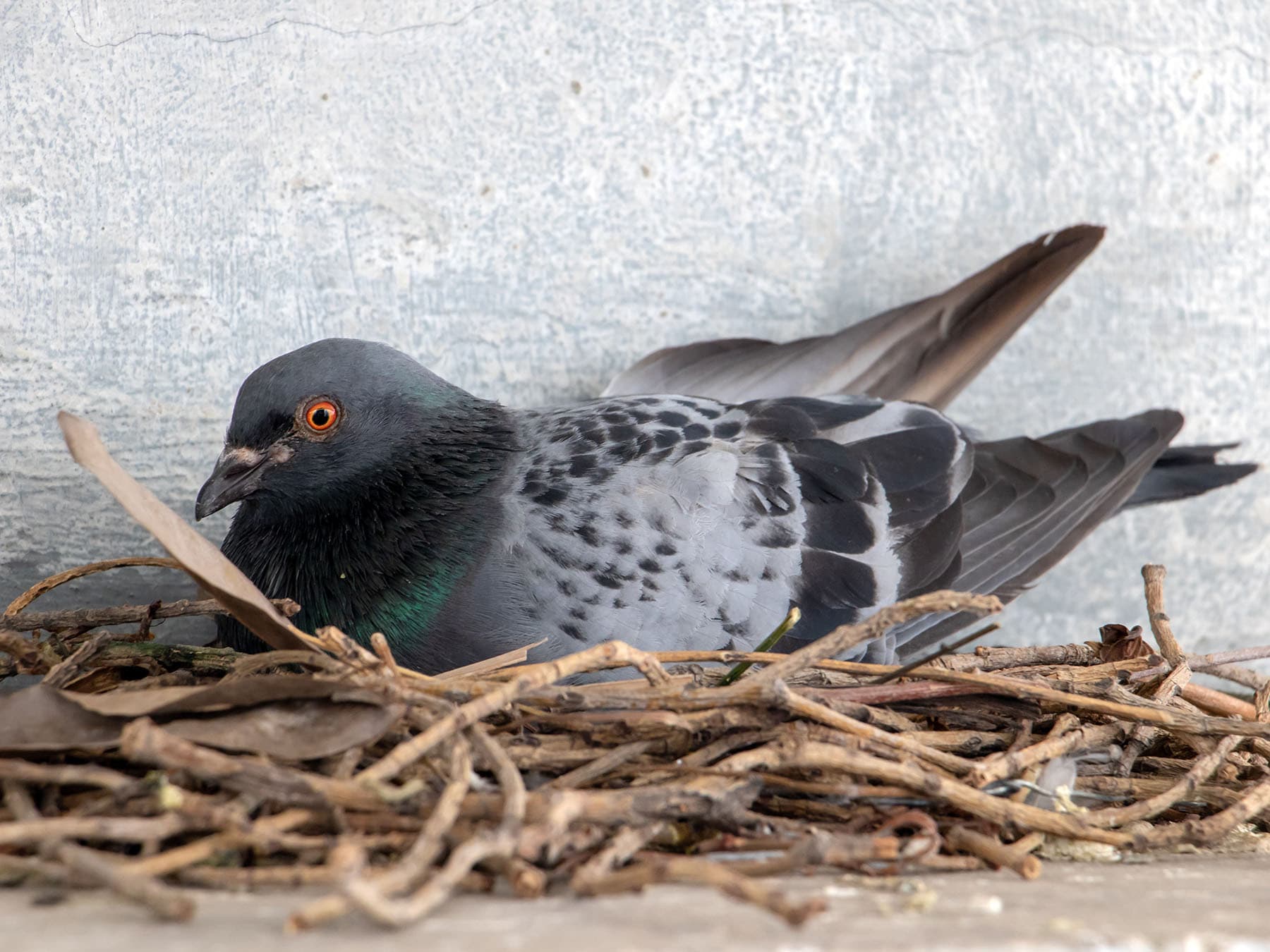
Behaviour
Feral pigeons feed, roost and fly in flocks and nest in colonies, some of up to 1,000 birds, though living in groups is not obligatory. Pairs usually stay together for life. Courtship starts with the bow-coo and moves on to mutual preening; the female begs, the male passes her food from his crop, and they mate. Afterwards the male often makes a display flight, clapping his wings 3-5 times and gliding with them raised in a V.
The head-bob seems to be mainly a way of seeing. As a pigeon walks, its head stays still while the body moves forward beneath it, then darts ahead to the next fixed point. On a treadmill, where the view does not change, pigeons stop bobbing.14
Pigeons feed early, rest under cover at midday and feed again before dusk; those that live on handouts keep to people's hours and may seek out people who feed them. They sleep standing on one leg with the head drawn in, non-breeders in groups and pairs on their nest. They bathe in rain and sunbathe leaning over on one side with a wing raised.
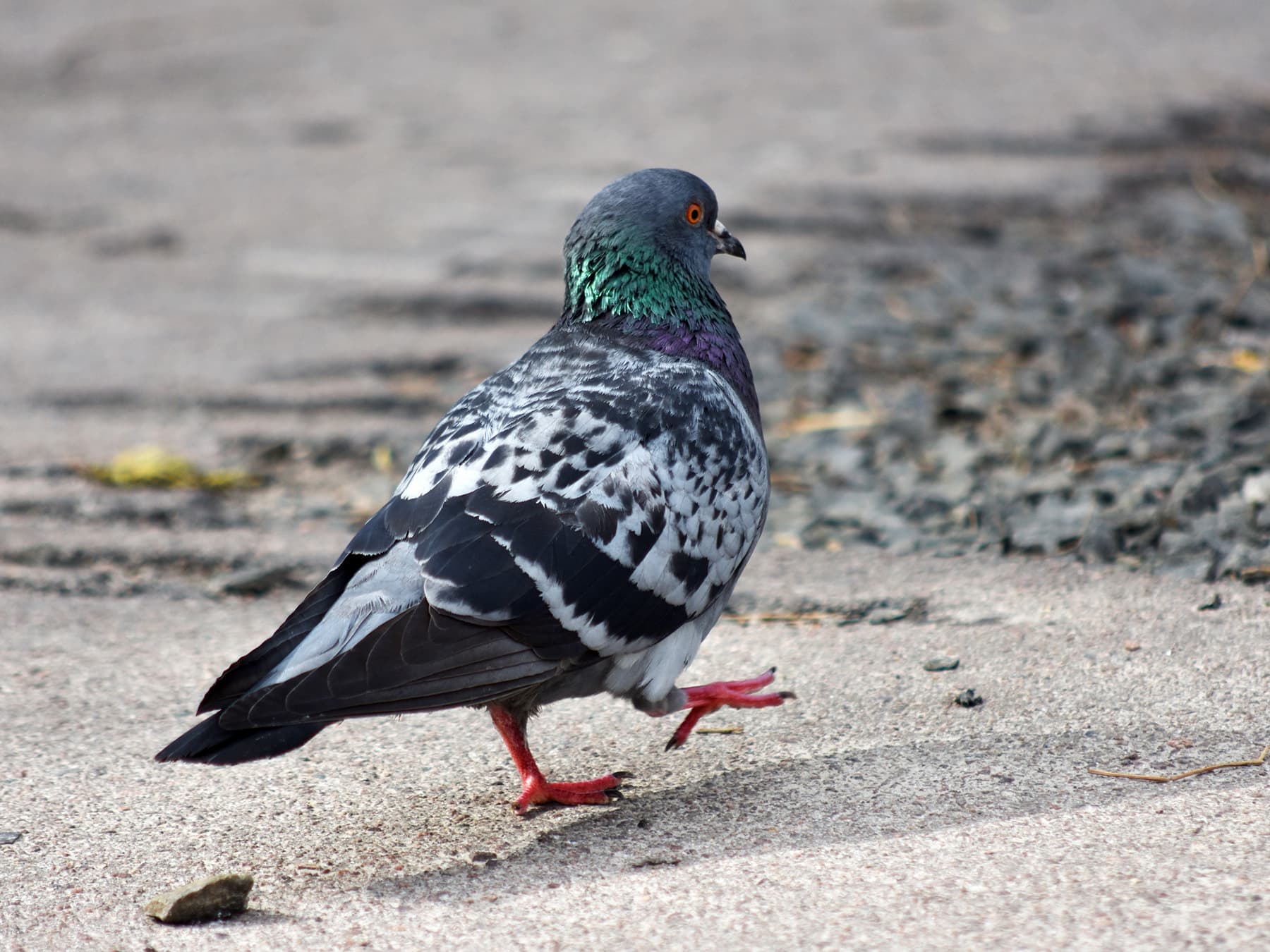
Flight and homing
Pigeon flight is strong and direct, powered by flight muscles that make up about 31% of the bird's weight; homing pigeons can fly 480 km (300 miles) in 7 hours, an average of 69 km/h (43 mph).3 Homing and racing pigeons are the same species, bred for their ability to find their way back to their loft.
How they do it is still debated. Pigeons use the sun as a compass and, when it is hidden, the earth's magnetic field. How they work out where they are in the first place, the "map" step, is less clear: smell, magnetism and low-frequency sound have all been proposed. On familiar routes they also follow landmarks and other pigeons.
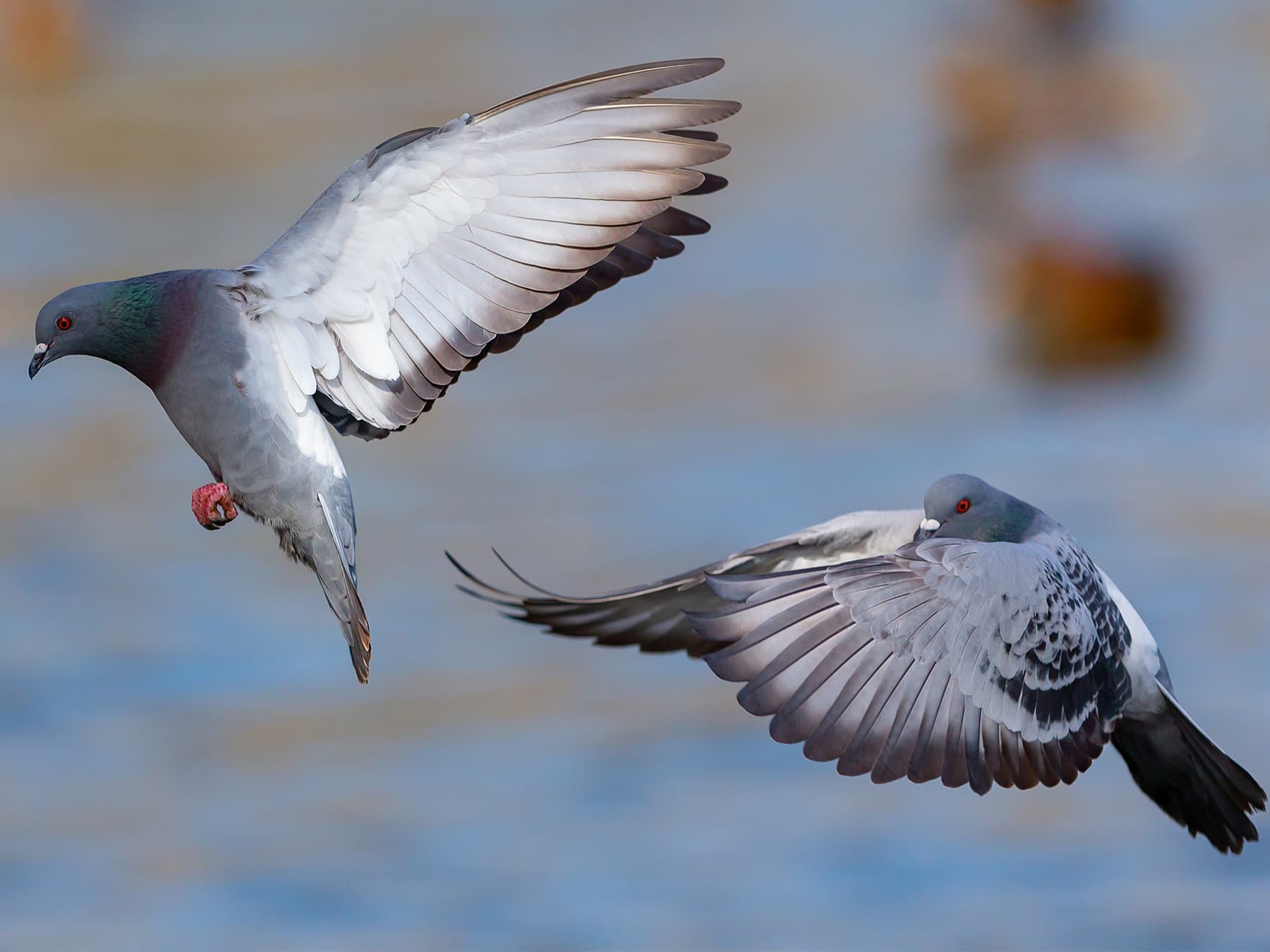
Lifespan and predators
A feral pigeon that reaches breeding age lives about three years on average: about two in three adults survive from one year to the next, and 57% of young birds survive their first year.9
The oldest ringed Rock Dove in Britain and Ireland was caught alive by a ringer on Fair Isle, Shetland, in 2023, 10 years 6 months 2 days after it was ringed as a full-grown bird.15 On EURING's European list the oldest of the species is a pigeon of the domestic form in Finland, also caught alive by a ringer, at 11 years 3 months; EURING counts age from the likely year of hatching, so for a bird ringed full-grown its figure is a minimum.16 Kept pigeons can live far longer. More: how long pigeons live, and the records.
Predators and other dangers
Pigeons are a favourite prey of the Peregrine, which takes adults in flight, and they help support the Peregrines that stay around cities. Hawks take perched birds, and owls, crows, ravens, gulls and, in North America, raccoons and opossums take adults, eggs or young.3 Mites, common in nests, can kill pigeons, and pigeons at high latitudes can starve if snow lies unbroken for four days or more. Threads, string, hair and fishing line wound round the feet are a common cause of the deformed feet seen on town pigeons.17
Conservation
The Rock Dove is of Least Concern worldwide and on the UK's Green list.9 Partners in Flight puts the world population at about 140 million birds,18 and the UK population is about 465,000 pairs. UK numbers are poorly monitored: the Breeding Bird Survey shows a moderate long-term decline that is not statistically significant. In North America the Breeding Bird Survey shows a decline of 0.85% a year in the United States from 1966 to 2025.19
The bird in trouble is the wild Rock Dove. Interbreeding with feral pigeons is the greatest threat to wild populations: where feral pigeons arrive, they come to dominate.
Legal status
In the UK, feral pigeons are wild birds in law, protected with their nests and eggs like other birds by the Wildlife and Countryside Act 1981 in Great Britain20 and the Wildlife (Northern Ireland) Order 1985.21 General licences in each nation, GL41 and GL42 in England,22, 23 GL002 in Wales,24 GL03 in Scotland25 and TPG1 in Northern Ireland,26 let owners or occupiers of the land, or people they authorise, kill or take feral pigeons, and take their nests and eggs, for set purposes such as protecting public health and safety.
In the United States the Rock Pigeon is a non-native species and is not covered by the Migratory Bird Treaty Act.27 If pigeons are nesting on your building, the RSPCA's advice is to leave an active nest alone until the young have flown.28
Similar birds
Often mistaken for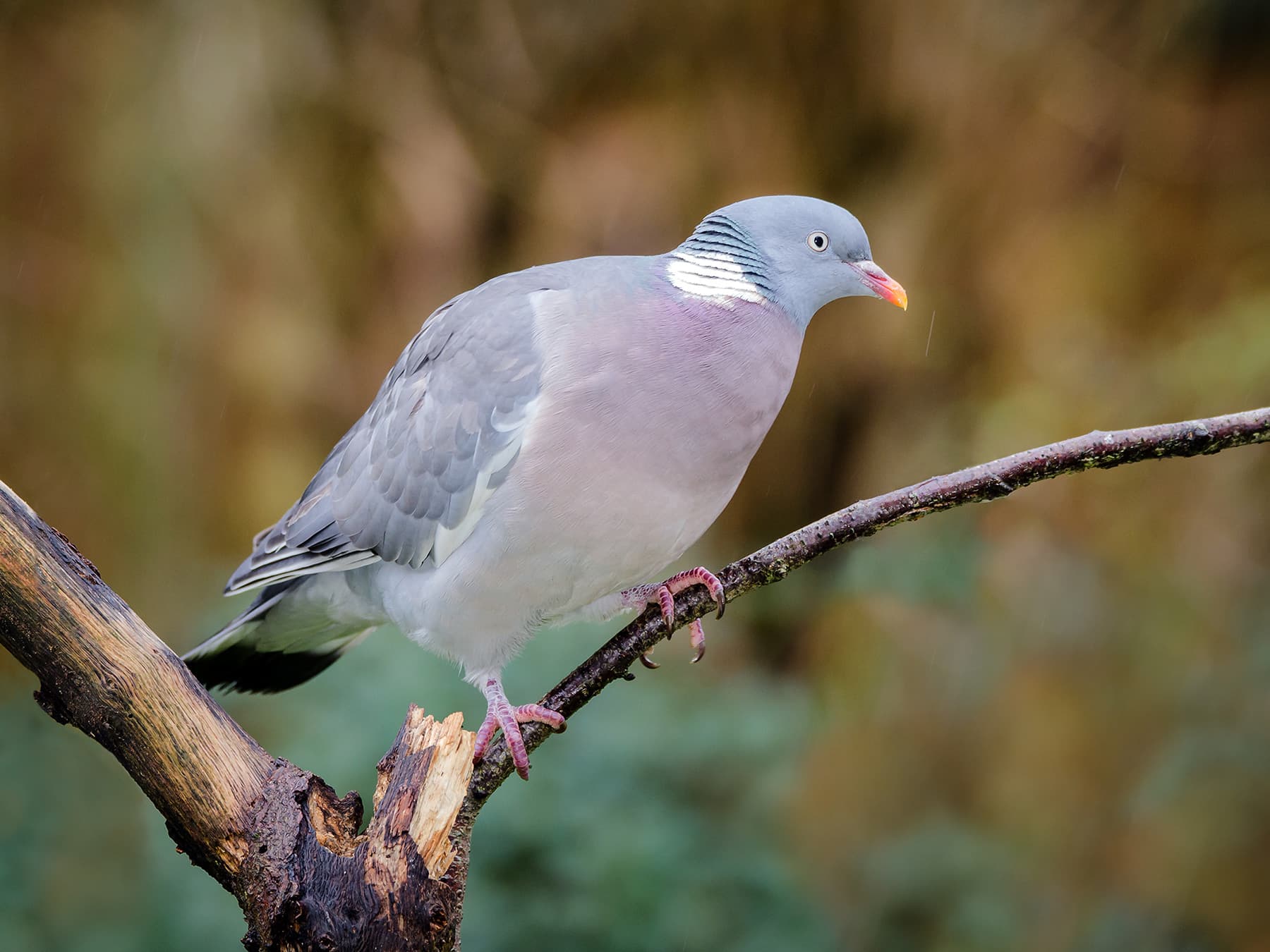
More photos
8 photos A feral pigeon of the wild type on gravel
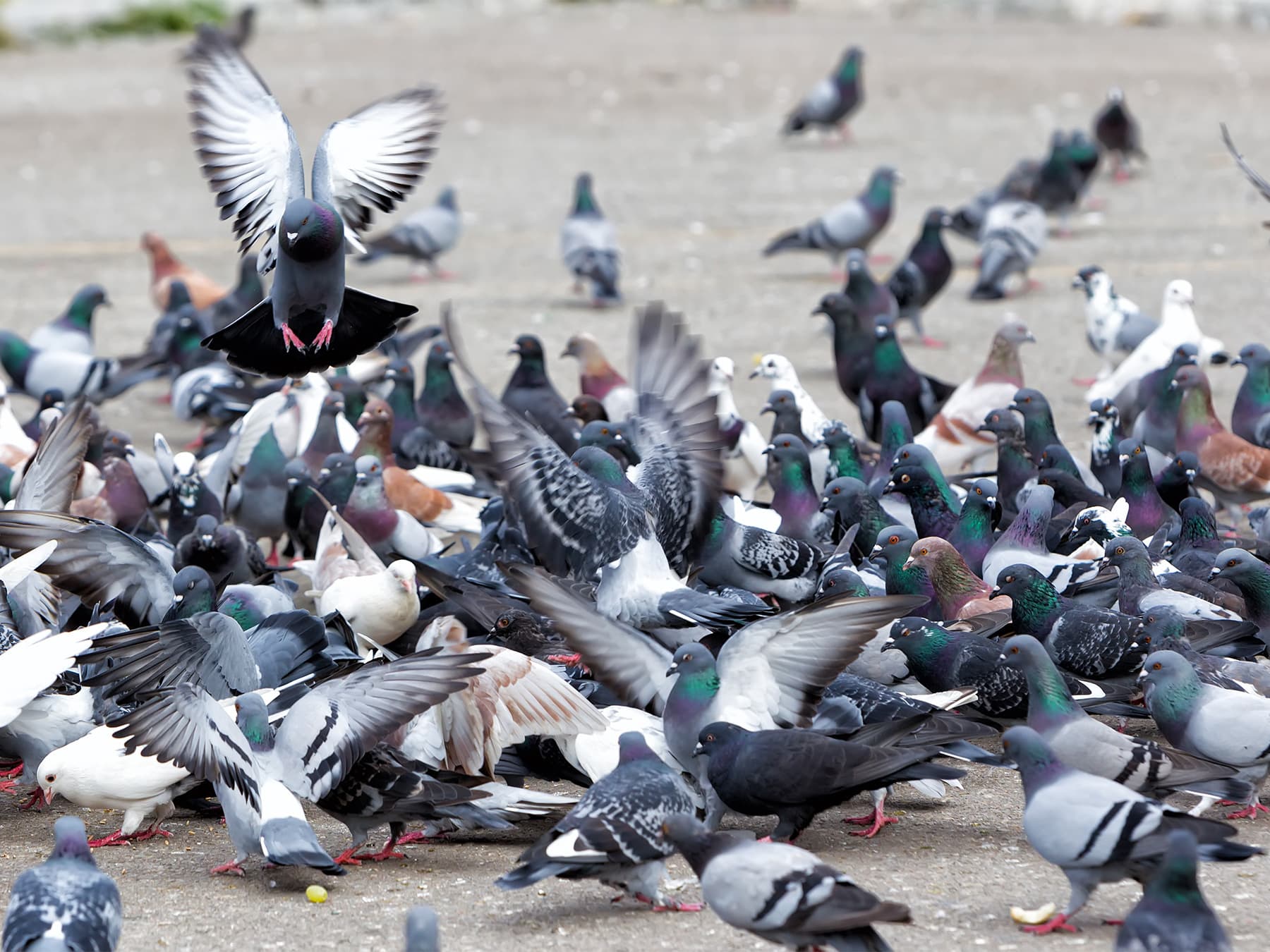 A feeding flock of feral pigeons in many colours
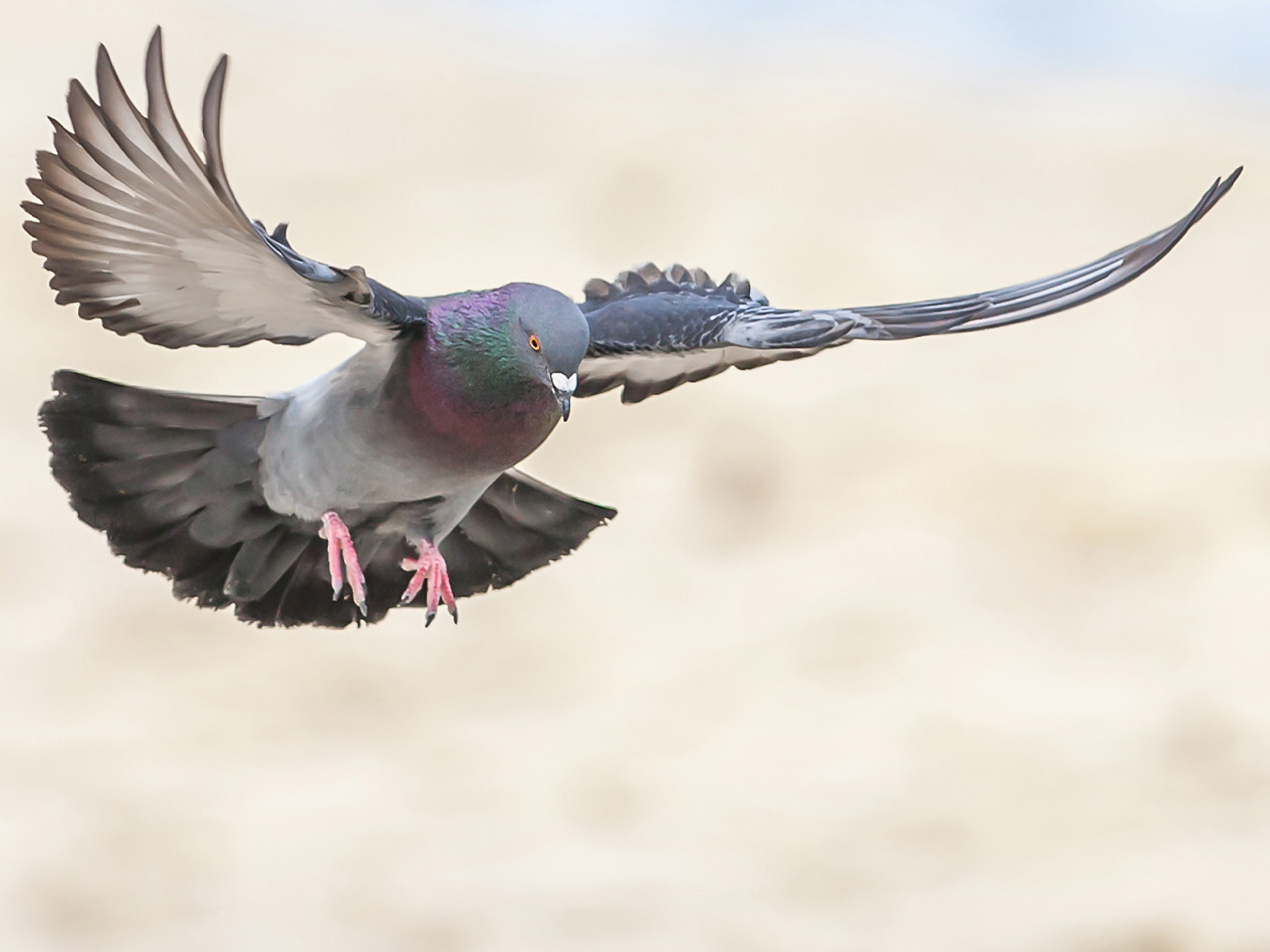
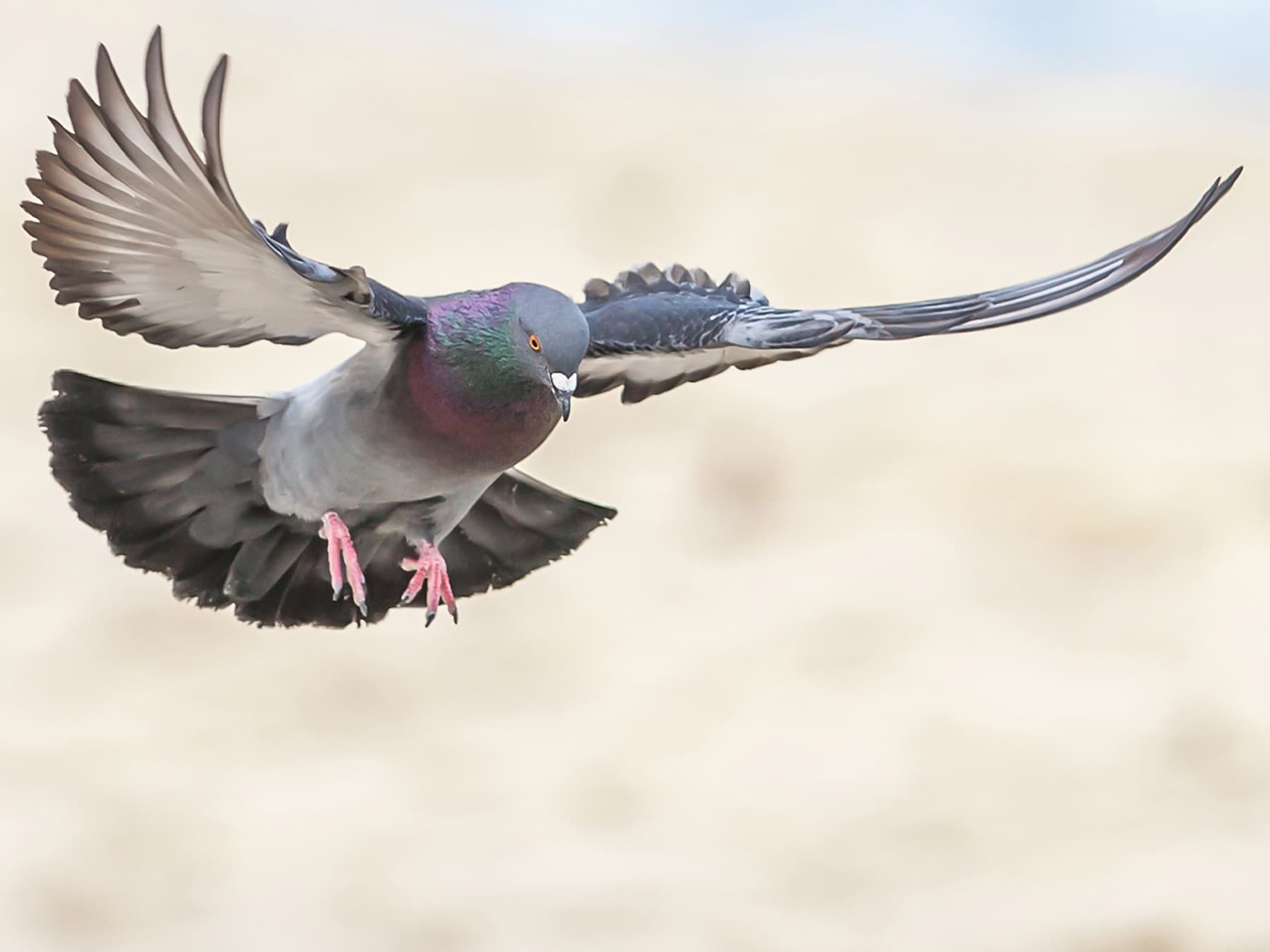 A feral pigeon in flight with its wings raised
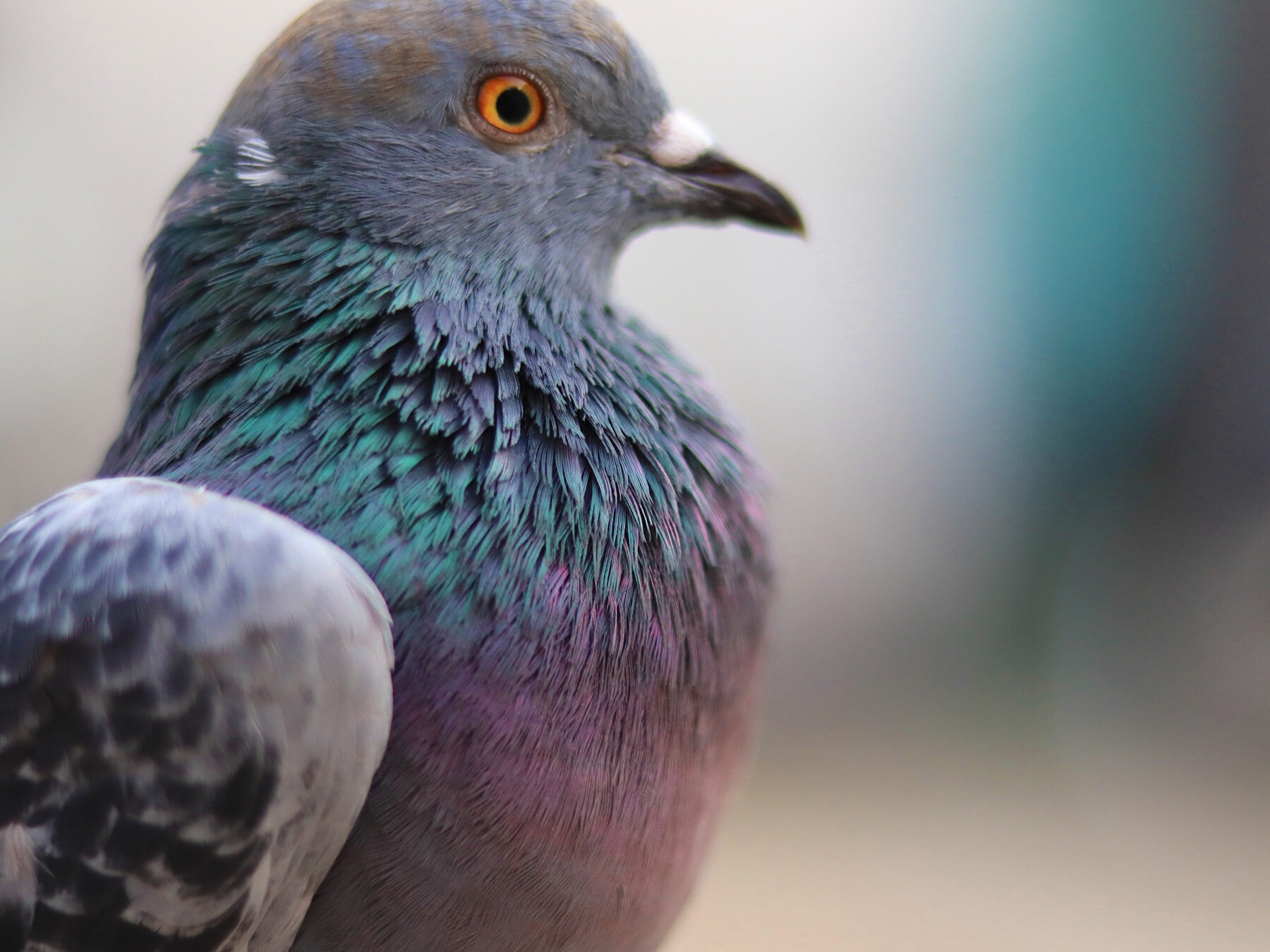
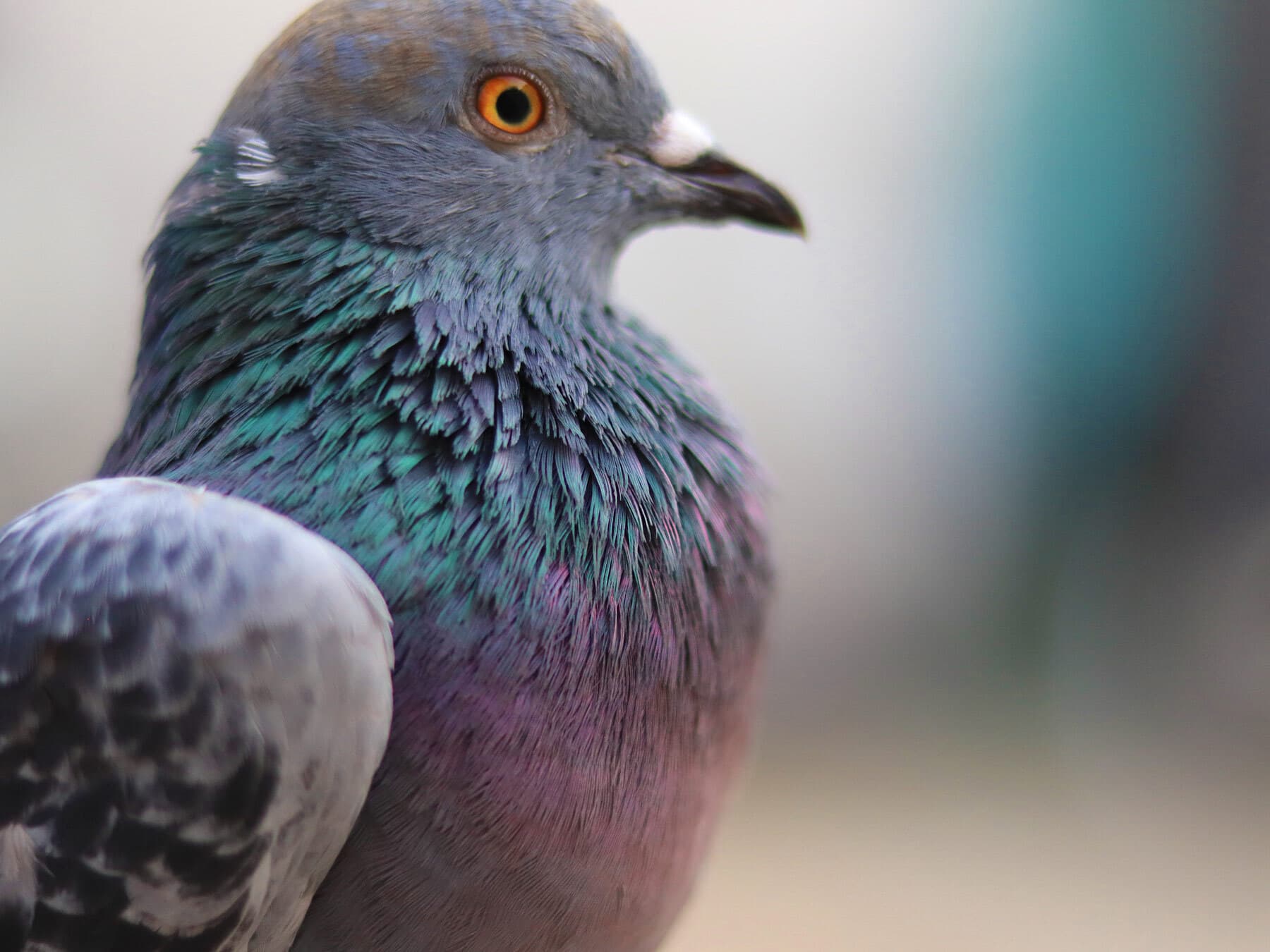 Close-up of the green and purple sheen on a pigeon's neck
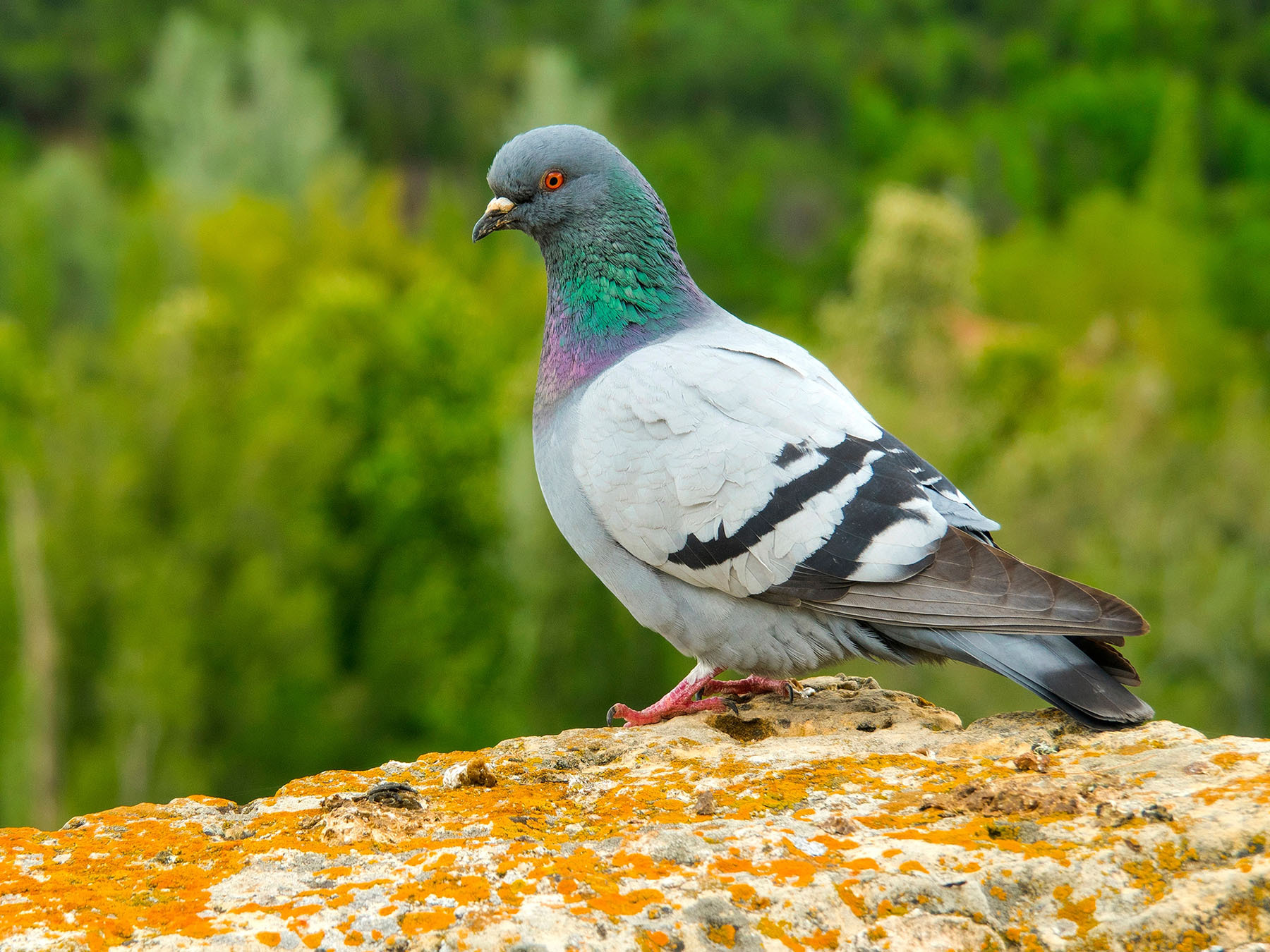
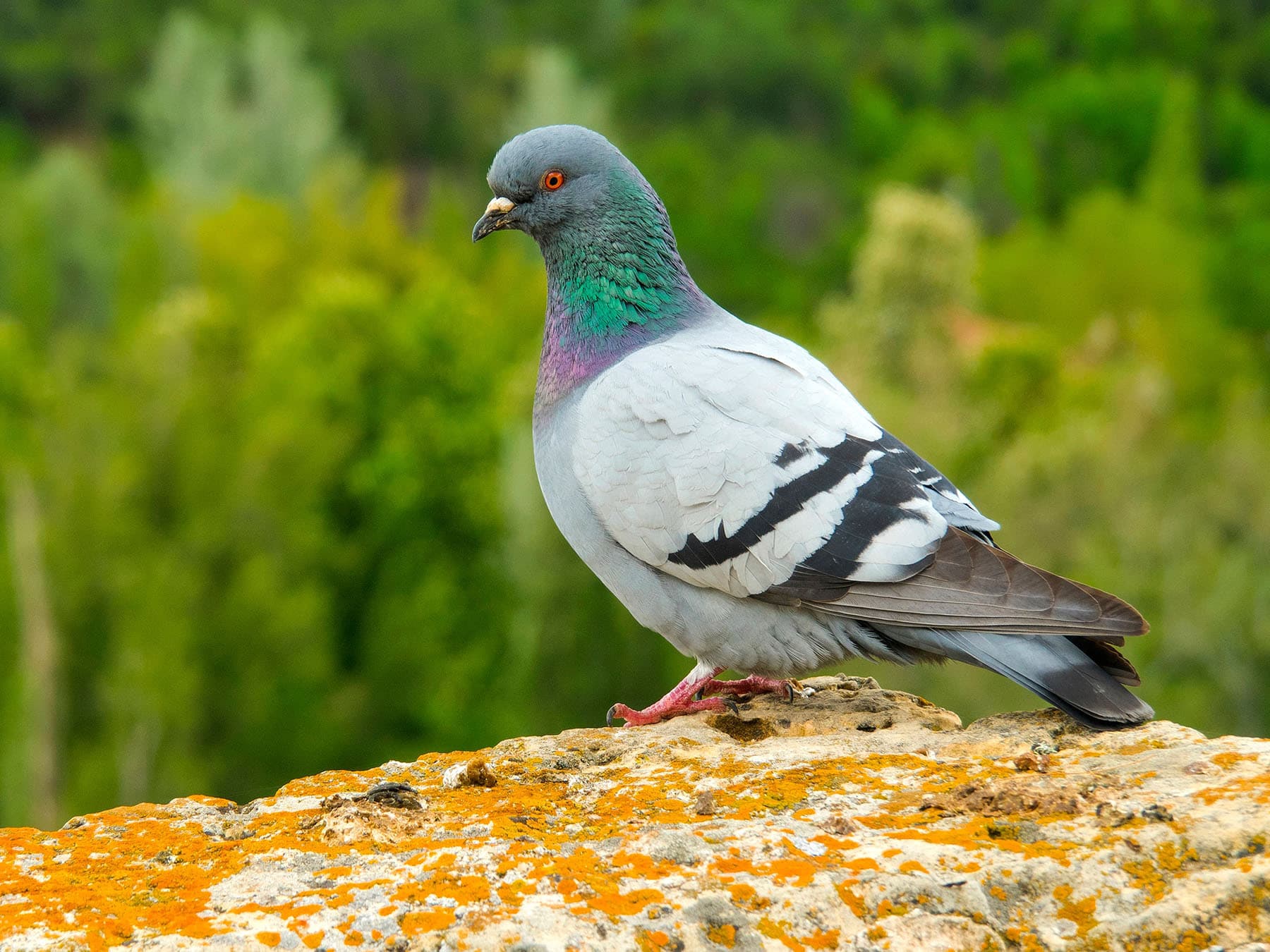 A pale feral pigeon on a lichen-covered rock
 A white feral pigeon by a river
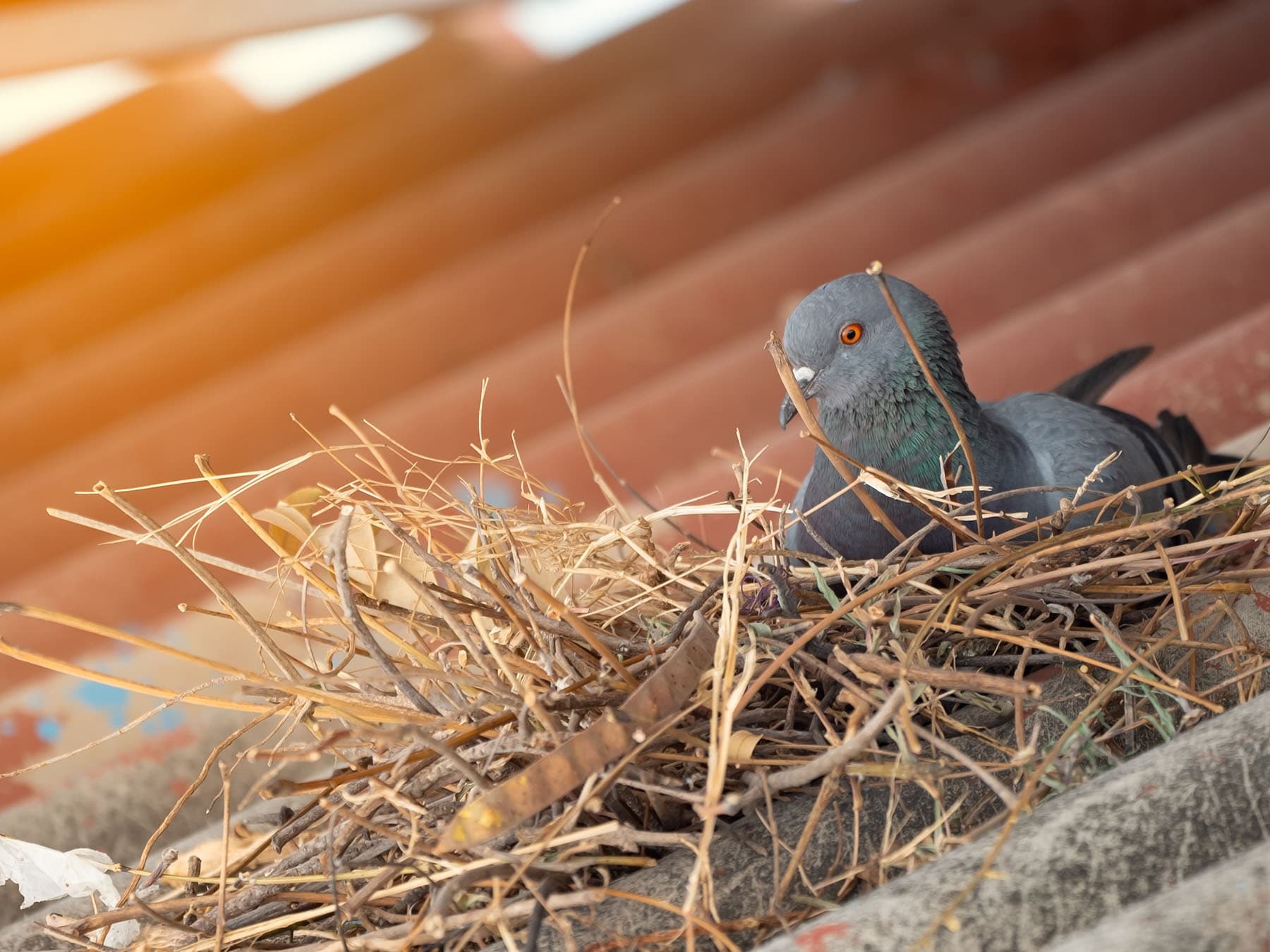 A feral pigeon on its nest under roof sheeting
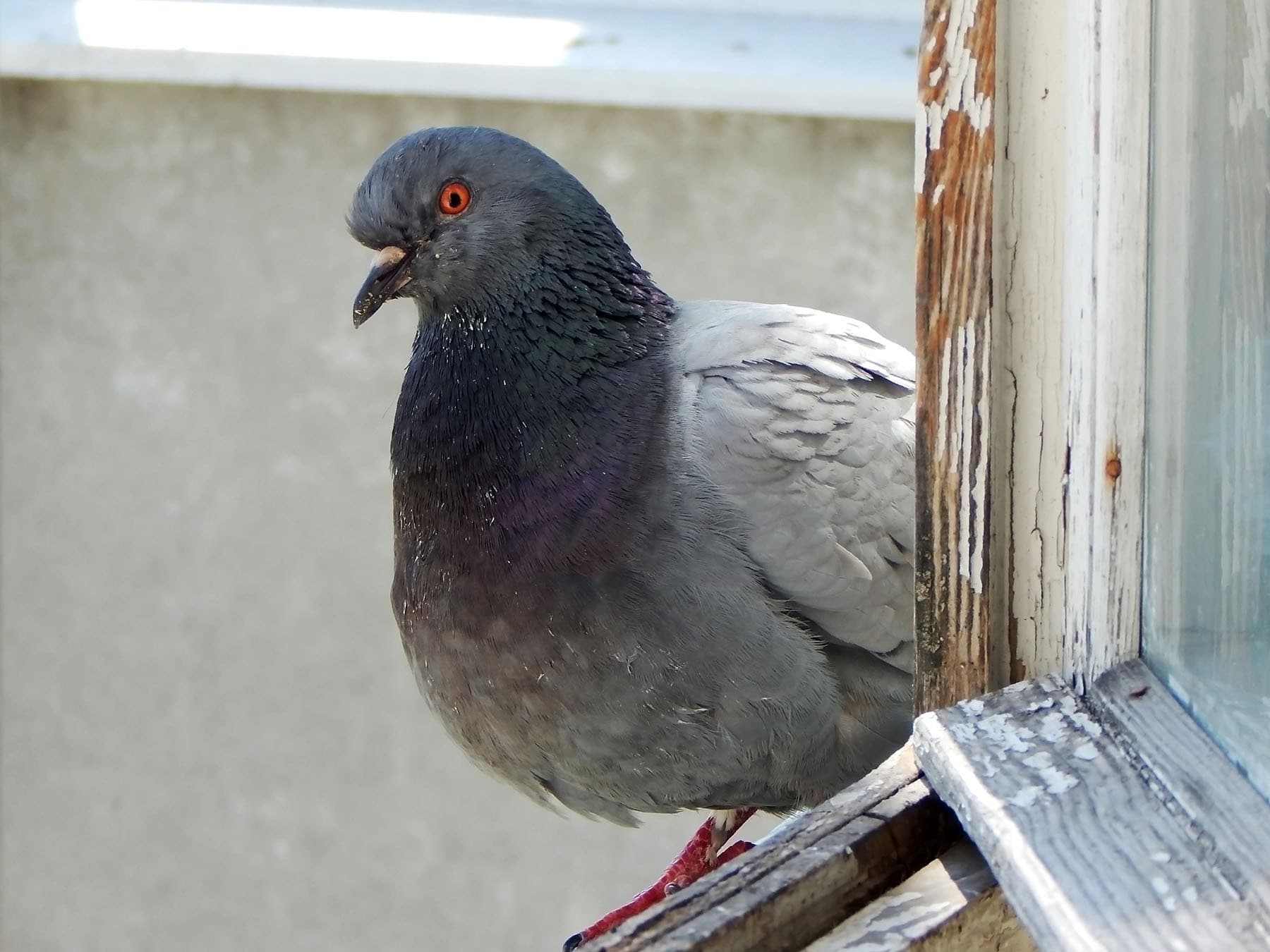 A feral pigeon on a window ledge
Rock Dove guides
2 guidesQuick facts
- Length
- 31–34 cm
- Wingspan
- 63–70 cm
- Weight
- 230–370 g
- Lifespan
- 3 years · oldest recorded 11.25 years · UK record 10 years 6 months
- Family
- Pigeons & Doves
- Migration
- Resident
- Global status (IUCN)
- Least Concern
- World population
- About 140 million (Partners in Flight)
- Population trend
- UK: poorly monitored; long-term decline not statistically significant (BTO). US: -0.85% a year 1966-2025 (Breeding Bird Survey)
- Also called
- Feral Pigeon, Rock Pigeon, City Pigeon
- Scientific name
- Columba livia
Questions
4Are pigeons and doves the same?
Pigeons and doves belong to the same family, and there is no scientific line between the two words: people tend to call the smaller, more delicate species doves and the stouter ones pigeons. The town pigeon and the wild Rock Dove are one species.1 More: pigeons vs doves.
Do pigeons mate for life?
As a rule, yes. Pigeons are monogamous and pair for life, and extra-pair matings were found in only about 1% of nests in a Kansas study. A female that loses her mate pairs with another male. More: do pigeons mate for life?
Do pigeons carry diseases?
Like other animals, pigeons carry diseases, but the RSPCA says they rarely carry any that spread to people or pets through casual contact. Their droppings, like other animals', can hold bacteria and parasites harmful to people, so avoid touching them and wash your hands if you do.
Why do you never see baby pigeons?
Because they stay hidden in the nest, on a ledge under cover, until they are about a month old and nearly adult-sized. More about baby pigeons.
Sources
29- 1RSPB (2025). Doves vs Pigeons. What's the difference?. RSPB, Identifying birds. Accessed 26 October 2026. Source (opens in a new tab)
- 2RSPB. Rock Dove/Feral Pigeon. RSPB Birds A-Z. Accessed 26 October 2026. Source (opens in a new tab)
- 3Lowther, P. E. and Johnston, R. F. (2020). Rock Pigeon (Columba livia), version 1.0. Birds of the World (S. M. Billerman, editor). Cornell Lab of Ornithology. doi:10.2173/bow.rocpig.01 (opens in a new tab)
- 4Cornell Lab of Ornithology. Rock Pigeon overview and life history. All About Birds. Accessed 26 October 2026. Source (opens in a new tab)
- 5Smith, W. (2022). Wild Rock Doves: solving a genetic enigma. BTO blog. Accessed 26 October 2026. Source (opens in a new tab)
- 6RSPCA. Pigeons in the UK: facts, behaviour and common myths. RSPCA Advice and welfare. Accessed 26 October 2026. Source (opens in a new tab)
- 7BTO. Stock Dove (Columba oenas). BTO BirdFacts. Accessed 26 October 2026. Source (opens in a new tab)
- 8National Audubon Society. Mourning Dove. Audubon Guide to North American Birds. Accessed 26 October 2026. Source (opens in a new tab)
- 9BTO. Rock Dove (Columba livia). BTO BirdFacts. Accessed 26 October 2026. Source (opens in a new tab)
- 10Smith, W. J. et al. (2022). Limited domestic introgression in a final refuge of the wild pigeon. iScience 25: 104620. doi:10.1016/j.isci.2022.104620 (opens in a new tab)
- 11Shapiro, M. D., Kronenberg, Z., Li, C., Domyan, E. T. et al. (2013). Genomic diversity and evolution of the head crest in the rock pigeon. Science 339: 1063-1067. doi:10.1126/science.1230422 (opens in a new tab)
- 12National Audubon Society. Rock Pigeon. Audubon Guide to North American Birds (text adapted from Kaufman, Lives of North American Birds, 1996). Accessed 26 October 2026. Source (opens in a new tab)
- 13Gillespie, M. J., Haring, V. R., McColl, K. A., Monaghan, P. et al. (2011). Histological and global gene expression analysis of the 'lactating' pigeon crop. BMC Genomics 12: 452. doi:10.1186/1471-2164-12-452 (opens in a new tab)
- 14Frost, B. J. (1978). The optokinetic basis of head-bobbing in the pigeon. Journal of Experimental Biology 74: 187-195. doi:10.1242/jeb.74.1.187 (opens in a new tab)
- 15BTO. Longevity records for Britain & Ireland in 2024. BTO Online Ringing and Nest Recording Report. Accessed 26 October 2026. Source (opens in a new tab)
- 16Fransson, T., Kolehmainen, T., Moss, D. and Robinson, R. (2023). EURING list of longevity records for European birds (1 September 2023). EURING. Accessed 26 October 2026. Source (opens in a new tab)
- 17RSPCA. Found a sick or injured pigeon. RSPCA Advice and welfare. Accessed 26 October 2026. Source (opens in a new tab)
- 18Partners in Flight (2023). Population Estimates Database, version 3.1 (2023). Accessed 26 October 2026. Source (opens in a new tab)
- 19Hostetler, J. A. et al. (2025). The North American Breeding Bird Survey, Analysis Results 1966-2025. U.S. Geological Survey data release. doi:10.5066/P1OSNSFC (opens in a new tab)
- 20UK Parliament (1981). Wildlife and Countryside Act 1981, section 1. Accessed 7 October 2026. Source (opens in a new tab)
- 21UK Government (1985). The Wildlife (Northern Ireland) Order 1985, Article 4. Accessed 8 October 2026. Source (opens in a new tab)
- 22Natural England (2026). GL41: general licence to kill or take certain species of wild birds to preserve public health or public safety. Accessed 26 October 2026. Source (opens in a new tab)
- 23Natural England (2026). GL42: general licence to kill or take certain species of wild birds to prevent serious damage. Accessed 26 October 2026. Source (opens in a new tab)
- 24Natural Resources Wales (2026). General Licence 002 (WCA/GEN/002/2026): to kill or take feral pigeon to preserve public health, public safety or prevent the spread of disease. Accessed 26 October 2026. Source (opens in a new tab)
- 25NatureScot (2026). General licence for birds GL03/2026: to kill or take, or damage or destroy the nest and eggs of, certain birds to preserve public health, public safety and prevent the spread of disease. Accessed 26 October 2026. Source (opens in a new tab)
- 26Department of Agriculture, Environment and Rural Affairs (2026). General licence TPG/1/2026: to kill or take certain birds for the purpose of preserving public health or public safety. Accessed 26 October 2026. Source (opens in a new tab)
- 27U.S. Fish and Wildlife Service (2020). List of Bird Species To Which the Migratory Bird Treaty Act Does Not Apply. Federal Register 85: 21262 (16 April 2020). Accessed 26 October 2026. Source (opens in a new tab)
- 28RSPCA. Living with pigeons. RSPCA Advice and welfare. Accessed 26 October 2026. Source (opens in a new tab)
- 29BTO. Nest boxes for birds. BTO, Helping birds. Accessed 26 October 2026. Source (opens in a new tab)

Checked by
Nathan Cope, founder and editor
Nathan founded Birdfact and leads its writers and contributors in the UK, the US and Canada. He has watched and studied birds for more than ten years, and checks every article and species guide before it’s published.