
Philippine Eagle
Monkey-eating Eagle, Great Philippine Eagle · Pithecophaga jefferyi
By the Birdfact teamChecked by Nathan Cope
On this page12 sections
How to recognise it
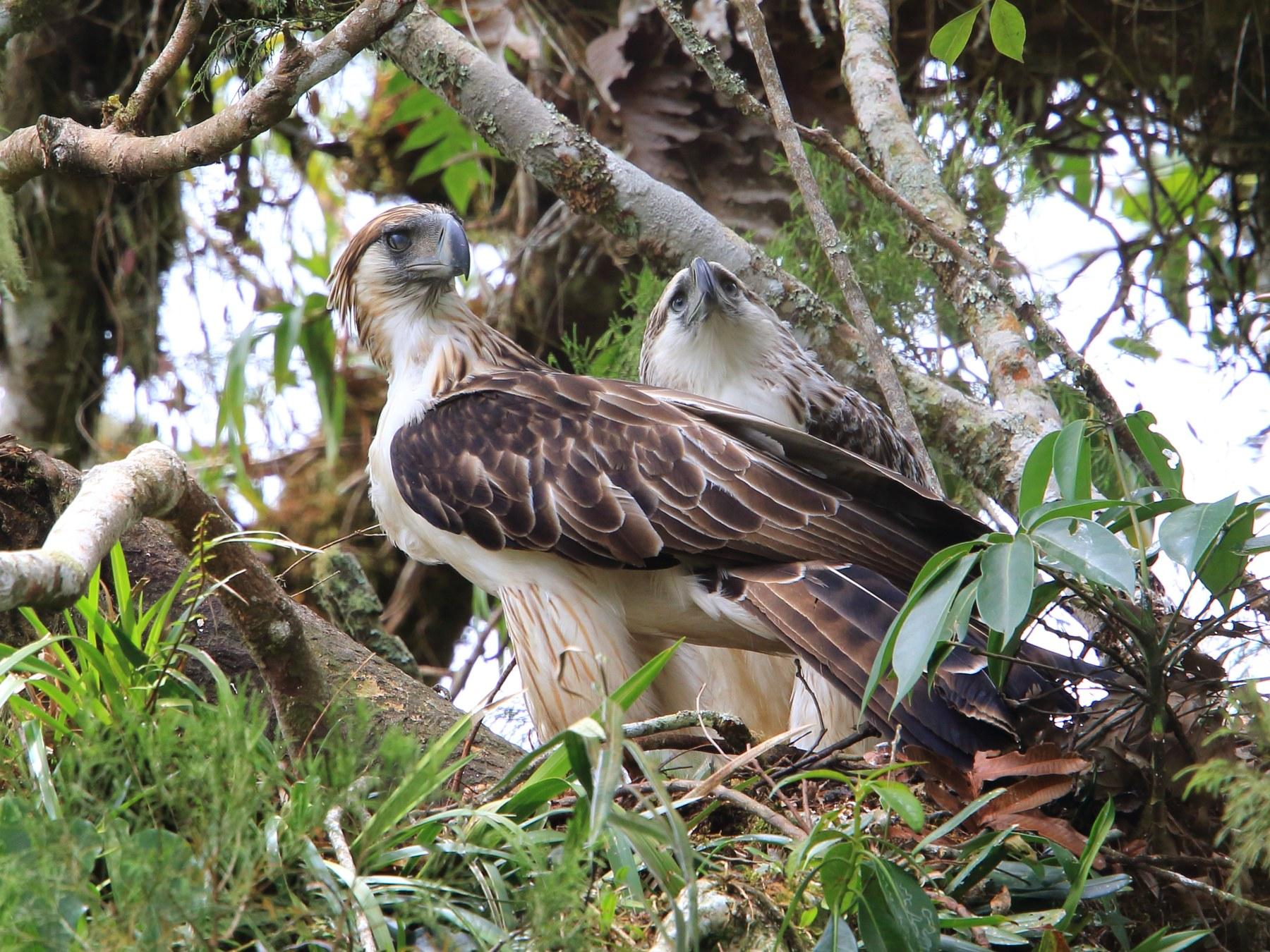
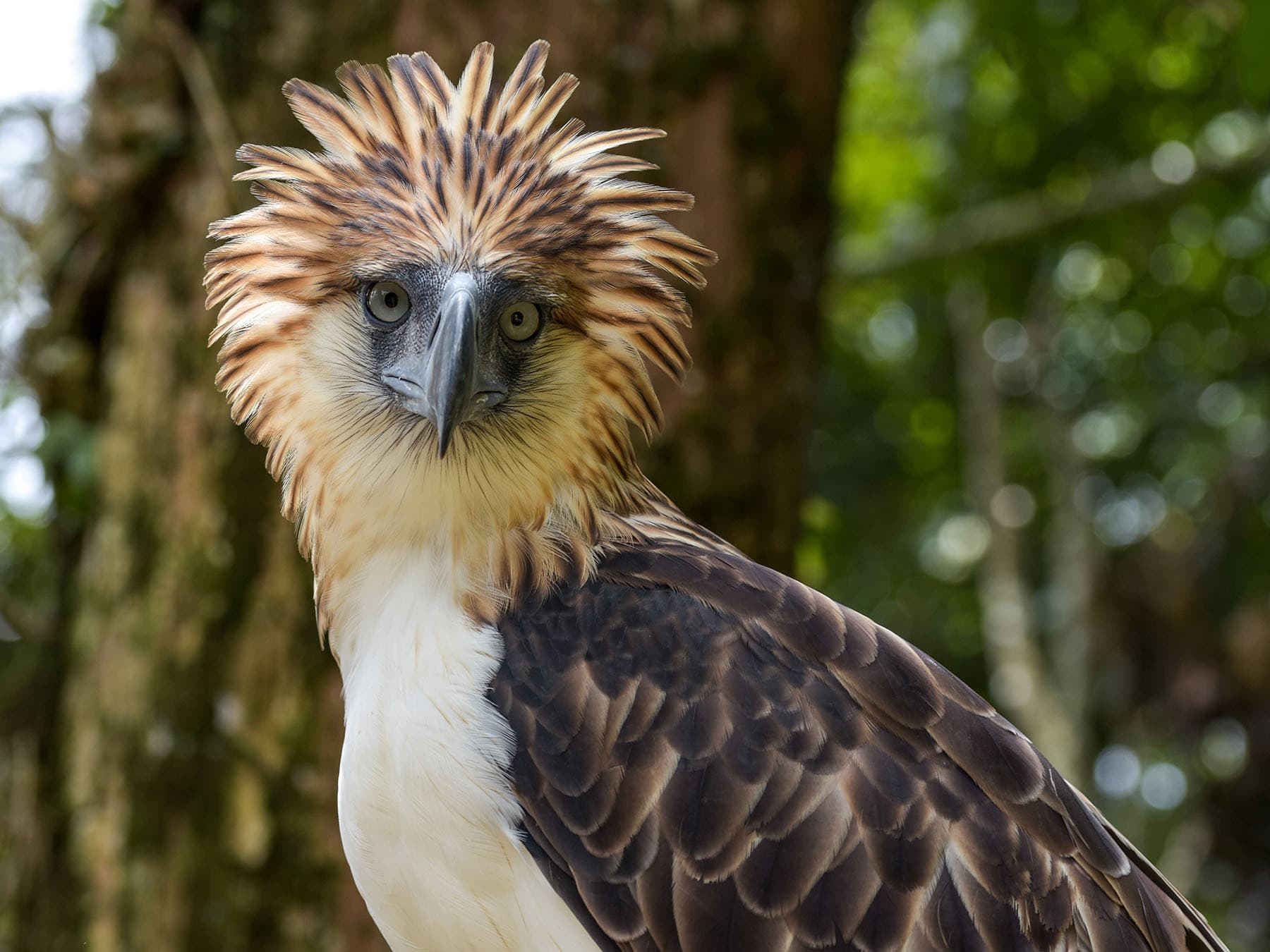
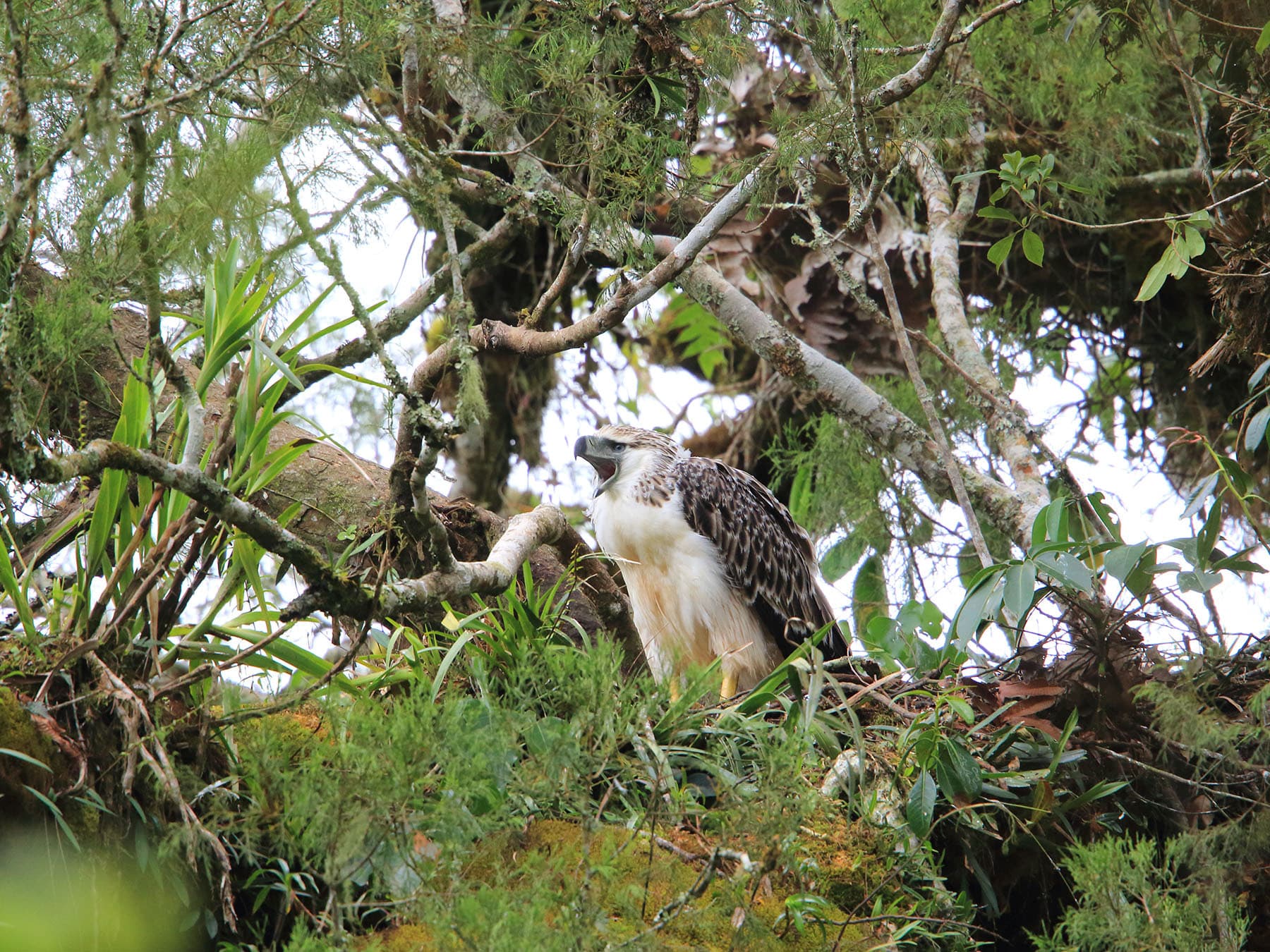
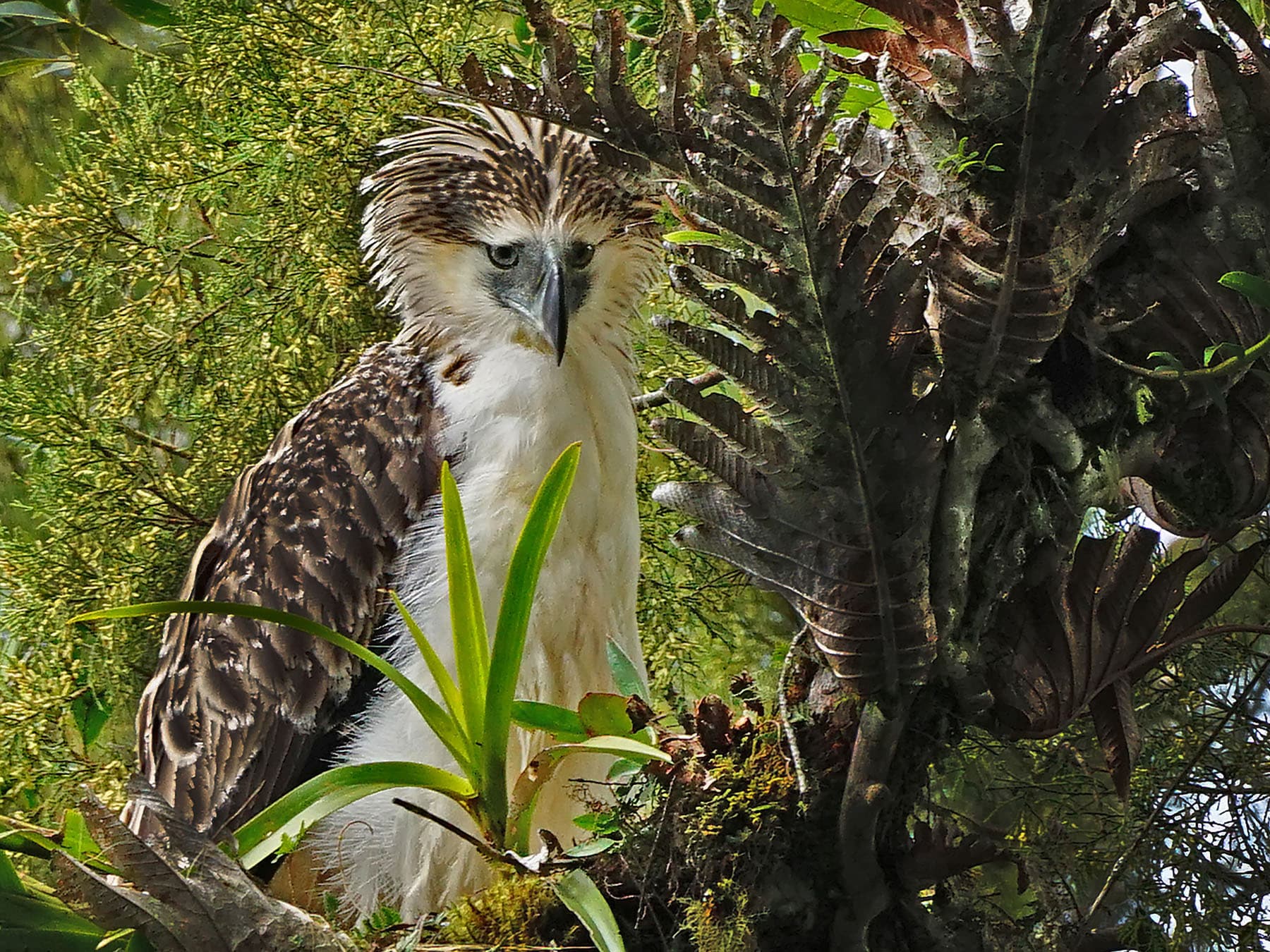
The Philippine Eagle has a large, deep bill and long feathers on the back of the head that form a shaggy crest. Adults are brown above and creamy white below, with a buff crown and crest boldly streaked with black.
Close up, look for the bluish-grey eye, the greenish-grey to greenish-black cere at the base of the bill and the yellow feet. The brown feathers of the back have buff and cream edges, and there are rufous streaks on the sides of the throat and on the thighs.
Its scientific name is Pithecophaga jefferyi. W. R. Ogilvie-Grant described it in 1896 from a specimen from Samar, and it is the only species in its genus, with no subspecies. DNA studies place it with the snake eagles rather than with the group that includes the Harpy Eagle.1
It was long known as the Monkey-eating Eagle, and is also called the Great Philippine Eagle. A presidential proclamation of 8 May 1978 made Philippine Eagle its official name, saying the old one 'denigrates its qualities'.2 It was declared the national bird of the Philippines on 4 July 1995.3
Size and weight
A Philippine Eagle is 90-100 cm (35-39 in) long, with a wingspan of 184-202 cm (about 6 ft to 6 ft 8 in), and weighs 4.7-8.0 kg (10.4-17.6 lb). The Philippine Eagle Foundation calls it the largest forest raptor in the Philippines and among the largest and most powerful of forest raptors.4
There is more on its measurements in our guide to Philippine Eagle size.
Male, female and young
Males and females look alike, and Birds of the World gives no separate measurements for the two sexes.
Young birds look like adults but have white edges to the feathers of the back and the upperwing coverts, a brown eye rather than the adult's bluish-grey, and paler, whitish-yellow feet. We found no source for how many years a young bird takes to reach adult plumage.
Identification: similar species
Several much smaller crested birds of prey share its islands, among them these three. A Philippine Hawk-Eagle is 56-69 cm long, with a white throat, a dark-streaked rufous breast and blackish-barred thighs. A Pinsker's Hawk-Eagle is 54-61 cm long and weighs about 1.2 kg; adults have a bright yellow eye and a white throat with a broken black central stripe. A Philippine Serpent Eagle is about half the length, at 47-53 cm, with a short bushy crest, yellow eyes and a broad pale band across the tail and flight feathers.
Not sure it’s a Philippine Eagle? Check your photo: Birdfact names the bird and shows the look-alike side by side.
Its size
Adults- Length
- 90–100 cm
- Wingspan
- 184–202 cm
- Weight
- 4700–8000 g
Its song and calls
Its call is fairly weak for a bird of this size. The usual call is a mellow, drawn-out whistle, 'wheeeeuw', given again and again; each call lasts about 0.8 seconds and usually drops slightly in pitch.5 Begging young give a high-pitched series of notes.
Heard one and not sure? Let the bird song identifier listen.
When and where to see it
The Philippine Eagle stays in the same forest all year. Within the Philippines it has been recorded on Luzon (in the east), Samar, Leyte and Mindanao, and Mindanao is its stronghold, with most of the population.
On Leyte, a 2026 study says the native population was lost after Typhoon Haiyan, called Yolanda in the Philippines, in 2013, and that work to bring eagles back is under way; the study picked release sites in the Anonang-Lobi Range and on Mount Nacolod.6 The same study says the suitable forest left on Mindanao is now considered saturated by existing pairs.6
Its home is primary dipterocarp forest, above all on steep slopes. It will use secondary and gallery forest at times, though not forest with an open canopy, and turns up less often in patches of forest cut off by cleared land. It has been found from sea level to 2,000 m.
Each pair needs a lot of room. Six adults fitted with GPS tags on Mindanao between 2013 and 2021 had a median home range of 68 km², with individual ranges of 39-161 km², and a median core area of 13 km².7
Spotting tips
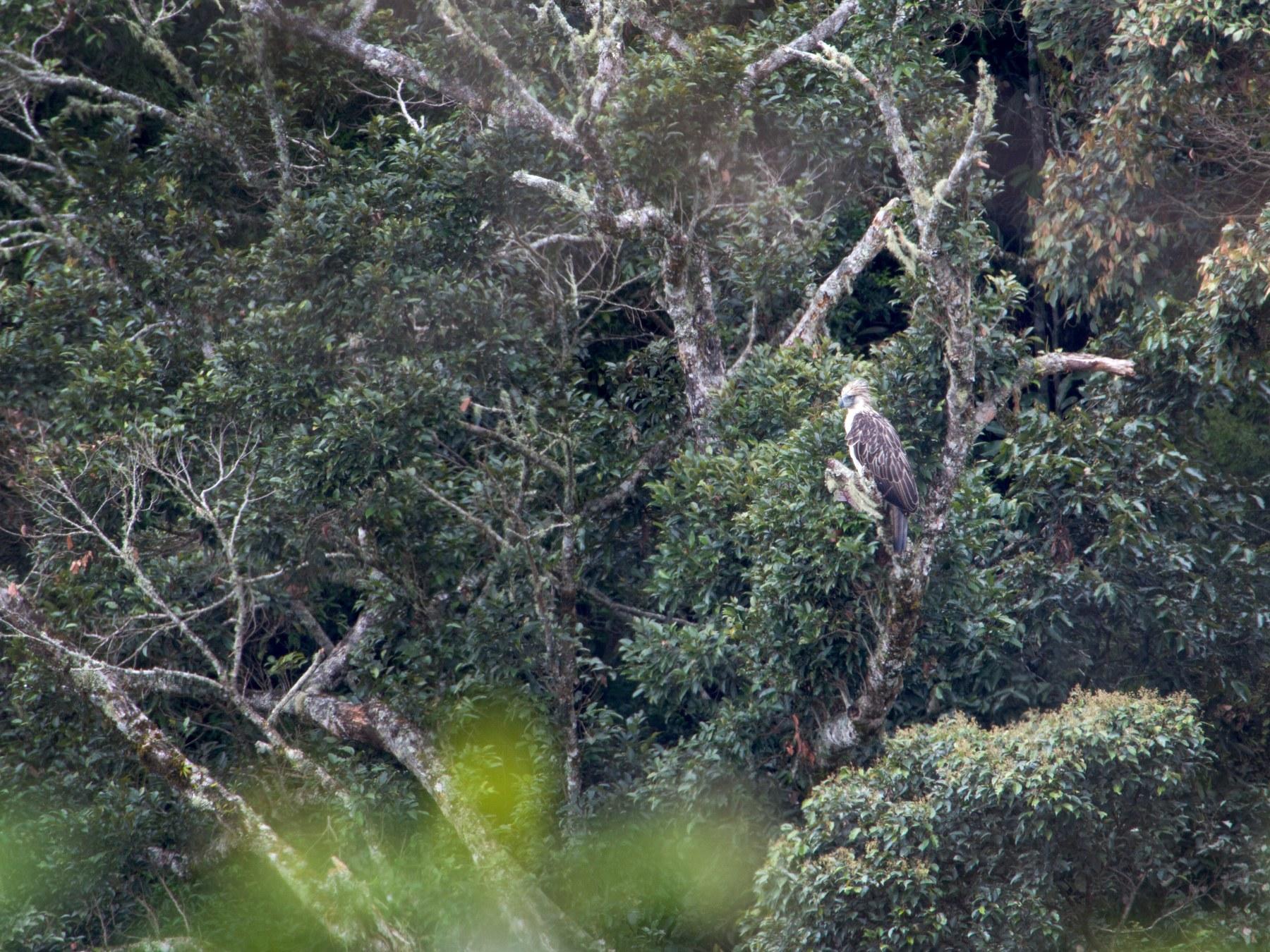
A hunting bird works its way downhill through the canopy from perch to perch, then soars back up to the top of the slope to start again. Size settles most confusion: the hawk-eagles and serpent eagle that share its islands are roughly half to three-quarters its length.
What it eats
Despite its old name, the Philippine Eagle lives mainly on flying lemurs and palm civets, and takes monkeys less often. A 2001 review traces the name Monkey-eating Eagle to the mistaken belief that it eats only monkeys.8
It also takes a wide range of other prey: rats, flying squirrels, bats, snakes, monitor lizards and birds, including hawks, owls and hornbills. A deer's leg has also been recorded.
What it eats differs from island to island. On Mindanao its main prey is the Philippine Flying Lemur, which does not live on Luzon; there, the eagle has been found taking two endemic species of cloud rat.9 At one nest on Mount Sinaka, central Mindanao, 17 prey items were recorded in 1999-2000, mostly mammals, with civets and flying lemurs making up the bulk.10
Hunting and feeding
It hunts mostly from perches in the forest canopy, and despite its size it is said to be fast and agile in the air.11 Pairs have been reported hunting monkeys together, one bird distracting the troop while the other comes in from behind.
Nesting and breeding
A pair raises one young at a time, and because the young bird depends on its parents for so long, a successful breeding cycle usually takes two years. Pairs that fail will try again.
The pair builds a huge nest more than 30 m up in an enormous forest tree, usually resting on an epiphytic fern, a fern that grows on the tree itself. Big dipterocarps such as the native lauan are typical nest trees. The female lays a single large white egg.
Timing differs between islands. On Mindanao nesting begins between September and December, and it is somewhat different on Luzon. Laying has been given as October to December.
Raising the young
Incubation lasts 58-64 days. Both parents incubate, but the female does most of it: at one Mindanao nest she did 74% of the incubation, which lasted 58 days.10 The female mainly feeds, broods and guards the chick while the male hunts, and late in the nestling period she starts hunting too. For about the first 40 days the male does most of the hunting.4
Sources differ on when the young bird leaves the nest. Birds of the World gives about 23-24 weeks; BirdLife International and the Peregrine Fund give about 4-5 months.5, 9, 11 In observations published in 1985 and tabled by the Philippine Eagle Foundation, which does not say whether the birds were wild or captive, the young left the nest tree at 130-164 days old and made their first observed kill at 304 days.12
After fledging the young bird depends on its parents for a long time, and the figures differ again. Birds of the World says another year or more; BirdLife says almost a year and a half near the nest, and the Peregrine Fund up to 17 months.5, 9, 11
Behaviour
The Philippine Eagle is active by day and rests at night. It lives in pairs, which stay together for life.
One pair watched on Mount Sinaka performed eight distinct courtship displays and mated about 1.5 times a day, from two months before laying into the first month of incubation.10
Young birds stay close to home at first. At one territory on Mindanao, a young bird stayed within 0.6 km of the nest for 2 months after fledging, within 1 km at 4 months and within 5 km at 5-9 months.5
Lifespan and predators
Nobody knows how long Philippine Eagles live in the wild: we found no wild longevity record.
In captivity it has lived for more than 40 years. One captive bird lived more than 42 years, and a bird that arrived full-grown at Rome Zoo in 1934 died there in 1976, at least 41 years old.5, 12
It is slow to mature: females become sexually mature at about five years old and males at about seven.
Conservation
The Philippine Eagle is listed as Critically Endangered on the IUCN Red List, in BirdLife International's 2025 assessment, and it has been rated Critically Endangered in every assessment since 1994. BirdLife lists it because its population is extremely small after exceedingly rapid declines over the last three generations (57 years), driven by widespread forest loss and made worse by hunting and persecution. Young birds appear to be joining the adult population at a very low rate, so the decline may continue.9
The trend is inferred rather than measured. With no robust monitoring, BirdLife precautionarily suspects a fall of at least 50%, and up to 90%, over those three generations, and it suspects that future declines will be slower, as forest loss has slowed and some conservation work is under way.9
Population
Nobody knows exactly how many are left. BirdLife estimates 64-462 pairs, or 128-924 mature individuals, a deliberately wide range.9 Its low end is the bleakest scenario of a 2025 paper by Collar and Berryman, and its high end the most hopeful of habitat models by Sutton and colleagues (2023, 2024), which assume every patch of suitable habitat is occupied.9
Despite much searching, only 3 nests on Luzon and 35 on Mindanao have been found in recent years. Before large-scale forest clearance began, around the start of the 20th century, the population is estimated to have been up to 6,000 birds.9
A 2026 study read the whole genomes of 35 eagles in the Philippine Eagle Foundation's care. Their genome-wide heterozygosity, a measure of genetic variety, was among the lowest measured in any raptor. The paper's summary calls it the lowest, and even by the method that gave the highest values it was only slightly above the White-tailed Eagle and Bald Eagle.1
Pressures on the population
BirdLife names habitat loss and hunting as the main pressures. For most of the 20th century much of the forest was clear-felled for timber, and from about the late 1980s cleared for shifting (swidden) farming; mining and severe weather are more marginal. Forest cover in the Philippines fell from 34.9% of the land in 1969 to 22.2% in 1987, a drop of 36% in 19 years, according to the Forest Management Bureau.9 A 2016 paper, citing satellite work, says the country has been losing nearly 50,000 hectares of natural forest a year since 2000.13 In the Eastern Mindanao Biodiversity Corridor, a 2026 model found highly suitable nesting habitat on 41% of the land under mining concessions.14
Hunting and persecution have almost certainly made the declines worse. Inexperienced young birds are easily shot or trapped, and eagles are also caught by accident in traps set for wild pigs and deer, and in snares.9 Birds of the World's 2015 account reports gunshot wounds in 7 of 11 eagles recovered from 1999 to 2006, and says the main causes of recent declines were then thought to be low survival of young birds and their inability to move between forest fragments across hostile land.5 A 2016 paper calls shooting and hunting the primary factor in the decline.13
Legal status and protection
The Philippine Eagle is listed on CITES Appendix I, which controls international trade.15 BirdLife says it is protected by law in the Philippines and listed there as Critically Endangered.9 The national wildlife act of 2001, Republic Act 9147, does not name it, and leaves it to the environment secretary to classify threatened species.16
The Philippine Eagle Foundation, formed in 1987, runs the world's only two breeding and rehabilitation centres for the species.9, 5 It hatched its first two captive-bred eagles in 1992, and its page now gives 29 bred since then.17, 18 Between 2004 and 2011, three captive-bred and four rehabilitated eagles were released and satellite-tracked on Mindanao, at Mount Kitanglad, Mount Apo and Mount Kimangkil; at Kitanglad, three of them moved consistently into non-forest land below 1,500 m.19
A national Philippine Eagle Integrated Conservation Plan was first published in 1996, revised in 2008, and now runs under a 2021-2030 framework.9
Similar birds
Often mistaken for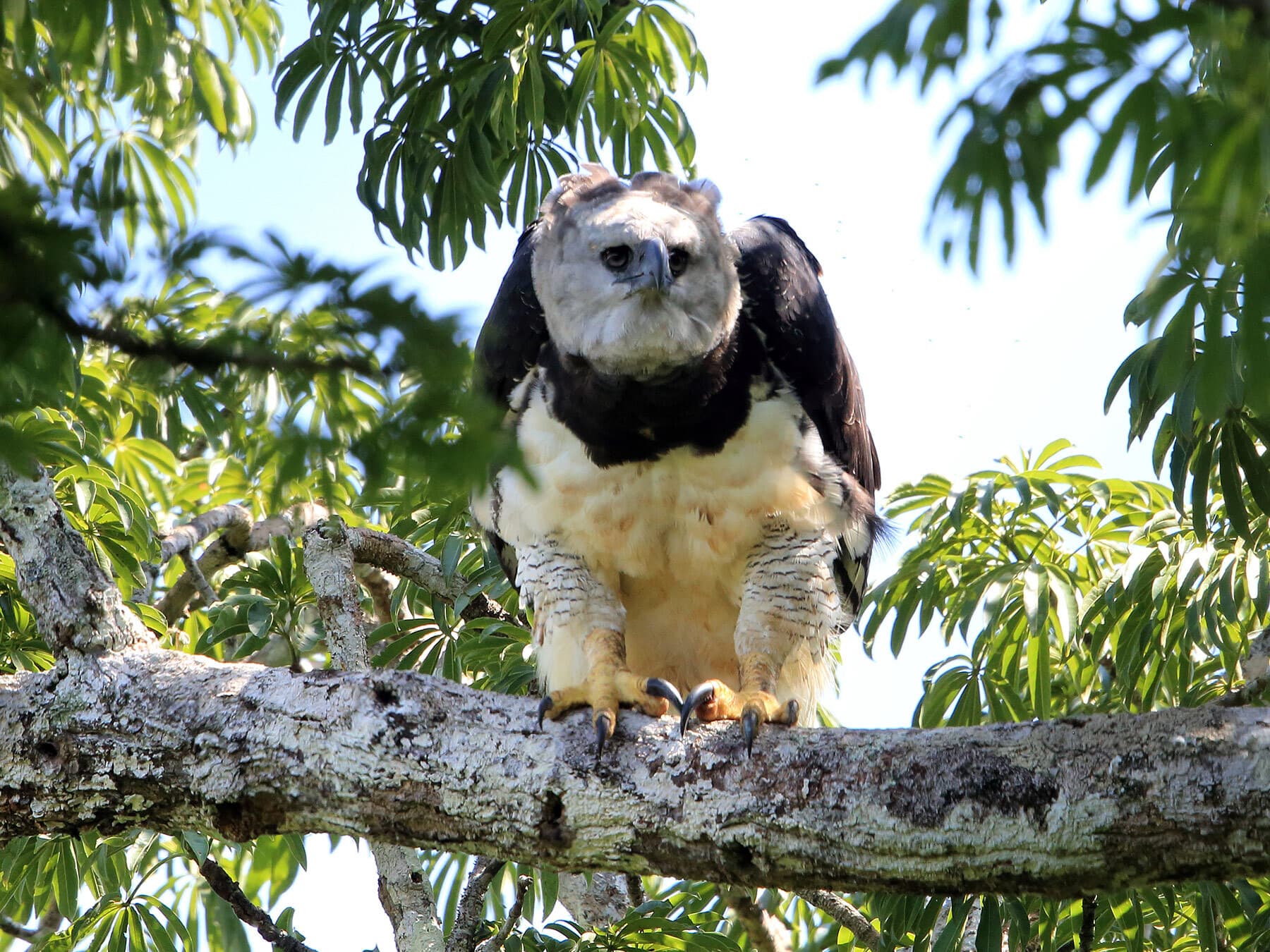
Quick facts
- Length
- 90–100 cm
- Wingspan
- 184–202 cm
- Weight
- 4700–8000 g
- Family
- Hawks & Eagles
- Migration
- Resident
- Global status (IUCN)
- Critically Endangered
- World population
- 128–924 mature individuals (BirdLife 2025 estimate)
- Population trend
- Decreasing (inferred; BirdLife 2025)
- Also called
- Monkey-eating Eagle, Great Philippine Eagle
- Scientific name
- Pithecophaga jefferyi
Sources
32- 1Perdon, D. M., Pascual, F. et al. (2026). Genomic analysis reveals recent population decline and exceptionally low genome-wide heterozygosity of the critically endangered Philippine eagle, Pithecophaga jefferyi (Aves: Accipitridae). BMC Genomics 27: 514. doi:10.1186/s12864-026-12859-9 (opens in a new tab)
- 2Republic of the Philippines, Office of the President (Ferdinand E. Marcos) (1978). Proclamation No. 1732, s. 1978: Declaring the so-called Monkey Eating Eagle as the Philippine Eagle. Official Gazette (Wayback Machine capture of 2 Jul 2018). Accessed 21 November 2026. Source (opens in a new tab)
- 3Republic of the Philippines, Office of the President (Fidel V. Ramos) (1995). Proclamation No. 615, s. 1995: Declaring the Philippine Eagle as the National Bird of the Philippines. Lawphil. Accessed 21 November 2026. Source (opens in a new tab)
- 4Philippine Eagle Foundation (2025). The Philippine Eagle. Philippine Eagle Foundation. Accessed 21 November 2026. Source (opens in a new tab)
- 5Clark, W. S., Sharpe, C. J., Boesman, P. F. D. and Marks, J. S. (2020). Philippine Eagle (Pithecophaga jefferyi), version 1.0. Birds of the World (Cornell Lab of Ornithology). doi:10.2173/bow.grpeag1.01 (opens in a new tab)
- 6Gentiles, D. J. et al. (2026). Identifying Suitable Release Sites for Philippine Eagles in Leyte for Aiding Reintroduction Using GIS-based Multi-criteria Decision-making. Philippine Journal of Science 155. doi:10.56899/155.03.06 (opens in a new tab)
- 7Sutton, L. J. et al. (2023). Space-time home-range estimates and resource selection for the Critically Endangered Philippine Eagle on Mindanao. Ibis 166: 156-170. doi:10.1111/ibi.13233 (opens in a new tab)
- 8Maala, C. P. (2001). Endangered Philippine Wildlife Species with Special Reference to the Philippine Eagle (Pithecophaga jefferyi) and Tamaraw (Bubalus mindorensis). Journal of International Development and Cooperation 8. Accessed 21 November 2026.
- 9BirdLife International (2025). Species factsheet: Philippine Eagle Pithecophaga jefferyi (the 2025 IUCN Red List assessment text). BirdLife DataZone / IUCN Red List. Accessed 21 November 2026. Source (opens in a new tab)
- 10Ibañez, J. C. et al. (2003). Notes on the Breeding Behavior of a Philippine Eagle Pair at Mount Sinaka, Central Mindanao. The Wilson Bulletin 115: 333-336. doi:10.1676/01-054 (opens in a new tab)
- 11The Peregrine Fund. Philippine Eagle. The Peregrine Fund, Explore Raptors. Accessed 21 November 2026. Source (opens in a new tab)
- 12Philippine Eagle Foundation (2007). Philippine Eagle Biology and Ecology (from the Training Manual on Research and Monitoring Techniques for Birds of Prey in the Philippines). philippineeagle.org (Wayback Machine capture of 12 Jun 2008). Accessed 21 November 2026. Source (opens in a new tab)
- 13Ibañez, J. C., Sumaya, A. M., Tampos, G. and Salvador, D. (2016). Preventing Philippine Eagle hunting: what are we missing?. Journal of Threatened Taxa 8: 9505-9511. doi:10.11609/jott.2301.8.13.9505-9511 (opens in a new tab)
- 14Sutton, L. J., Ibañez, J. C. et al. (2026). Directing conservation action for the Critically Endangered Philippine Eagle Pithecophaga jefferyi to mitigate mining impacts and maximise indigenous land management. Bird Conservation International 36. doi:10.1017/s0959270926100586 (opens in a new tab)
- 15CITES Secretariat (2025). Appendices I, II and III valid from 7 February 2025. CITES. Accessed 21 November 2026. Source (opens in a new tab)
- 16Congress of the Philippines (2001). Republic Act No. 9147 (Wildlife Resources Conservation and Protection Act), 30 July 2001. Lawphil. Accessed 21 November 2026. Source (opens in a new tab)
- 17Philippine Eagle Foundation (2025). History. Philippine Eagle Foundation. Accessed 21 November 2026. Source (opens in a new tab)
- 18Philippine Eagle Foundation (2025). Conservation Breeding. Philippine Eagle Foundation. Accessed 21 November 2026. Source (opens in a new tab)
- 19Abaño, T. R. C. et al. (2015). Dispersal of Philippine Eagles Released in the Forests of Mindanao, Philippines. Journal of Raptor Research 49: 506-512. doi:10.3356/rapt-49-04-506-512.1 (opens in a new tab)
- 20Sutton, L. J. et al. (2023). Priority conservation areas and a global population estimate for the critically endangered Philippine Eagle. Animal Conservation 26: 684-700. doi:10.1111/acv.12854 (opens in a new tab)
- 21Ledvina, E., Pyle, P. and Boesman, P. F. D. (2025). Philippine Hawk-Eagle (Nisaetus philippensis), version 2.0. Birds of the World (Cornell Lab of Ornithology). doi:10.2173/bow.phihae1.02 (opens in a new tab)
- 22Fjeldså, J. (2020). Pinsker's Hawk-Eagle (Nisaetus pinskeri), version 1.0. Birds of the World (Cornell Lab of Ornithology). Accessed 21 November 2026. Source (opens in a new tab)
- 23Clark, W. S. and Marks, J. S. (2020). Philippine Serpent-Eagle (Spilornis holospilus), version 1.0. Birds of the World (Cornell Lab of Ornithology). doi:10.2173/bow.phseag1.01 (opens in a new tab)
- 24BirdLife International (2024). Species factsheet: Pithecophaga jefferyi (older text and data table, before the 2025 assessment). BirdLife DataZone (Wayback Machine captures of 22 Jan 2025 and 14 Apr 2024). Accessed 21 November 2026. Source (opens in a new tab)
- 25Luczon, A. U. et al. (2014). Genetic diversity of the Critically Endangered Philippine Eagle Pithecophaga jefferyi (Aves: Accipitridae) and notes on its conservation. Journal of Threatened Taxa 6: 6335-6344. doi:10.11609/jott.o3748.6335-44 (opens in a new tab)
- 26Bacus, M. G., Gaite, P. L. A. et al. (2025). Mitochondrial Genome Analysis of Philippine Eagles (Pithecophaga jefferyi Ogilvie-Grant 1896) From the Greater Mindanao Faunal Region. Ecology and Evolution 15. doi:10.1002/ece3.72572 (opens in a new tab)
- 27Hernandez, J. R. et al. (2026). A Reference Genome for the Critically Endangered Philippine Eagle (Pithecophaga jefferyi), the National Bird of the Philippines. bioRxiv (preprint, not peer reviewed). doi:10.64898/2026.04.12.717985 (opens in a new tab)
- 28Miranda, H. C. Jr, Salvador, D. I., Ibanez, J. C. and Balaquit-Ibanez, G. A. (2000). Summary of Philippine Eagle reproductive success, 1978-98. Journal of Raptor Research 34. Accessed 21 November 2026.
- 29Lewis, R. E. (1986). A rain-forest raptor in danger. Oryx 20: 170-175. doi:10.1017/S0030605300020032 (opens in a new tab)
- 30AviList Core Team (2025). AviList: The Global Avian Checklist, v2025b. AviList. doi:10.2173/avilist.v2025b (opens in a new tab)
- 31IUCN (via GBIF) (2026). The IUCN Red List of Threatened Species (GBIF checklist copy). GBIF. doi:10.15468/0qnb58 (opens in a new tab)
- 32BirdLife International (2025). Pithecophaga jefferyi. The IUCN Red List of Threatened Species 2025: e.T22696012A273773083. IUCN Red List. doi:10.2305/iucn.uk.2025-2.rlts.t22696012a273773083.en (opens in a new tab)

Checked by
Nathan Cope, founder and editor
Nathan founded Birdfact and leads its writers and contributors in the UK, the US and Canada. He has watched and studied birds for more than ten years, and checks every article and species guide before it’s published.